TL;DR: A 2026 claims analysis in Exploratory Research in Clinical and Social Pharmacy found that FDA-declared first-generation antipsychotic shortages were followed by medication switching in 9.13% of included patients with psychotic spectrum disorders, with especially high switching after thiothixene, trifluoperazine, and molindone shortages.
Key Findings
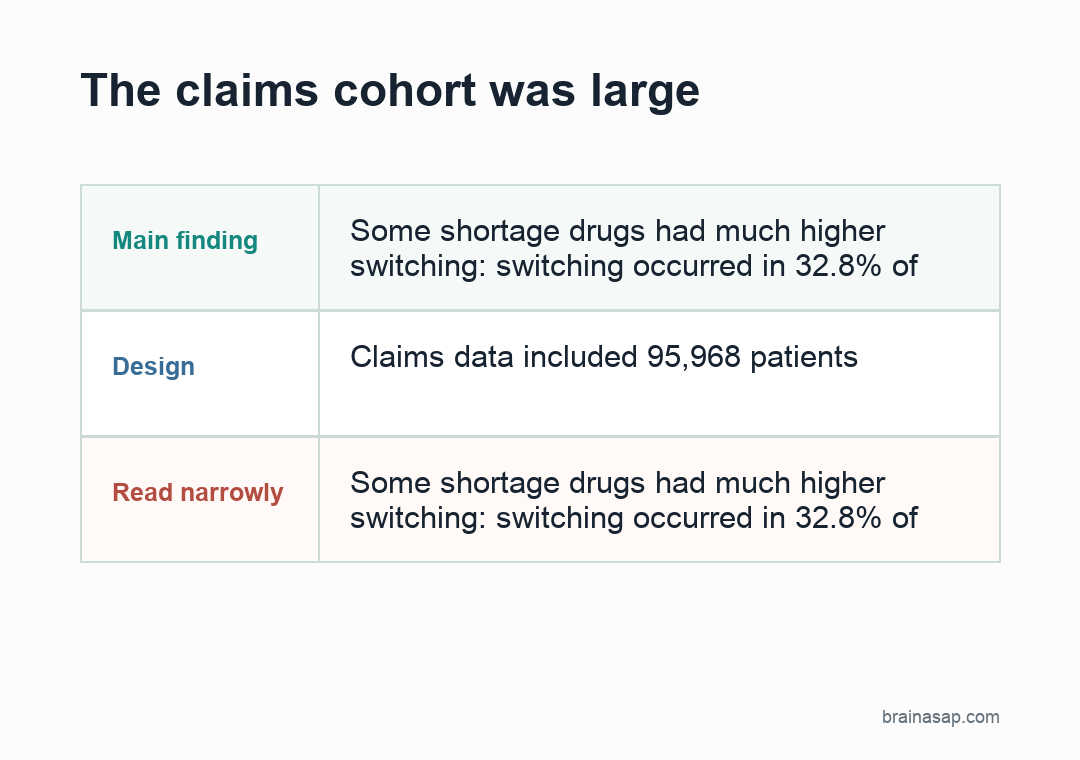
- The claims cohort was large: 95,968 patients had a psychotic spectrum disorder diagnosis and recent first-generation antipsychotic use before a declared shortage or discontinuation.
- Haloperidol dominated the cohort: 52,344 patients, or 54.5%, were receiving haloperidol before the shortage index date.
- Perphenazine was second most common: 16,966 patients, or 17.7%, were receiving perphenazine.
- Overall switching reached 9.13%: 8,763 patients initiated a new antipsychotic with medication possession ratio of at least 80% after the shortage or discontinuation date.
- Some shortage drugs had much higher switching: switching occurred in 32.8% of thiothixene users, 55.2% of trifluoperazine users, and 100% of the small molindone group.
Source: Exploratory Research in Clinical and Social Pharmacy (2026) | Tabah et al.
First-generation antipsychotics are older medications used for schizophrenia, acute psychosis, and related psychotic spectrum disorders. They can remain important when a patient is stable on a specific drug, even if newer second-generation options are more common in everyday clinical prescribing.
This study looked at what happened after FDA-declared shortages or discontinuations of oral first-generation antipsychotics in the United States. The question was not whether the shortages caused relapse, but whether medication use changed afterward.
Claims Data Tracked Switching After Antipsychotic Shortages
Researchers used the Komodo Healthcare Map from January 2016 through September 2023. Eligible patients had a psychotic spectrum disorder diagnosis and a prescription claim for a first-generation antipsychotic during the 6 months before the shortage or discontinuation date.
They also needed at least one antipsychotic claim during the 12 months after that index date. The study excluded people whose medication possession ratio for the original drug was below 80% or who had an inpatient hospitalization within 6 months of the index date.
- Index date: the FDA-declared shortage or discontinuation date for the original antipsychotic.
- Medication possession ratio: a claims-based estimate of how much medication supply a patient had available.
- Switching: use of a new antipsychotic after the index date with medication possession ratio of at least 80%.
Haloperidol and Perphenazine Accounted for Most Shortage Exposure
The final cohort included 95,968 people. The mean age was 52.6 years, 53.7% were male, and 56.3% used Medicare prescription drug insurance.
Most patients were on 2 drugs before the index date. Haloperidol accounted for 52,344 patients, or 54.5% of the sample, while perphenazine accounted for 16,966 patients, or 17.7%.
Other first-generation antipsychotic groups were smaller, including fluphenazine, thioridazine, loxapine, trifluoperazine, thiothixene, pimozide, and molindone.
The medication mix is important because shortage pressure is not distributed evenly. A shortage affecting a rarely used drug can create a small absolute number of switches but a large burden for the patients who depend on that specific medication, especially when alternatives have different side-effect profiles.
Switching Was Concentrated in Specific First-Generation Antipsychotics
Across all shortage drugs, 8,763 people, or 9.13%, switched to a new antipsychotic by the study definition. Time to the first switch claim ranged from 22 to 103 days after the shortage or discontinuation date.
The overall number hides large differences by original medication. Switching was reported for 32.8% of thiothixene users and 55.2% of trifluoperazine users.
The molindone group reached 100% switching, but that figure came from only 7 patients. It should be read as a signal from a tiny subgroup, not as a stable population estimate.
- Common original drugs: haloperidol and perphenazine supplied most of the cohort.
- High-switch drugs: thiothixene and trifluoperazine had much larger switching percentages.
- Tiny subgroup: molindone switching was complete in this dataset, but the denominator was only 7.
Most Documented Switches Went to One New Drug
Across medication groups, more than 85% of documented switches were to one antipsychotic during follow-up. The most common switch destinations were second-generation antipsychotics.
Risperidone accounted for 18.1% of switches, followed by quetiapine at 13.6%, olanzapine at 11.7%, aripiprazole at 11.6%, and perphenazine at 9.1%.
Switching is not neutral for every patient. A drug that controls psychosis can differ from its replacement in movement-disorder risk, metabolic effects, sedation, anticholinergic effects, cost, and patient acceptability.
Shortage Claims Data Cannot Prove Clinical Harm
The paper is strongest as a utilization study. It shows that antipsychotic shortages and discontinuations were followed by measurable switching in claims data, especially for some smaller first-generation antipsychotic groups.
It does not show whether symptoms worsened, whether prescribers switched preemptively, or whether some switches reflected better contemporary practice. Claims data also cannot capture every pharmacy-level shortage experience or every clinical reason behind a medication change.
Key limits include:
- Descriptive design: the study did not establish that shortages caused each switch.
- Claims-only outcomes: relapse, side effects, adherence experience, and symptom control were not directly measured.
- Stable-user selection: people with lower pre-index medication possession ratio were excluded.
- Small subgroups: some striking percentages came from uncommon medications with few users.
Practical takeaway: first-generation antipsychotic shortages can reshape treatment patterns for people with psychotic spectrum disorders. The next question is whether forced or shortage-related switching affects relapse, tolerability, and continuity of care.
Citation: DOI: 10.1016/j.rcsop.2026.100725. Tabah et al. First-generation antipsychotic shortages in the United States: Utilization and switching patterns. Exploratory Research in Clinical and Social Pharmacy. 2026;22:100725.
Study Design: Descriptive pre-post prescription-claims analysis of FDA-declared first-generation antipsychotic shortages and discontinuations.
Sample Size: 95,968 people with psychotic spectrum disorders and qualifying antipsychotic claims.
Key Statistic: 8,763 patients, or 9.13%, switched antipsychotics after the shortage/discontinuation index date; switching was 55.2% for trifluoperazine and 32.8% for thiothixene.
Caveat: Claims data show medication switching, not symptom outcomes or the clinical reason for each switch.