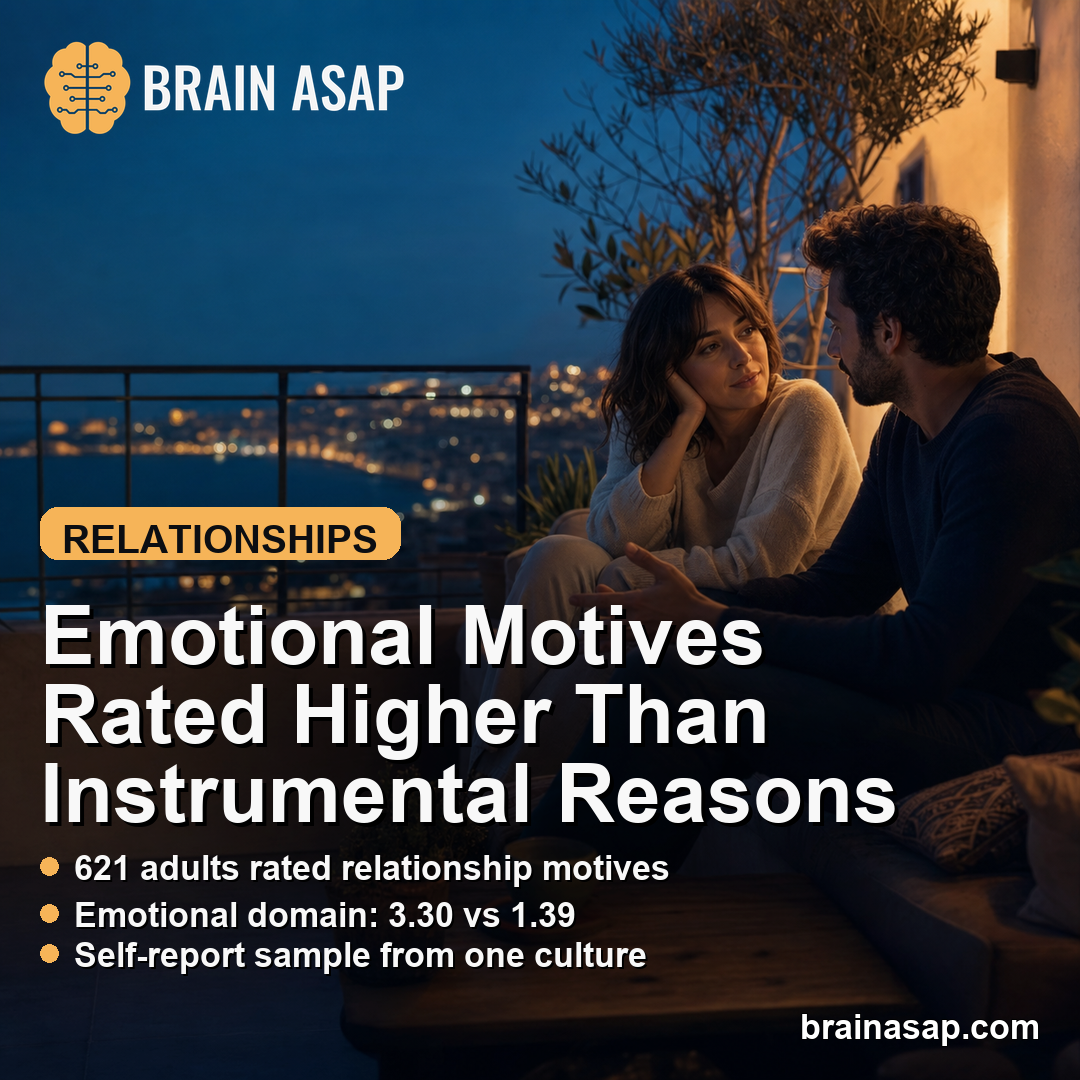
TL;DR: A 2026 mixed-methods study in Evolutionary Psychological Science found that 621 Greek-speaking adults rated emotional motives for lasting relationships—such as attraction, love, companionship, and support—much higher than instrumental motives such as money, social pressure, or revenge (3.30 vs 1.39 on a five-point scale). The convenience-sample survey describes stated motivations, not what causes relationships to begin or what people in other cultures would report.
Key Findings
- Two samples built and rated the motive list: A first survey of 209 Greek-speaking adults generated 104 possible reasons for seeking a lasting romantic relationship; a second survey of 621 adults rated them.
- Emotional motives received higher ratings: The emotional-fulfillment domain averaged 3.30 out of 5, compared with 1.39 for instrumental reasons such as social pressure, financial support, and revenge.
- Attraction and connection led the specific categories: 89.3% of participants rated that factor above the scale midpoint; 86.4% did so for creating positive experiences and 83.2% for pursuing true love.
- No sex effect survived correction for multiple tests: Men and women substantially overlapped, while the three largest age associations involved companionship, loneliness avoidance, and family-formation motives.
- Self-report and one cultural setting limit generalization: Recruitment through social media and university networks and an exploratory factor structure also restrict causal interpretation.
Source: Apostolou and Neophytou, Evolutionary Psychological Science (2026).
Reasons for pursuing a lasting relationship can include attraction, companionship, emotional support, sex, family plans, financial security, and pressure from other people. Researchers developed a relationship-specific list to see how those motives clustered and which ones participants considered most important.
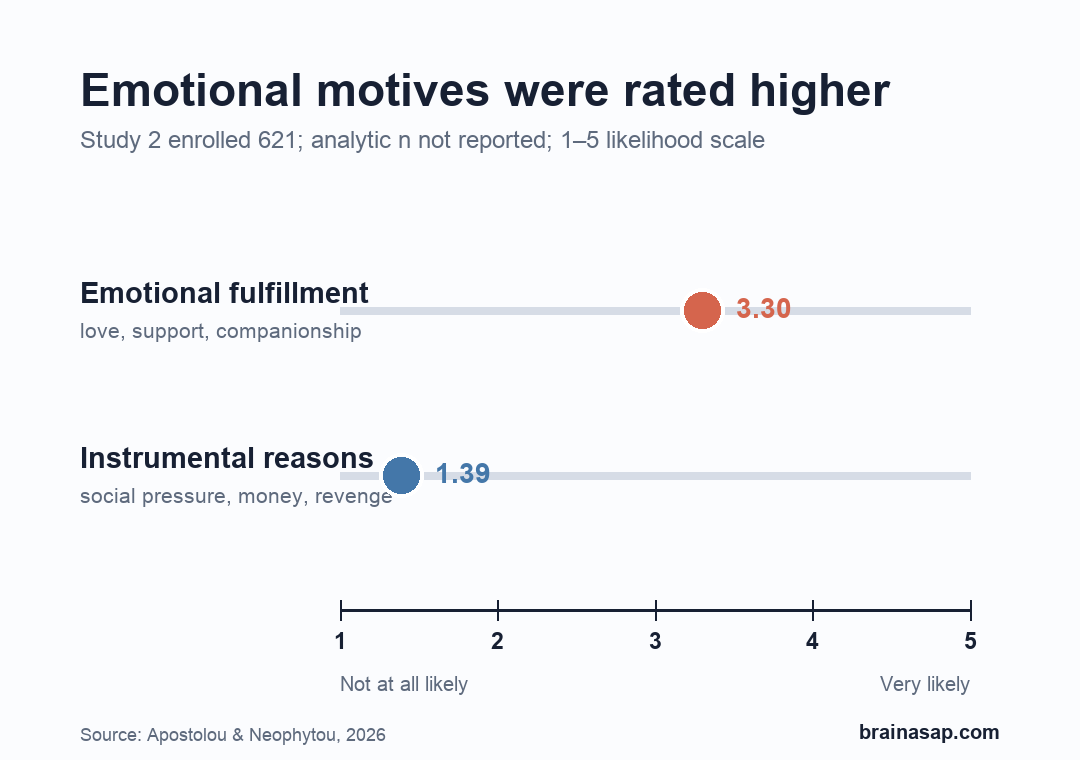
Emotional Motives Averaged 3.30 Versus 1.39 for Instrumental Reasons
The main comparison separated the 13 motive categories into two broader domains. Emotional fulfillment included romantic attraction, true love, positive experiences, emotional support, companionship, personal growth, well-being, sexual needs, loneliness avoidance, and family formation.
Instrumental reasons grouped three motives based on practical or social outcomes: reducing pressure from family and peers, obtaining financial support, and making an ex-partner or other people jealous.
On the five-point likelihood scale, emotional fulfillment averaged 3.30 (SD 0.70), while instrumental reasons averaged 1.39 (SD 0.53). The emotional-fulfillment domain received the higher average rating, but researchers did not report an inferential test comparing the two domain means.
The two domains were not competing personality types. Most respondents rated five to nine of the 13 categories above the midpoint, indicating that several motives often coexist for the same person.
Two Surveys Generated 104 Motives and Grouped 89 Into 13 Categories
- Study 1: 209 Greek-speaking adults, including 111 women and 98 men, generated possible motives. Mean age was 35.2 years for women and 36.7 for men.
- Study 2: 621 Greek-speaking adults, including 325 women, 285 men, and 11 people who did not specify sex, rated the motives. Forty-two percent were single, 29.4% were in a relationship, 20.4% were married, and 8.2% selected another relationship status.
Participants answered an open-ended question about reasons that might motivate them to form a lasting romantic relationship. Two graduate coders grouped the responses, reconciled disagreements, and produced 104 distinct items.
Study 2 used the same social-media and university-linked recruitment approach in Greece and the Republic of Cyprus. Each participant rated all 104 items from 1, “not at all likely to motivate me,” to 5, “very likely to motivate me.”
Exploratory factor analysis removed 15 items that did not meet the loading threshold, leaving 89 items grouped into 13 factors. A second factor analysis then organized those factors into the emotional and instrumental domains.
Factor analysis identifies items that tend to receive similar ratings. It does not show that the categories are fixed psychological systems, nor does it establish the evolutionary mechanisms proposed to explain them.
Attraction, True Love, and Positive Experiences Ranked Highest
Romantic attraction and connection received the highest specific-factor rating, averaging 4.00 out of 5. Its items included chemistry, mutual attraction, love, sexual attraction, shared enjoyment, and interest in a particular partner.
- Romantic attraction and connection: 89.3% of respondents had an average factor rating above 3.
- Creation of positive experiences: 86.4% rated this factor above the midpoint.
- Pursuit of true love: 83.2% rated this factor above the midpoint.
- Emotional support: 70.5% rated this factor above the midpoint.
Need for companionship and personal growth were above the midpoint for 59.5% and 57.2% of participants, respectively.
Instrumental categories were uncommon by the same measure. Financial support exceeded the midpoint for 5.1%, relief from peer or family pressure for 3.8%, and vengeance for 1.1%.
These percentages represent the share whose average rating within a category was greater than 3. They do not mean that each person selected one primary motive, and they do not measure how often a motive actually produced a relationship.
No Sex Difference Survived the Multiple-Testing Correction
Researchers tested sex and age associations for all 13 categories while accounting for relationship status. To reduce false positives from repeated testing, they set the significance threshold at p<.004 using a Bonferroni correction.
No difference between women and men passed that threshold. Several uncorrected comparisons had p-values below .05, but their effect sizes were very small and were not treated as statistically significant after correction.
The three largest age associations involved loneliness avoidance, companionship, and family formation. Older participants placed more importance on loneliness avoidance and companionship, while younger participants placed more importance on family formation.
Partial eta-squared effect sizes for those three associations ranged from 0.025 to 0.031, so age explained only a small share of rating differences.
Because age was measured rather than assigned, the survey cannot show that getting older changes relationship motives. Cohort differences, existing family circumstances, social networks, or other unmeasured characteristics could account for the pattern.
A Greek-Speaking Convenience Sample Limits Generalization
Self-report was the central measurement limit. Participants may not know every influence on their choices, and socially desirable motives such as love and support may be easier to endorse than money, pressure, or revenge.
Recruitment was non-random and limited to Greek-speaking adults reached through social media and university-linked networks; sexual orientation was not reported. Economic interdependence, family expectations, relationship norms, personality, and previous experiences could produce a different structure in another sample.
The analysis was exploratory and did not confirm the 13-factor structure in a separate group.
A typesetting shift also appears in Table 2’s overall-mean column; several values do not align with the sex-specific means, endorsement percentages, or ranked order described in the text. The domain means and endorsement percentages are internally consistent with the results narrative.
In this Greek-speaking sample, participants rated emotional-fulfillment motives higher than motives involving financial help, social pressure, or revenge. Cross-cultural replication and longitudinal observation would be needed to determine whether the same categories predict who actually starts or sustains a relationship.
Citation: DOI: 10.1007/s40806-026-00481-7. Apostolou and Neophytou. Why do People Form Intimate Relationships? An Exploratory Investigation in a Greek-Speaking Sample. Evolutionary Psychological Science. 2026.
Study Design: Two-study mixed-methods investigation using open-ended item generation followed by an online rating survey and exploratory factor analysis.
Sample Size: 209 Greek-speaking adults in Study 1 and 621 in Study 2.
Key Statistic: The emotional-fulfillment domain averaged 3.30 out of 5, compared with 1.39 for instrumental reasons.
Caveat: Self-report, non-probability recruitment, one cultural context, no confirmatory sample, and a typesetting problem in one table limit interpretation.