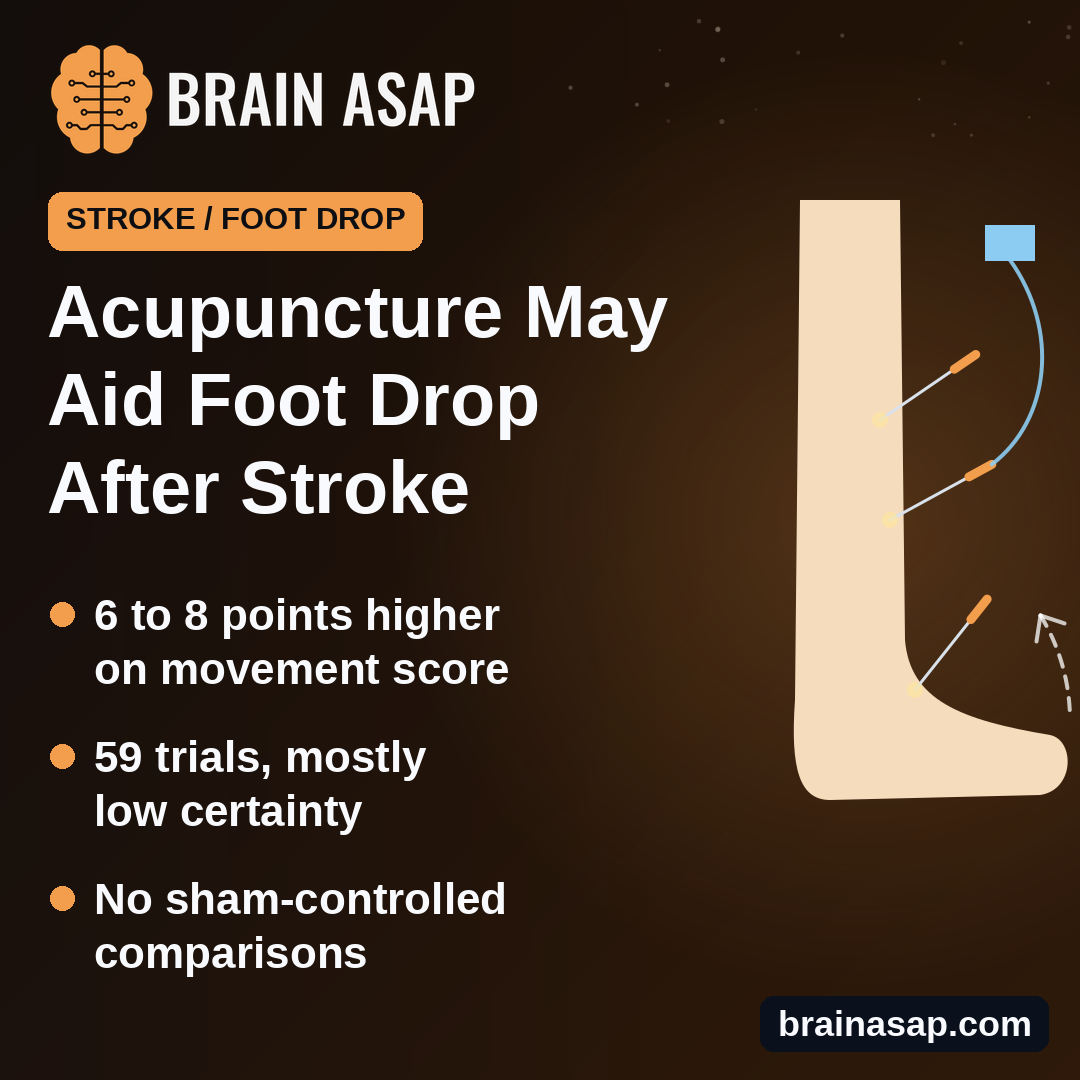
TL;DR: Pooling 59 trials, all from China, researchers found that adding acupuncture or electroacupuncture to standard rehab after a stroke was linked to better leg movement scores for people with foot drop. But the studies varied widely and many had quality problems, so the size of the benefit is uncertain.
Key Findings
- 59 trials, 4,596 people: Standard rehab alone vs rehab plus some form of acupuncture.
- Motor scores: About 6 points higher with needle acupuncture and 8 points with electroacupuncture.
- Special techniques unclear: No clear movement-score gain in 3 studies.
- Shaky evidence: Huge differences between studies, likely small-study bias, moderate-to-low certainty.
- Safety unknown: Side effects were too poorly reported to judge.
Source: Frontiers in Neurology (2026) | Huang et al.
After a stroke, many people cannot lift the front of the foot properly. This is called foot drop, and it makes the toes catch and drag when walking, raising the risk of trips and falls. Rehab and ankle braces help, but recovery is often slow.
Acupuncture is widely added to stroke rehab in China. A team from Guangdong pooled the trials to see what the evidence shows.
Comparing Rehab Alone With Rehab Plus Needles
The review included 59 randomized trials with 4,596 people with foot drop after stroke. In every trial, both groups got standard rehab. One group also received acupuncture of some kind, and the researchers analyzed three types separately:
- Needle acupuncture: Traditional needling at set points.
- Electroacupuncture: Needles with a mild electric current.
- Special techniques: Other methods such as specific scalp or needling styles.
The main outcome was the Fugl-Meyer Assessment, a standard score of movement ability after stroke.
Movement Scores Were Higher With Acupuncture
Compared with rehab alone, pooled movement scores were 6.25 points higher with needle acupuncture (25 studies) and 7.99 points higher with electroacupuncture (9 studies). The authors note these are close to or above the 6-point change often considered meaningful for leg function in chronic stroke.
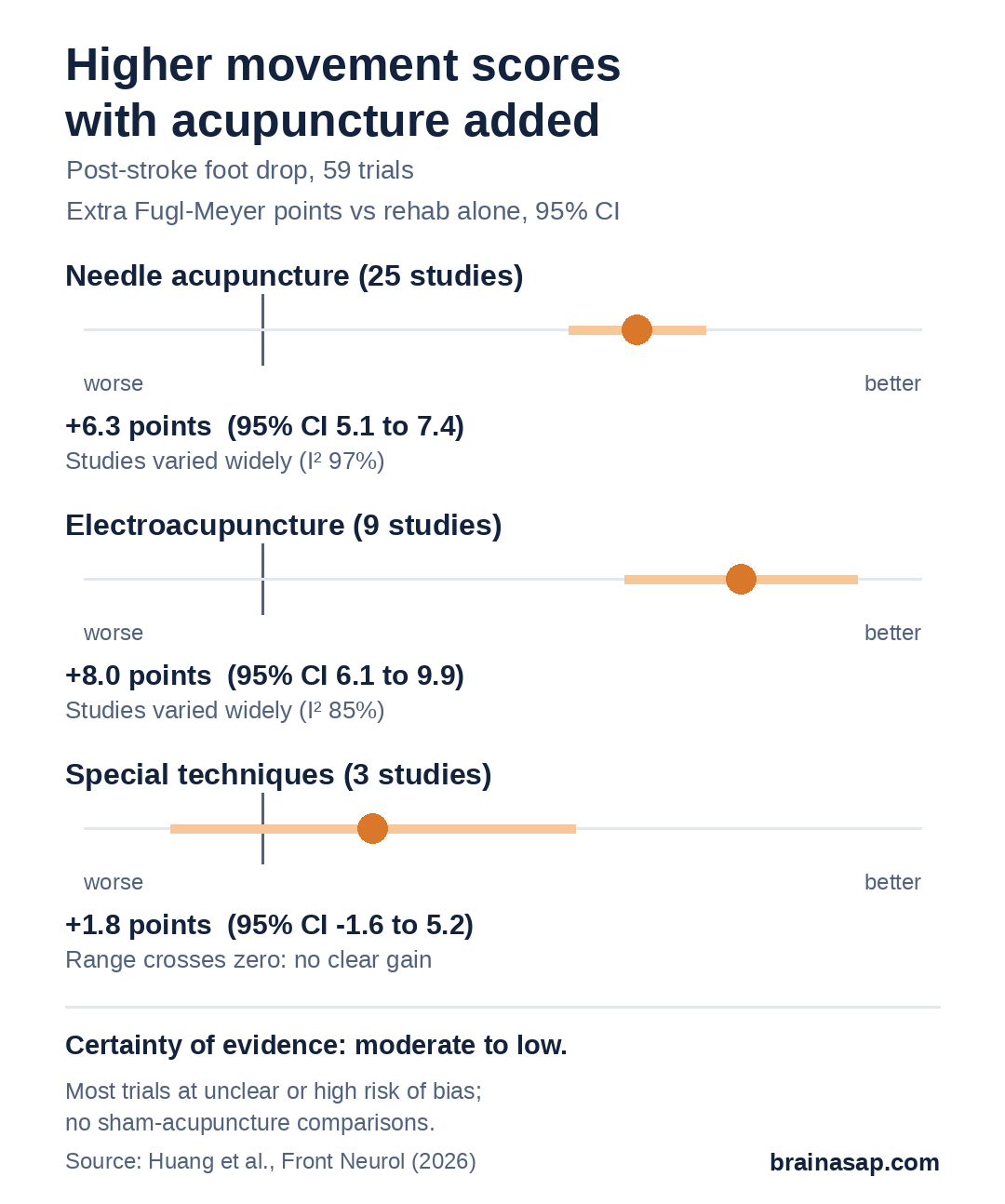
Gains also showed up for ankle range of motion, balance, daily living skills and muscle stiffness in some analyses. Special techniques did not clearly improve the movement score in the 3 studies that measured it.
The points used most often were on the outer lower leg and ankle: Yanglingquan (GB34), Zusanli (ST36) and Jiexi (ST41).
Why These Numbers Need Caution
- Huge variation: Studies disagreed strongly (I² up to 97%).
- Bias risk: Most trials had unclear or high risk of bias.
- No sham control: Comparisons were against rehab alone, so placebo effects and extra attention cannot be ruled out.
- Small-study effects: After adjusting for them, one outcome, overall clinical response, lost significance.
- Safety unclear: Side effects were rarely reported.
Better Trials Are Needed Before Acupuncture Becomes Routine for Foot Drop
For stroke survivors with foot drop, acupuncture alongside regular rehab may help movement, and electroacupuncture had the largest pooled effect. But the evidence is too uneven to say how much it helps or which approach is best.
Large, well-blinded trials with sham acupuncture and clear safety reporting are the next step to settle the question.
Citation: DOI: 10.3389/fneur.2026.1794012. Huang Y, Lin Y, Zheng B, Zhao X, Su Q, Wang Y, Ai J, Fu W, Lin C. Meta-analysis and acupoint selection patterns of acupuncture for post-stroke foot drop. Front Neurol. 2026;17:1794012.
Study Design: Systematic review and meta-analysis of randomized controlled trials, with acupoint pattern analysis.
Sample Size: 59 trials; 4,596 participants (2,306 acupuncture plus rehab, 2,290 rehab alone).
Key Statistic: Fugl-Meyer MD 6.25 (95% CI 5.11 to 7.40) needle acupuncture; 7.99 (6.05 to 9.93) electroacupuncture.
Caveat: High heterogeneity, unclear or high risk of bias, possible small-study effects; moderate-to-low certainty.