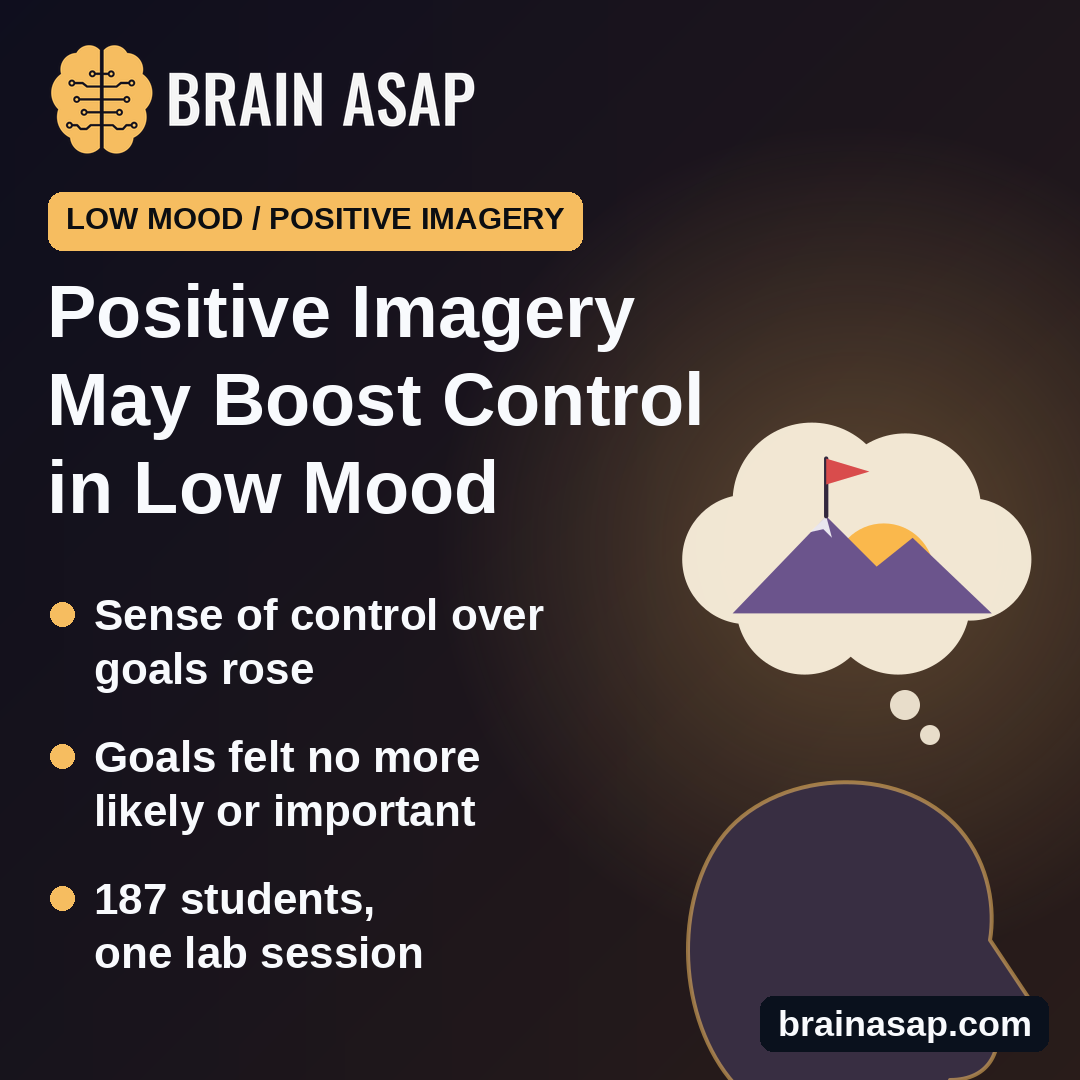
TL;DR: In a lab study of 187 UK students, a few minutes spent vividly imagining good future events made those with more low-mood symptoms feel more in control of their goals. It did not make anyone feel their goals were more likely or more important.
Key Findings
- 187 students, 4 groups: Imagined their own goal successes, general happy scenes, neutral scenes, or did a letter search.
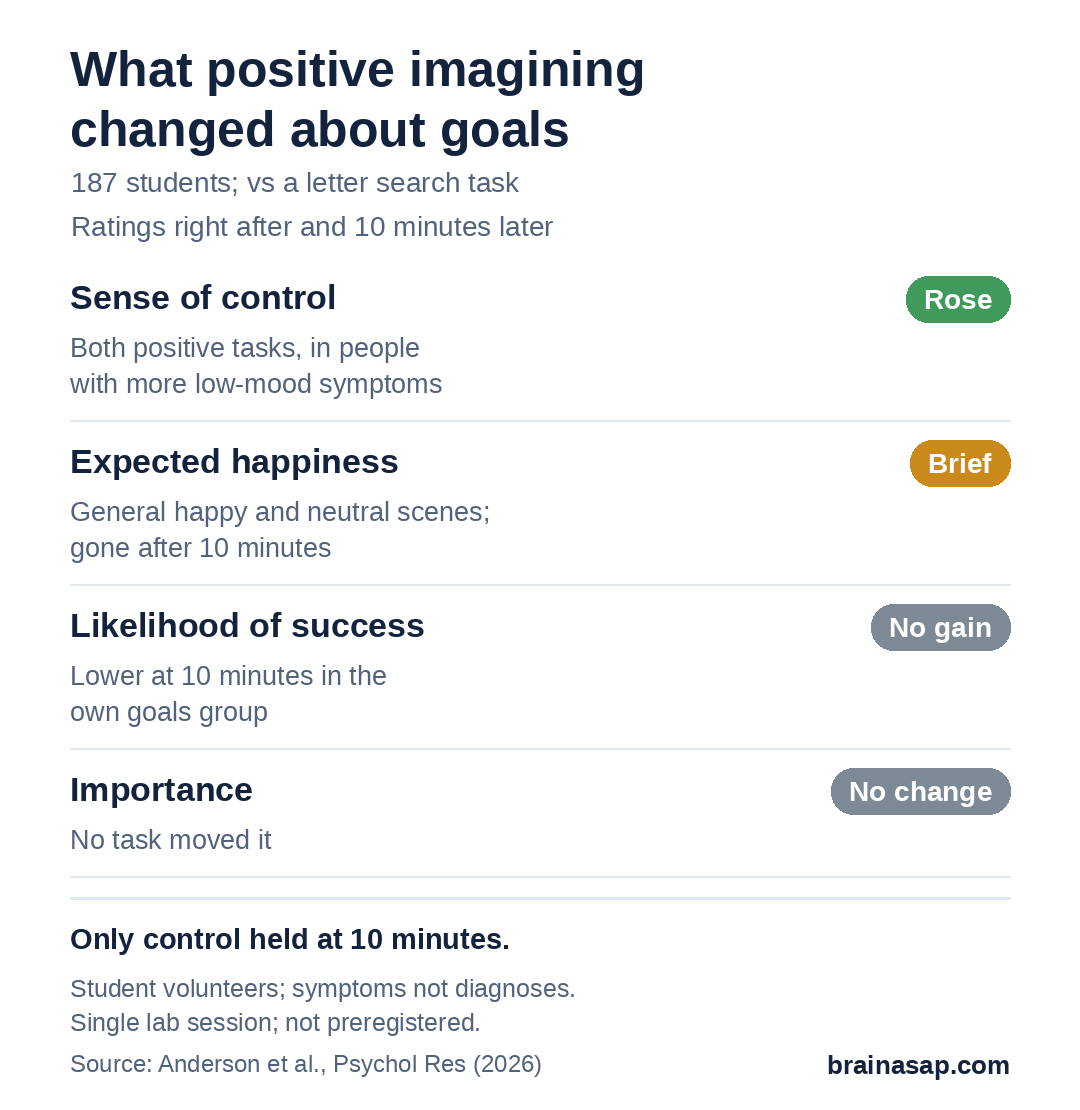
- More sense of control: Both positive imagining tasks raised it, but only in people with more depressive symptoms.
- Lasted 10 minutes only for the general happy scenes.
- No gain in hope: Likelihood and importance of goals did not rise.
- Surprise drop: Imagining one’s own goals lowered some ratings 10 minutes later.
Source: Psychological Research (2026) | Anderson et al.
People with depression often struggle to picture good things happening to them. That gap may sap motivation: it is hard to work toward a goal that feels out of reach or out of your hands. So can practicing positive imagining change how people feel about their own goals?
Psychologists at the Universities of Hull and York St John tested this in a single 90-minute lab session.
Four Ways to Spend Seven Minutes
The 187 participants were university students aged 18 to 59 (average 26). Each listed personal goals for the next week, year and 5 to 10 years, then rated their top nine on how likely, controllable, important and vivid they felt, and how happy or disappointed they would be.
Next, each person was randomly assigned to one of four tasks, each 27 short trials of about 15 seconds:
- Own goals group: Vividly imagined specific moments of achieving their own goals, like walking across the stage at graduation.
- General happy scenes group: Imagined positive future events from a set list, not tied to their goals.
- Neutral scenes group: Imagined everyday, emotionally flat scenes.
- Letter search group: Hunted for tilted letters, with no imagining.
They rated their goals again right after and once more after 10 minutes of a jigsaw puzzle. Everyone also completed a depression symptom questionnaire; scores ranged widely, from 0 to 56 on an 80-point scale.
Control Rose for People With More Low-Mood Symptoms
Overall, no task changed goal ratings across the whole group. The effect showed up only when depressive symptoms were considered. People with more symptoms generally felt less control over their goals. But after either positive imagining task, that gap narrowed: their sense of control rose relative to the letter search group.
Ten minutes later, the boost held only in the general happy scenes group.
Most Other Hopes Stayed Put
- Expected happiness: Rose briefly in higher-symptom people after general happy scenes, but also after neutral scenes, and faded by 10 minutes.
- Likelihood and importance: No improvement in any group.
- Mood: Did not differ between groups at any point, so mood shifts do not explain the results.
Imagining Your Own Goals Backfired a Little
The biggest surprise came from the own goals group. Ten minutes after the task, compared with the letter search group, they rated their goals as less likely, less vivid and less rewarding to achieve, and said failure would be less disappointing. The researchers had predicted the opposite and can only offer possible reasons.
Limits of a One-Session Lab Test
- Students, not patients: Depressive symptoms were measured, not diagnosed.
- Very short follow-up: The last ratings came 10 minutes after the task.
- Not preregistered: With six ratings and several interactions tested, some effects could be chance.
- Small changes: Effects showed up as statistical interactions, not large shifts.
Can Imagery Training Help Over Weeks?
The hint here is that general positive imagining, not even tied to one’s own goals, may help people with low mood feel more in charge of their future. That is encouraging for therapies that train imagery. Whether repeated practice over weeks makes goals feel more reachable, and whether people then act on them, is what the next study needs to show.
Citation: DOI: 10.1007/s00426-026-02369-4. Anderson RJ, Clayton McClure JH, Shevchenko J, Riggs KJ, Dewhurst SA. The effects of episodic simulation on the cognitive and emotional expectancies related to personal goals. Psychol Res. 2026;90:168.
Study Design: Randomized four-group laboratory experiment; multilevel models with baseline ratings as covariates.
Sample Size: 187 students analyzed (189 took part; 2 excluded for missing data).
Key Statistic: Controllability: goal-related imagery × depression b = 0.02 (p = .012), general imagery × depression b = 0.02 (p < .001); general imagery effect persisted at 10 minutes (b = 0.02, p = .007).
Caveat: Nonclinical student sample, single session, 10-minute follow-up; most hypotheses unsupported.