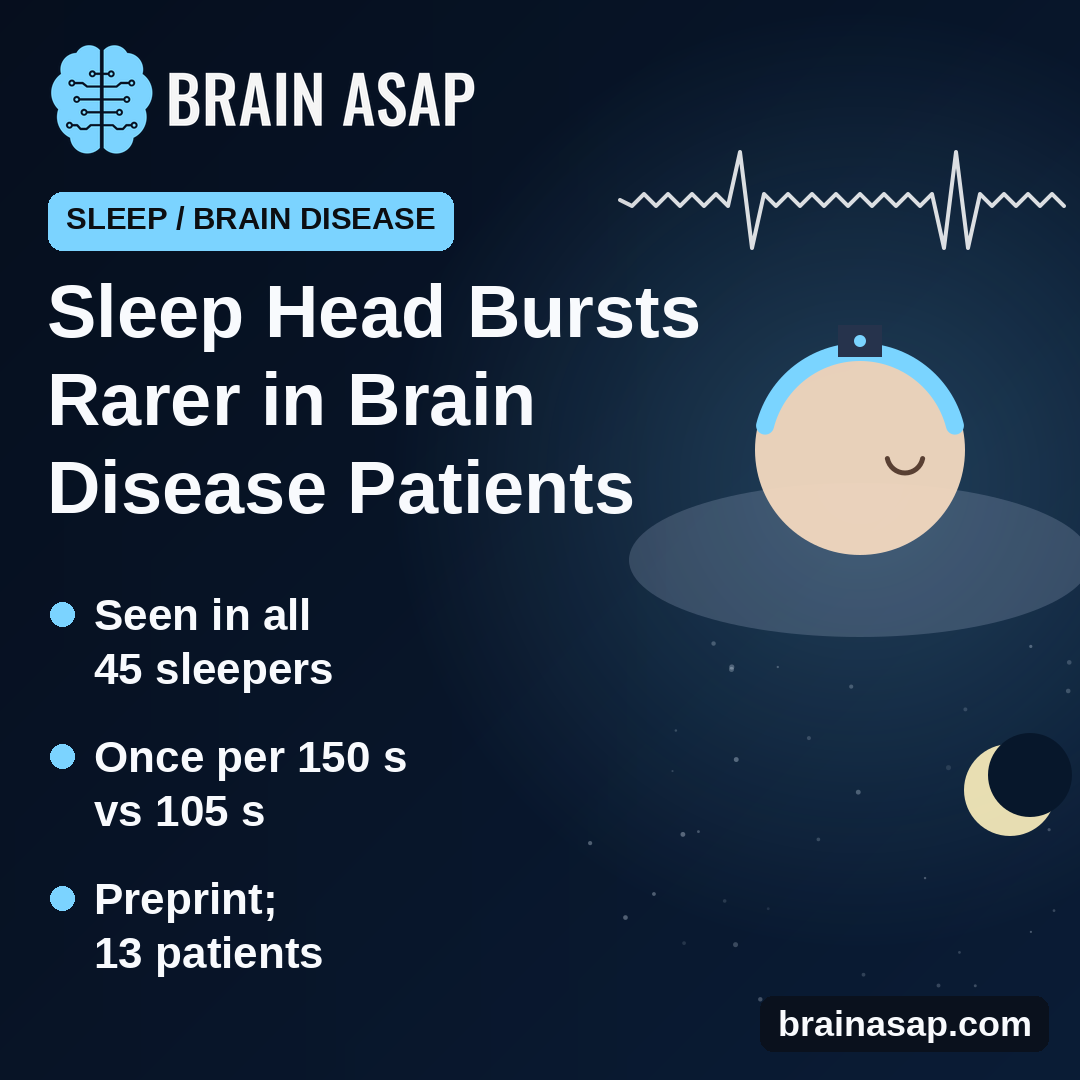
TL;DR: A headband sensor picked up brief bursts of force inside the head during sleep in all 45 people tested. People with neurodegenerative diseases had fewer bursts per minute than healthy volunteers, in an early, not yet peer-reviewed study.
Key Findings
- A new sleep signal: 1- to 2-second “sleep bursts” showed up in every one of 45 sleepers.
- Fewer bursts with brain disease: About once every 150 seconds vs once every 105 seconds in healthy people.
- All sleep stages: Burst rates did not change between light, deep and dream sleep.
- Linked to brain waves: Slow delta waves rose just before and after each burst.
- Cause unknown: The authors suspect a link to the brain’s waste-clearing system, but did not test it.
Source: bioRxiv preprint (2026) | Walsh et al.
During sleep, the brain flushes out waste, a process scientists think may help protect against diseases like Alzheimer’s. But it is hard to watch this happen in a sleeping person at home. A team at UC San Francisco found something unexpected while recording tiny head movements at night.
A Headband That Feels the Head Pulse
The researchers used a headband with very sensitive motion sensors, the kind used to detect the small push of each heartbeat in the skull. Volunteers wore it at home for one or more nights, and most also wore a forehead EEG to track sleep stages.
Two groups took part:
- Healthy volunteers: 32 people aged 23 to 87 (average 53) without thinking problems.
- Brain disease group: 13 people aged 51 to 84 (average 66) with neurodegenerative diseases, recruited from UCSF memory and aging programs.
Every Sleeper Had Short Bursts of Force
Besides the regular heartbeat pulse, the sensors picked up brief 1- to 2-second surges of force from inside the head. The team named them sleep bursts. They appeared in all 45 people across 756 hours of sleep, often at regular intervals of roughly 16 to 23 seconds when they came in runs.
Recordings from the arms and legs in 11 people suggested the bursts were not caused by body movements. EEG showed slow delta brain waves rising just before and after each burst, which suggests the brain itself is involved.
People With Brain Disease Had Fewer Bursts
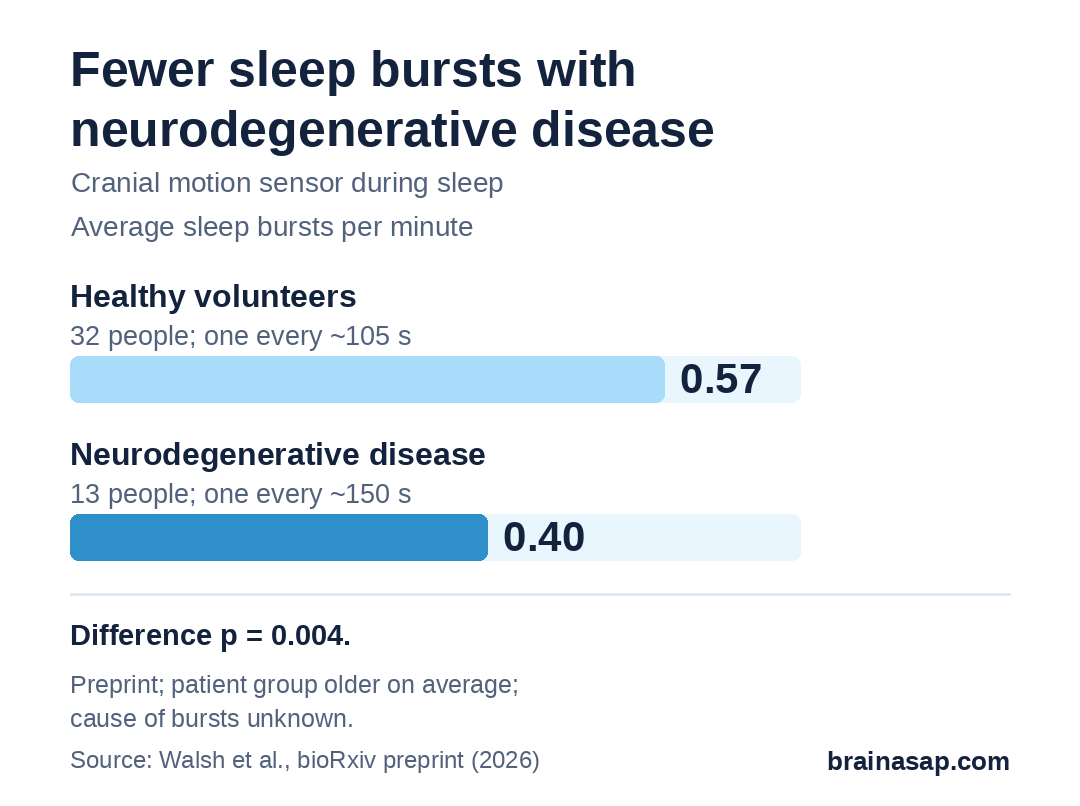
Healthy volunteers averaged 0.57 bursts per minute, or about one every 105 seconds. The brain disease group averaged 0.40 per minute, about one every 150 seconds (p = 0.004). During bursts, delta brain-wave power was also lower in the brain disease group across all sleep stages.
A Promising Signal From a Very Early Study
- Preprint: Not yet peer reviewed.
- Small and uneven groups: 13 patients, about 13 years older on average than the healthy group.
- Diseases not separated: Results for specific conditions were not reported.
- Waste-clearing link untested: The connection to the glymphatic system is a hypothesis.
- Conflicts: Two authors co-founded MindRhythm, Inc., and one holds related head-sensor patents.
Could a Headband Track Brain Health During Sleep?
If confirmed, sleep bursts could become a simple at-home measure of how the brain behaves during sleep, and possibly an early sign of brain disease. For now it is a new observation, not a test anyone can use.
The key question is what actually causes these bursts, and whether fewer of them come before memory and movement problems appear.
Citation: DOI: 10.64898/2026.08.28.747878. Walsh CM, Lovoi PA, Yack L, et al. Intermittent Cranial Accelerometric Pulses – a Potential Marker of Neurodegenerative Disease. bioRxiv preprint, version posted September 28, 2026.
Study Design: Observational case-control study using a cranial accelerometer headband with home EEG.
Sample Size: 32 healthy volunteers and 13 people with neurodegenerative disease; 756 hours of sleep.
Key Statistic: 0.57 vs 0.40 sleep bursts per minute (p = 0.0043).
Caveat: Not peer reviewed; small, age-mismatched groups; authors hold related commercial interests.