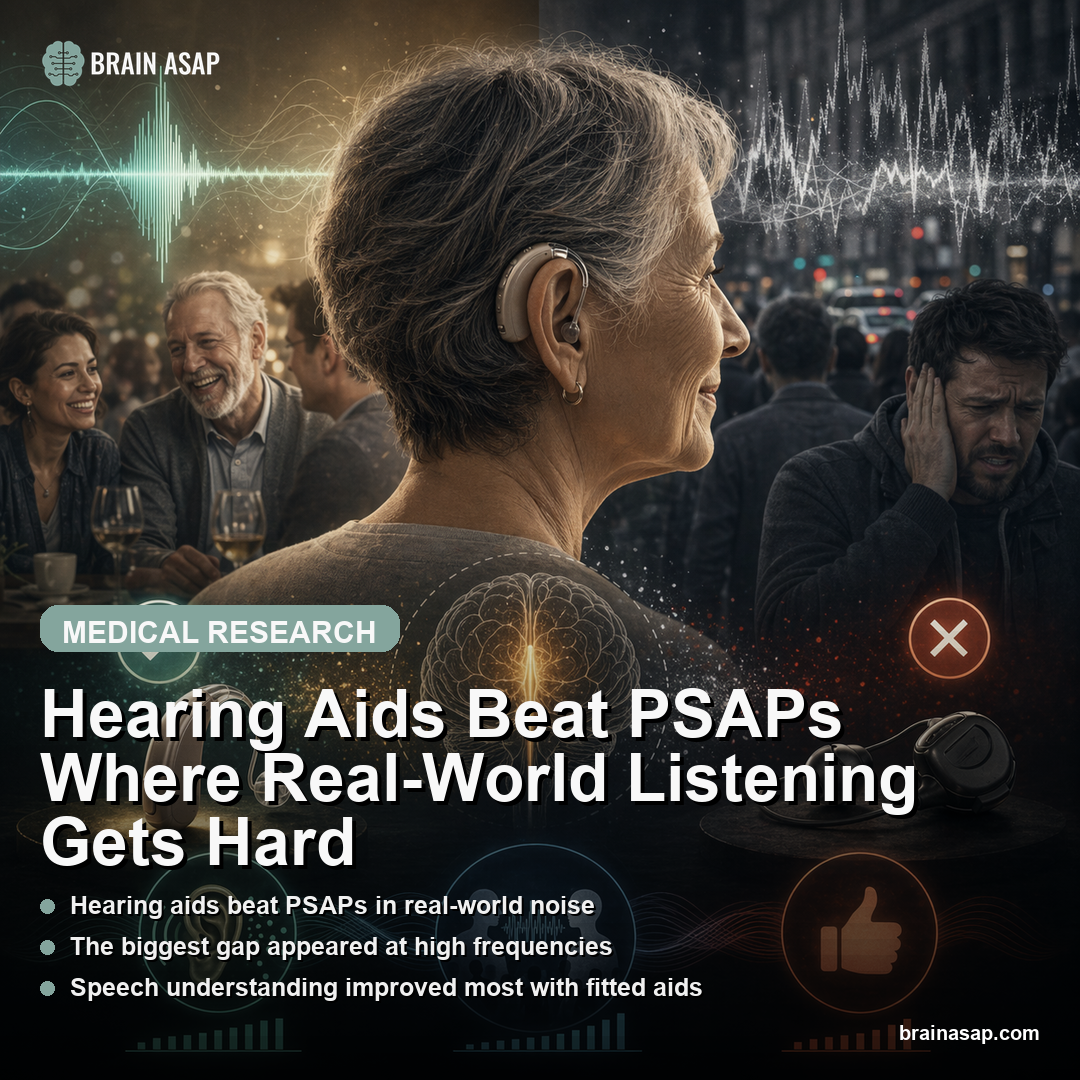
Hearing Aids Beat PSAPs Where Real-World Listening Gets Hard
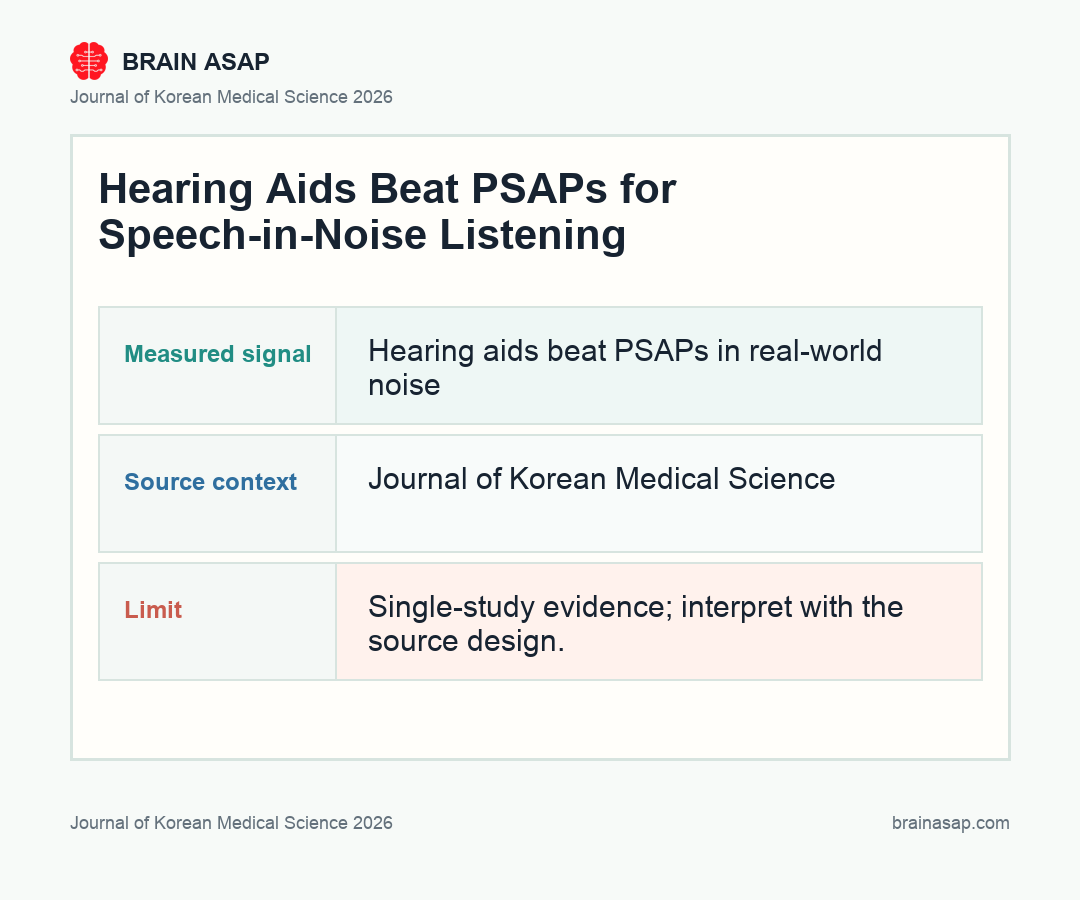
TL;DR: Hearing aids beat personal sound amplifiers where listening gets hardest: high-frequency sound, speech in noise, and daily user satisfaction.
Key Findings
- Hearing aids won the crossover test: Adults with sensorineural hearing loss used either a hearing aid or a PSAP for 3 months, then switched to the other device for another 3 months in a multicenter randomized trial.
- Only hearing aids improved 4,000 to 6,000 Hz hearing: Both device classes helped from 250 to 3,000 Hz, but at the higher frequencies that carry consonants and speech clarity, significant gains showed up only with hearing aids.
- Speech understanding climbed from 53.0% unaided to 80.4% with hearing aids: Word recognition improved with both device types, but hearing aids beat PSAPs, which reached 72.6% in the pooled comparison.
- Noise performance favored hearing aids by roughly 5 dB: On the Hearing in Noise Test, hearing aids reached an average signal-to-noise threshold of -18.9 dB versus -13.9 dB for PSAPs, meaning users could tolerate substantially more background noise.
- Dropout was twice as high with PSAPs: Overall withdrawal reached 28.3% during PSAP use versus 14.3% during hearing-aid use, a practical clue that lower-cost devices were harder to stick with.
- 76.7% would recommend hearing aids to family: User satisfaction questionnaires and custom surveys both leaned toward hearing aids, with premium models doing best and basic PSAPs trailing both hearing-aid tiers.
Source: Journal of Korean Medical Science (2026) | Han et al.
Hearing aids won most clearly where listening breaks down in real life: high-frequency speech detail and noisy rooms. Those are the situations that make people give up on conversations, restaurants, and family gatherings.
Why Cheap Sound Amplifiers Keep Tempting People With Hearing Loss
The appeal of personal sound amplification products, or PSAPs, is obvious. They cost far less than prescription hearing aids, they are easier to buy, and they promise a shortcut for people who know they are missing speech but are not ready for a full audiology workflow.
The problem is that “making sound louder” is not the same as restoring hearing in the places people actually struggle. Most adults with age-related or noise-related hearing loss are not asking whether they can hear a tone in a quiet room. They are asking whether they can follow fast speech, pick out consonants, and survive a loud dinner table.
That is the real target this Korean multicenter crossover trial went after. Instead of testing one device family in isolation, the investigators had the same participants live with both hearing aids and PSAPs for 3 months each, then compared objective hearing outcomes with subjective satisfaction.
What a 73-Patient Crossover Design Revealed After 6 Months of Real Use
The study started with 117 randomized participants, but 73 completed enough of the protocol to be analyzed. The reason is this was not a one-visit gadget comparison. Patients used one device type for a full 3 months, then crossed over to the other for another 3 months, giving the researchers a more realistic view of what daily use feels like.
The enrolled group had sensorineural hearing loss, a mean age of 58.1 years, and a mix of unilateral and bilateral users. The trial also compared subtypes: premium and basic hearing aids, plus higher-end and basic PSAPs, which lets the paper ask whether cheaper amplification can get close enough to be a serious alternative.
The answer depends heavily on what outcome you care about. On basic sound-field thresholds, both device classes helped at lower and mid frequencies. But once the study moved from “Can you detect the tone?” to “Can you actually handle speech?” the gap widened fast.
The Biggest Separation Showed Up at 4,000 to 6,000 Hz
Both PSAPs and hearing aids significantly improved thresholds from 250 to 3,000 Hz. That is the part of the paper that could easily mislead a casual reader into thinking the cheap devices were close enough. But the crucial frequencies for crisp speech perception often live higher than that.
At 4,000 and 6,000 Hz, only hearing aids delivered significant improvement. Premium hearing aids showed the best performance from 2,000 to 6,000 Hz, and even basic hearing aids beat both PSAP categories in the high-frequency range. Those upper frequencies matter because they carry the edges of speech: “s,” “f,” “th,” and other consonant information which makes words separable rather than muddy.
This is one reason people can describe amplification as “loud enough” but still feel lost in conversation. A device can raise overall volume without restoring the high-frequency detail needed to decode speech rapidly and accurately.
How a 7.8-Point Speech Gain Turned Into a Much Larger Noise Advantage
The most intuitive numbers in the paper are the speech scores. Unaided word recognition sat at 53.0%.
With PSAPs, it rose to 72.6%. With hearing aids, it reached 80.4%. That means both approaches helped, but hearing aids preserved a clear edge even before the listening environment became messy.
The stronger result came from the Hearing in Noise Test. PSAP users averaged about -13.9 dB, while hearing-aid users reached -18.9 dB.
In plain language, hearing-aid users could understand speech with substantially more background noise crowding the signal. The device hierarchy was clear:
- Premium hearing aids: generally led the pack.
- Basic hearing aids: still outperformed both high-end and basic PSAPs.
- PSAP tiers: did not meaningfully separate from each other.
That is the difference between tolerating quiet one-on-one conversation and still functioning at a café or family event. Spending more inside the PSAP category did not buy users a convincing jump toward hearing-aid performance.
Satisfaction and Dropout Matter as Much as Audiology Scores
Hearing research can get trapped in threshold charts, but patients live in behavior. The paper’s satisfaction findings help explain why. Standardized questionnaires such as APHAB and IOI-HA favored hearing aids, and the custom surveys leaned the same way.
One standout detail is recommendation intent. 76.7% of participants said they would recommend hearing aids to a neighbor or family member with hearing loss. The study does not show comparable enthusiasm for PSAPs, and the dropout numbers reinforce that difference in lived experience.
During the crossover, 28.3% of participants withdrew while using PSAPs, compared with 14.3% during hearing-aid use. That is not just a side note. A device that looks acceptable on a spec sheet but gets abandoned in daily life is not a serious rehabilitation solution for many people.
What This Means for People Considering PSAPs as a Budget Shortcut
This paper does not say PSAPs are useless. They improved hearing thresholds and speech scores compared with going unaided, which matters for people locked out of hearing care by cost. If the real-world choice is PSAP versus nothing, the devices can still offer meaningful benefit.
What the trial does say is more specific: PSAPs did not match hearing aids on the hardest, most socially important parts of listening. They lagged at high frequencies, trailed on speech in noise, and left users less satisfied over time.
For people mainly struggling in quiet settings or needing a temporary affordability bridge, PSAPs may be better than silence. For anyone whose main complaint is “I can hear people talking, I just can’t make out the words,” this study suggests the cheaper shortcut still misses the part of hearing loss that hurts most.
The larger policy implication sits underneath all of this. People keep reaching for PSAPs because hearing aids remain too expensive and too hard to access.
The answer is probably not pretending the devices are equivalent. It is making the better technology easier to get.
Paper: Comparison of the hearing benefits and user satisfaction with hearing aids and personal sound amplification products: a multicenter prospective randomized crossover trial. Journal of Korean Medical Science. 2026;41(15):e131.. DOI: 10.3346/jkms.2026.41.e131
Authors: Han et al.
Study Design: Randomized clinical trial
Sample Size: 73 patients crossed over for 3 months each way: Adults with sensorineural hearing loss used either a hearing aid or a PSAP for 3 months, then switched to the other device for another 3 months in a multicenter randomized trial.
Key Statistic: Only hearing aids improved 4,000 to 6,000 Hz hearing: Both device classes helped from 250 to 3,000 Hz, but at the higher frequencies that carry consonants and speech clarity, significant gains showed up only with hearing aids.