Cannabinoids Had Weak Evidence for Mental Disorders
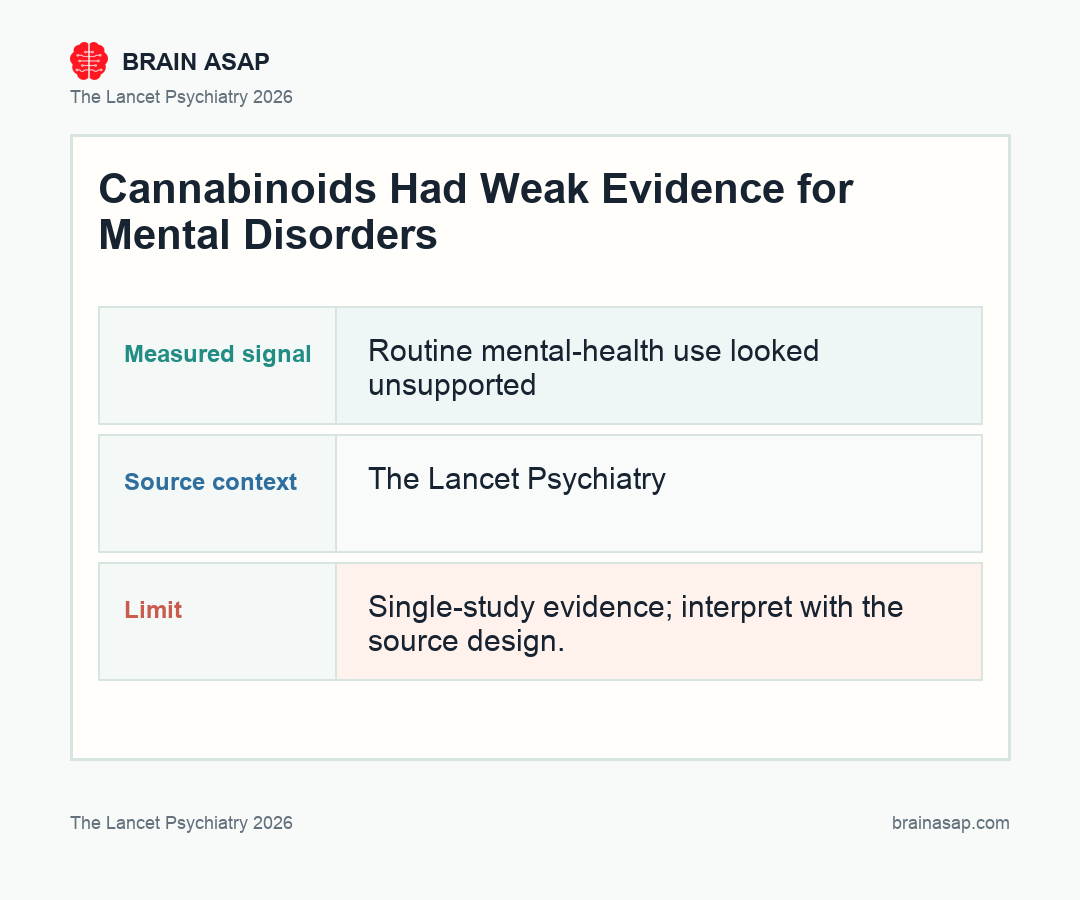
TL;DR: A Lancet Psychiatry review of randomized trials found little support for routine cannabinoid treatment in common mental disorders, despite possible weak signals in a few narrower conditions.
Key Findings
- 54 randomized controlled trials were reviewed: The analysis covered 2,477 participants across mental disorders and substance-use disorders.
- Routine use looked rarely justified: The authors found little evidence for efficacy in common conditions such as anxiety, PTSD, psychotic disorders, anorexia nervosa, and opioid use disorder.
- Possible benefits were narrower: Signals appeared for cannabis use disorder, insomnia, autism, and tics or Tourette syndrome, but evidence strength remained limited.
- Harms were central to the interpretation: The review emphasized psychotic symptoms, cannabis use disorder, adverse events, and delayed use of established treatments.
- Cannabinoid type mattered: THC, CBD, synthetic cannabinoids, dose, route, and psychiatric vulnerability should not be collapsed into one “medical cannabis” claim.
Source: The Lancet Psychiatry (2026) | Wilson et al.
Medical cannabis is already being used for anxiety, depression, trauma symptoms, sleep, and substance-use problems. The clinical evidence has moved more slowly than the market and the public narrative.
This review asks the basic question that should come before routine prescribing: do cannabinoids have enough randomized-trial evidence to support treatment of mental disorders and substance-use disorders?
Medical Cannabis Use Outran Psychiatric Evidence
Many jurisdictions now allow medical cannabis, and mental-health symptoms are among the common reasons people seek it. That creates a serious evidence gap because feeling short-term relief is not the same thing as proving durable psychiatric benefit.
The review focused on randomized controlled trials, or RCTs. In an RCT, participants are assigned to treatment or comparison conditions, which gives stronger evidence than open-label reports or clinic testimonials.
The final evidence base included 54 randomized trials and 2,477 participants. That sounds substantial until it is spread across many disorders, compounds, doses, and outcomes.
This is the key mismatch in the field. Medical cannabis is often discussed as one category, while the actual evidence is split across small trials asking different questions with different products.
The Review Did Not Support Broad Mental-Health Prescribing
The most important conclusion is restraint. The authors found little evidence supporting cannabinoids as routine treatment for common mental-health conditions such as anxiety disorders, PTSD, psychotic disorders, anorexia nervosa, or opioid use disorder.
Some patients will report benefit, especially for sleep, distress, or short-term relief. The randomized-trial evidence is still too weak and inconsistent to justify broad psychiatric approval.
- Anxiety and PTSD: popular real-world uses, but not supported strongly enough for routine cannabinoid treatment.
- Psychotic disorders: especially concerning because THC-containing products can worsen psychotic symptoms in vulnerable people.
- Opioid use disorder: evidence did not support cannabinoids as a reliable treatment despite interest in alternatives.
The gap between public enthusiasm and trial evidence is clinically serious because psychiatric conditions often fluctuate. A product can feel helpful during a crisis while failing to improve long-term symptoms, function, relapse risk, or treatment engagement.
That distinction is especially important for anxiety and trauma symptoms. Short-term sedation or emotional blunting can feel like improvement, while the longer-term question is whether the person functions better, relapses less, and needs fewer rescue treatments.
The Possible Signals Were Narrow and Still Uncertain
The review did identify possible signals in selected areas, including cannabis use disorder, insomnia, autism, and tics or Tourette syndrome. Those signals deserve follow-up because they points to condition-specific effects or subgroups.
The key is not to generalize them. A weak signal in Tourette syndrome does not justify cannabis treatment for depression, and a sleep-related effect does not automatically translate into better PTSD outcomes.
Clinical evidence has to stay attached to the specific disorder, compound, dose, and outcome that was actually tested. Otherwise, “medical cannabis” becomes a phrase that hides more than it explains.
This is also where trial size becomes a problem. A total of 2,477 participants across 54 trials leaves many comparisons underpowered once the evidence is divided by diagnosis, cannabinoid formulation, dose, and follow-up length.
THC and CBD Should Not Be Treated as One Drug
Cannabis is not a single medication. THC is the main intoxicating compound and can affect reward, anxiety, perception, psychosis risk, and dependence. CBD has different pharmacology and is often discussed as less intoxicating, though its psychiatric evidence still depends on dose and indication.
Synthetic cannabinoids add another layer because they can be more potent or pharmacologically different from plant-derived products. Route also matters: inhaled, oral, and pharmaceutical preparations can produce different onset, peak, duration, and adverse-event profiles.
- Compound: THC, CBD, combinations, and synthetic cannabinoids can behave differently.
- Dose and route: inhaled and oral products do not create the same exposure pattern.
- Patient vulnerability: psychosis history, age, substance-use risk, and comorbid disorders can change the risk-benefit profile.
That is why broad claims about cannabis for mental health are scientifically weak. The treatment question has to be much narrower.
A better trial question would sound specific: a defined CBD dose for a defined anxiety disorder over a defined number of weeks, or a defined cannabinoid formulation for tics with standardized adverse-event monitoring. Without that precision, the evidence stays too blurry for clinical decisions.
Psychiatry has learned this lesson before. A drug class can look promising in broad symptom language, then fail when tested against a specific diagnosis with a specific endpoint. Cannabinoid research needs that same discipline.
Psychosis, Dependence, and Delayed Care Are Real Clinical Risks
The harms are not abstract. THC-containing products can worsen psychotic symptoms, increase risk of cannabis use disorder, impair cognition or motivation in some users, and interact with existing psychiatric vulnerability.
Another risk is delayed evidence-based care. A patient who spends months chasing cannabis-based relief for PTSD, depression, anxiety, or opioid use disorder may postpone therapies with stronger support.
Future cannabinoid trials need better targeting, longer follow-up, clearer adverse-event reporting, and outcomes that matter to patients beyond short-term symptom ratings.
Those outcomes should include function, relapse, treatment retention, cognition, psychotic symptoms, and development of cannabis use disorder. A treatment that slightly improves sleep while worsening dependence risk would not be a clean psychiatric win.
The review therefore lands as a guardrail, not a final verdict on every cannabinoid. It says routine psychiatric use is ahead of the evidence, while leaving room for targeted trials that can prove a narrower, safer role.
For clinicians, the immediate implication is careful history-taking. Patients can already be using cannabis products for sleep, anxiety, trauma symptoms, or substance-use cravings, and that use can affect diagnosis, medication response, motivation, and risk assessment.
For patients, the evidence argues for transparency rather than shame. Cannabis use should be discussed directly with clinicians because the risk-benefit picture depends heavily on product, dose, frequency, psychiatric history, and treatment goals.
The Evidence Standard Should Rise With Use
The public-health problem is that use is already widespread. When a treatment becomes common before strong evidence exists, the burden shifts to researchers, clinicians, and regulators to catch up.
The review’s most defensible message is not moral panic. It is clinical discipline: cannabinoids should not be promoted as routine psychiatric treatments until stronger trials show which product helps which patient, at what dose, for how long, and with what tradeoffs.
For now, mental-health cannabis claims are moving faster than the evidence. The safest interpretation is narrow: possible signals exist, but common psychiatric use remains poorly supported and sometimes risky.
Paper: The efficacy and safety of cannabinoids for the treatment of mental disorders and substance use disorders: a systematic review and meta-analysis. The Lancet Psychiatry. 2026;13(4):304-315. DOI: 10.1016/S2215-0366(26)00015-5
Authors: Wilson et al.
Study Design: Systematic review and meta-analysis of randomized controlled trials testing cannabinoids as primary treatments for mental disorders and substance-use disorders.
Sample Size: 54 randomized controlled trials with 2,477 participants.
Key Statistic: The review found little evidence supporting routine cannabinoid treatment for common mental disorders, with possible but weak signals in selected conditions.
Caveat: Evidence strength varied by compound, disorder, dose, and outcome; stronger claims need better long-term trials.