TL;DR: A 2026 observational study in International Journal of Legal Medicine found that cocaine dominated analytically confirmed recreational drug toxicity cases in one Bologna emergency department, while ketamine was common and all new-psychoactive-substance-positive patients had psychomotor agitation.
Key Findings
- 110 ED patients: The observational study enrolled 110 patients with suspected acute recreational drug toxicity between March and November 2024.
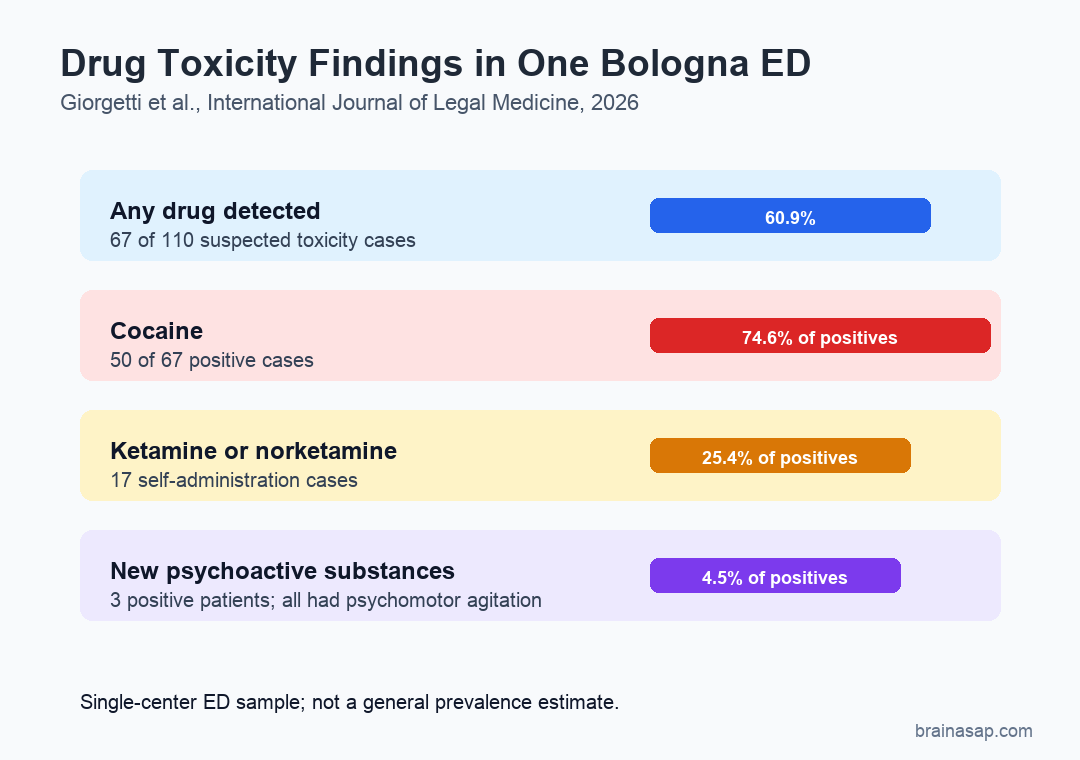
- 60.9% drug-positive: LC-MS/MS blood testing detected at least one drug in 67 patients, or 60.9% of the total cohort.
- 74.6% cocaine: Cocaine was detected in 50 of the 67 positive cases, making it the most frequent drug finding.
- 25.4% ketamine: 17 self-administration cases were positive for ketamine or norketamine, equal to 25.4% of positive cases.
- 3 NPS cases: New psychoactive substances were detected in 3 patients, and all 3 had psychomotor agitation.
Source: International Journal of Legal Medicine (2026) | Giorgetti et al.
New psychoactive substances (NPS) are drugs designed to mimic controlled substances while changing chemical structure enough to evade older drug laws or routine screening. Emergency departments can miss them because many standard immunoassays are built around older drug classes.
This study used liquid chromatography-tandem mass spectrometry, abbreviated LC-MS/MS, to test blood samples from patients who came to a Bologna emergency department with suspected acute recreational drug toxicity.
110 Suspected Recreational Drug Toxicity Cases Were Tested in Bologna
The study ran from March 1 to November 30, 2024 at the University-Hospital of Bologna. Patients were enrolled when emergency physicians suspected acute recreational drug toxicity from self-report or clinical signs such as altered consciousness, agitation, hallucinations, self-harm, or acute behavioral changes.
The enrolled group was mostly men, at 68.2%, with a mean age of 31.7 years. Triage codes were often urgent: orange codes accounted for 50.0% and red codes for 22.7%.
- Primary complaint: Agitation and behavioral changes were listed in 47 patients, or 42.7%.
- Altered mental status: 24 patients, or 21.8%, presented with altered mental status.
- Self-reported use: 38 patients reported using drugs, including cocaine, ketamine, cannabis, stimulants or amphetamines, and heroin.
- Testing scope: The laboratory method screened 182 NPS plus traditional drugs of abuse and metabolites.
The design is important: this was not a population survey. It was an emergency-department sample selected for suspected acute recreational drug toxicity.
Cocaine Was Detected in Nearly Three-Quarters of Positive Cases
At least one drug was detected in 67 patients, or 60.9% of the cohort. Among those positive cases, cocaine was the most common finding.
Cocaine appeared in 50 positive cases, equal to 74.6% of drug-positive presentations. The next most frequent categories were amphetamine or methamphetamine group drugs, methadone, other opioids, and delta-9-THC.
- Cocaine: 50 positive cases, or 74.6%.
- Amphetamine/methamphetamine group: 13 positive cases, or 19.4%.
- Methadone: 12 positive cases, or 17.9%.
- Other opioids: 11 positive cases, or 16.4%.
- Delta-9-THC: 4 positive cases, or 6.0%.
The paper frames this as consistent with Italian drug-toxicity patterns where cocaine remains highly prevalent. The ED data also show how often positive cases involved more than one drug category.
Ketamine or Norketamine Appeared in 25.4% of Positive Cases
Ketamine or norketamine was detected in 20 cases. Three were attributed to emergency-medical-service administration and were excluded from further ketamine-use analyses, leaving 17 self-administration cases.
Those 17 cases represented 25.4% of the 67 positive cases. Ketamine-positive presentations were often polydrug cases: 12 of the 17 also tested positive for another illicit drug.
- Cocaine co-detection: 9 ketamine-positive cases, or 52.9%, also tested positive for cocaine.
- Amphetamine group co-detection: 9 cases, or 52.9%, also tested positive for amphetamines or methamphetamines.
- Measured concentrations: Mean approximate ketamine concentration was 55 ng/ml, and mean approximate norketamine concentration was 101 ng/ml.
- Gender association: Ketamine-positive presentations involved a larger proportion of women than other illicit-drug-positive cases (p = 0.041).
The authors highlighted ketamine because it can complicate emergency care. It is also a medication used for sedation or intubation, so prior recreational exposure can matter when clinicians choose acute treatment.
All NPS-Positive Patients Had Psychomotor Agitation
NPS were detected in 3 patients, or 4.5% of drug-positive cases. The detected substances were synthetic cathinones: methylone in 2 cases, alpha-PHP in 1 case, and 3,4-MD-alpha-PHP in 1 case.
The NPS count was small but clinically pointed. All 3 NPS-positive patients had psychomotor agitation, compared with 39.0% of other illicit-drug-positive cases, and the association was statistically significant (p = 0.037).
- No NPS-only cases: Every NPS-positive patient was also positive for another illicit drug.
- Stimulant pattern: NPS-positive cases often overlapped with cocaine or amphetamine/methamphetamine findings.
- Clinical presentation: The paper singled out severe agitation as a reason to consider NPS, especially synthetic cathinones.
Agitation alone cannot identify NPS exposure. In this ED sample, the analytically confirmed NPS cases clustered around psychomotor agitation.
Single-Center Design Limits Prevalence Claims
The results are useful for emergency toxicology but should not be generalized to all of Italy or all recreational drug users. The study came from one Bologna hospital and only included patients selected because acute recreational drug toxicity was suspected.
Blood sampling timing also matters. The mean delay between presentation and sampling was 1.1 hours in positive cases, but the maximum was 7 hours. Short-lived compounds could have been missed.
- Single center: Regional drug availability can strongly shape what appears in one ED.
- Selection bias: The cohort included suspected acute toxicity, not routine community drug use.
- Analytical scope: The method was broad but still limited to the tested panel and its update cycle.
- Quantification limits: Some ketamine, norketamine, and NPS results were below or above quantification bounds.
The narrow conclusion is still practical: in this ED sample, cocaine dominated positive toxicology, ketamine was common, and synthetic cathinone-type NPS appeared in a small but clinically agitated subgroup. Comprehensive toxicology can change what clinicians see behind acute behavioral and consciousness changes.
Citation: DOI: 10.1007/s00414-026-03795-0. Giorgetti et al. Emergency Department presentations due to new psychoactive substances (NPS) and other illicit drugs: a clinical and toxicological study on recreational drug toxicity in Italy. International Journal of Legal Medicine. 2026;140:2079-2088.
Study Design: Single-center observational ED study with LC-MS/MS blood toxicology.
Sample Size: 110 patients with suspected acute recreational drug toxicity.
Key Statistic: 67 patients tested positive for at least one drug; cocaine appeared in 74.6% of positive cases and ketamine/norketamine self-administration in 25.4%.
Caveat: The sample came from one Bologna ED and cannot estimate general population drug-use prevalence.