TL;DR: A 2026 study in Psychological Medicine found that sleep quality partly explained how early adolescent depression, anxiety, and psychotic-like experience distress were linked to later school grades and social problems in the Adolescent Brain Cognitive Development Study.
Key Findings
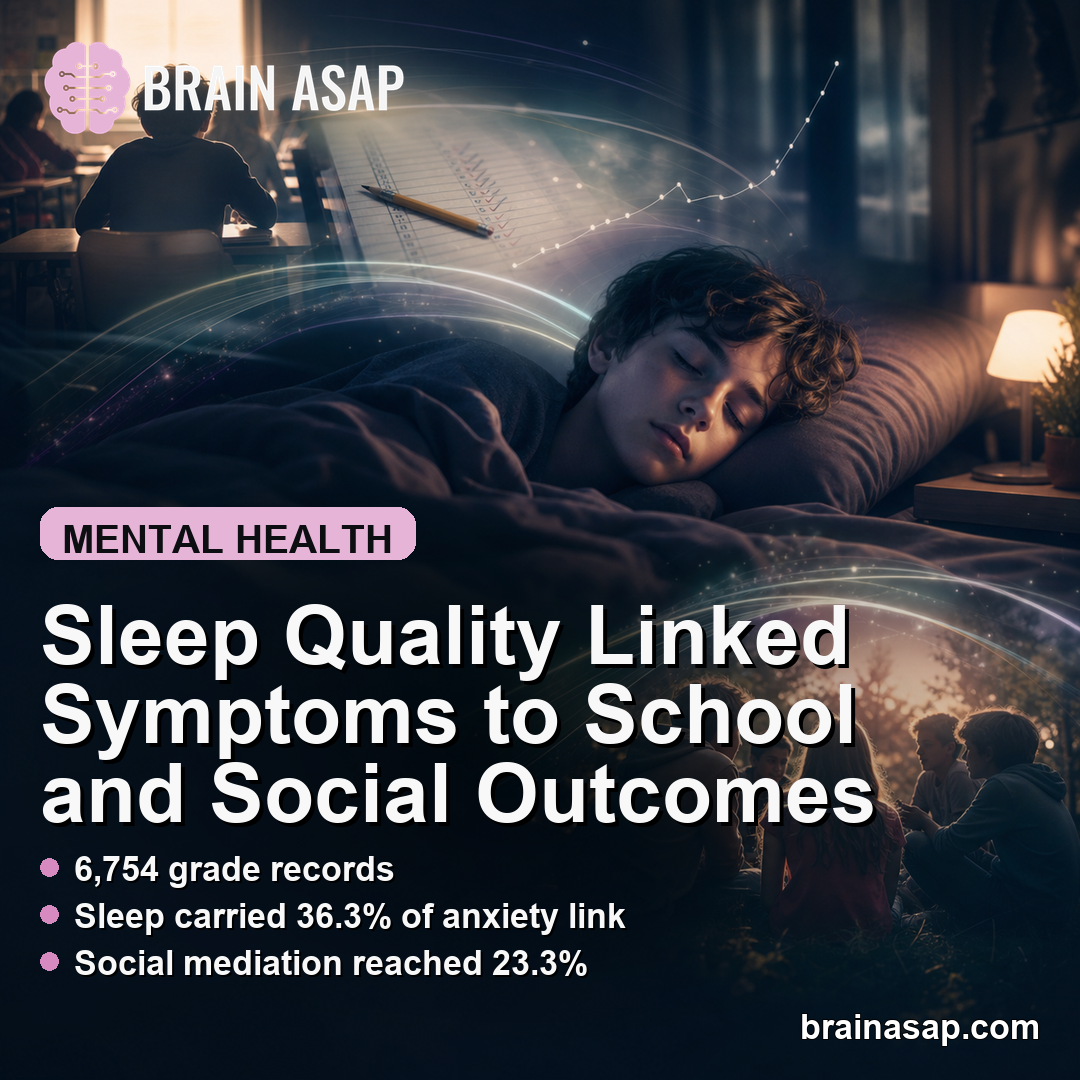
- Scale: Researchers analyzed 6,754 adolescents with grade data and 7,550 adolescents with social-problems data across three ABCD Study waves.
- Academic link: Sleep quality mediated 36.3% of the anxiety-to-academic-functioning association, more than screen time, physical activity, or diet.
- Social link: For social problems, sleep quality was the only lifestyle factor that consistently mediated the symptom-functioning links, accounting for 19.6% to 23.3% depending on the symptom domain.
- Screen time: Weekend screen time was the second strongest mediator for grades, but its effects were smaller than sleep quality and became weaker when weekday screen time was used.
- Context: Financial adversity weakened lifestyle mediation for grades, while family conflict, financial adversity, and worse school environment strengthened sleep-related mediation for social problems.
The analysis used data from the Adolescent Brain Cognitive Development (ABCD) Study, a large multisite U.S. cohort following children from late childhood into adolescence.
Researchers asked whether lifestyle factors at ages 11 to 12 helped explain why mental health symptoms at ages 10 to 11 were associated with grades and social problems at ages 12 to 13.
The study focused on four lifestyle mediators: sleep quality, screen time, physical activity, and Mediterranean-style diet score. Sleep and screen time were reverse-coded in the models so that higher values represented healthier patterns.
Sleep Quality Was the Dominant Mediator for School Grades
For academic functioning, the four lifestyle factors together significantly mediated the links between mental health symptoms and later grades. The strongest total mediation appeared in the anxiety model, where lifestyle factors together accounted for 48% of the anxiety-grade association.
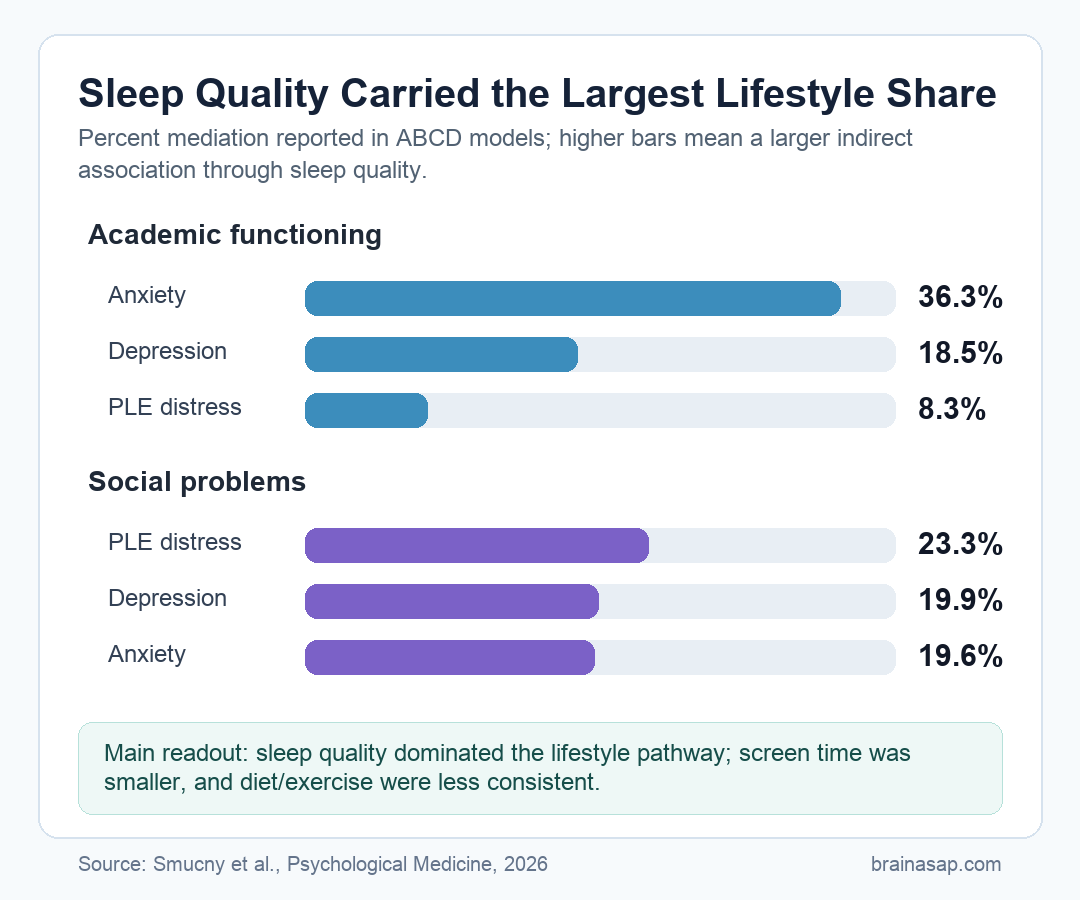
Sleep quality carried most of that signal. It mediated 36.3% of the anxiety association with academic functioning, 18.5% of the depression association, and 8.3% of the psychotic-like experience distress association.
Screen time was usually the next largest mediator, but it was much smaller. For example, screen time mediated 5.0% of the anxiety-grade association and 6.3% of the depression-grade association, compared with 36.3% and 18.5% for sleep quality.
Social Problems Were Also Mostly a Sleep-Quality Pathway
The social-problems models told a cleaner story. Lifestyle factors together mediated links between depression, anxiety, and psychotic-like experience distress with later social problems, but sleep quality was the only lifestyle mediator that stayed consistently significant across symptom domains.
For depression, sleep quality accounted for 19.9% of the association with later social problems. For anxiety, the estimate was 19.6%. For psychotic-like experience distress, it was 23.3%.
The social outcome was based on the Child Behavior Checklist Social Problems T-score, which includes parent-rated problems such as difficulty getting along with other children, being teased, loneliness, and immature behavior. That outcome is broader than friendship count or social-media use alone.
- Academic functioning: Sleep quality was largest, but screen time and physical activity contributed smaller pieces in some models.
- Social problems: Sleep quality drove almost all of the meaningful lifestyle mediation.
- Diet score: Mediterranean-style diet did not consistently mediate the main symptom-functioning links.
Weekend Screen Time Mattered More Than Weekday Screen Time
The researchers tested weekday screen time separately from weekend screen time. Weekend screen time showed a stronger mediating role, especially for academic functioning.
One likely explanation is simple range. Weekday screen time was lower on average because school limits discretionary hours. In Table 1, adolescents averaged 4.63 weekend screen-time hours in the grade-analysis sample versus 3.30 weekday hours.
Screen time still mattered in some models. The paper’s main signal was not a generic “screens explain everything” result.
The larger, more consistent finding was that sleep quality sat between mental health symptoms and later functioning.
Financial and Family Context Changed the Pattern
The environmental moderation results are important because they keep the interpretation from becoming too simple. Lifestyle pathways did not operate the same way in every context.
For grades, financial adversity weakened the mediating role of sleep quality and weekend screen time. In practical terms, sleep and screen habits may explain less of the academic gap when economic strain is high, possibly because housing, resources, stress, and school constraints exert more direct pressure on grades.
For social problems, the direction was different. Sleep-quality mediation became stronger as family conflict and financial adversity increased and as school environment worsened.
- Grades may be resource-sensitive: Academic outcomes can depend on tutoring, quiet study space, attendance, school support, and household stability.
- Social problems may be emotion-sensitive: Poor sleep can amplify irritability, withdrawal, and reactivity, especially in stressful family or school environments.
- Interventions may need pairing: Sleep support may help, but youth facing high adversity may also need family, school, and material supports.
The Study Does Not Prove Sleep Changes Would Cause Better Outcomes
The design was longitudinal but observational. The researchers ordered predictors, mediators, and outcomes across different waves, but that does not prove that improving sleep would cause better grades or fewer social problems.
Several limits matter. Sleep, screen time, and grades were parent-reported, which can inflate associations.
Physical activity came from a single question, while sleep quality came from a longer scale, so measurement precision may have favored sleep.
Diet was measured at the same wave as symptoms because later diet data were unavailable.
The best-supported claim is narrower: in this large early-adolescent cohort, sleep quality was the strongest lifestyle mediator between mental health symptoms and later functional outcomes.
The next test is whether sleep-focused interventions, especially when paired with support for high-adversity families, can change those outcomes directly.
Citation: DOI: 10.1017/S0033291726105121. Smucny et al. Mediating effects of healthy lifestyle factors on associations between mental health and functional outcomes in early adolescence. Psychological Medicine. 2026;56:e215.
Study Design: Longitudinal observational mediation analysis using three waves of ABCD Study data.
Sample Size: 6,754 adolescents in grade models and 7,550 adolescents in social-problems models.
Key Statistic: Sleep quality mediated 36.3% of the anxiety-to-academic-functioning association and 19.6% to 23.3% of symptom-to-social-problems associations.
Caveat: The study was observational and cannot prove that changing sleep quality would cause better grades or social functioning.