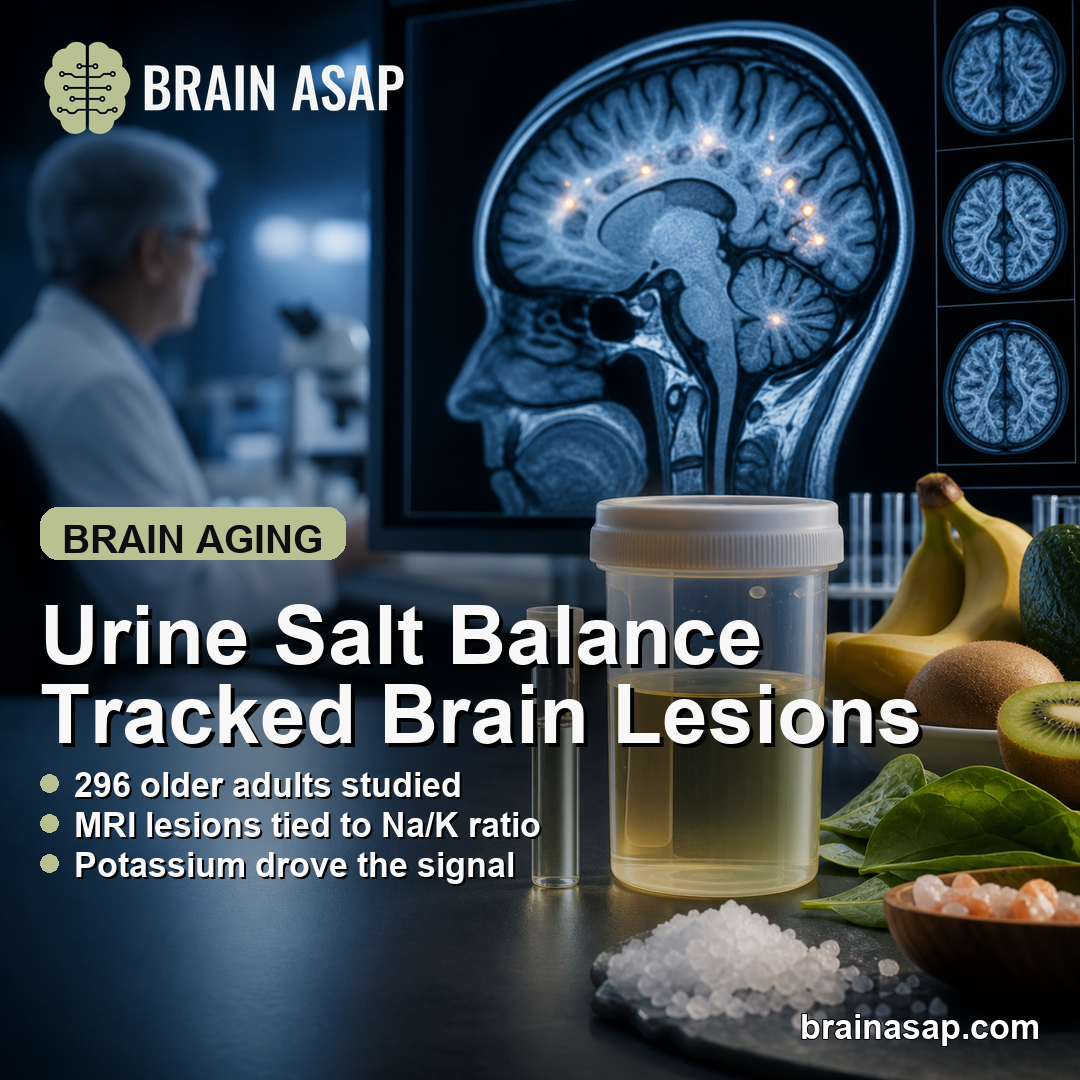
TL;DR: A 2026 preprint in medRxiv linked a higher 24-hour urinary sodium-to-potassium ratio with deep white matter lesions on brain MRI in older Japanese adults, with the association appearing to depend more on lower potassium excretion than on sodium alone.
Key Findings
- Urine balance was matched to MRI lesions: The analysis included 296 adults from two rural Japanese communities who completed brain MRI and 24-hour urine collection.
- Deep white matter lesions were common: Lesions were present in 119 participants, or 40.2% of the analyzed cohort.
- Higher ratio tracked higher odds: Each 1-standard-deviation increase in urinary sodium-to-potassium ratio was linked to 44% higher odds of lesions.
- Top quartile carried more lesion odds: The highest sodium-to-potassium quartile had 2.48 times higher odds of lesions than the lowest quartile.
- Potassium drove the contrast: Urinary potassium showed an inverse association, while urinary sodium alone was not statistically significant.
Deep white matter lesions are MRI-visible signs of cerebral small vessel disease. They are common with aging and have been associated in prior research with stroke risk, cognitive decline, and functional impairment.
This study asked a narrower question: whether the balance between sodium and potassium, measured through a full-day urine collection, tracked with those deep brain MRI findings.
24-Hour Urine Testing Captured Sodium-Potassium Balance
The researchers analyzed 296 community-dwelling adults from Saga, Japan. The average age was 68.7 years, and most participants were at least 60 years old.
Each participant underwent brain magnetic resonance imaging (MRI), and deep white matter lesions were graded with the Fazekas scale. For the main analysis, the researchers treated grade 0 as absent and grades 1 through 3 as present.
The urine measure was also unusually specific. Participants completed a 24-hour urine collection, allowing the team to estimate sodium excretion, potassium excretion, urinary albumin, and the sodium-to-potassium ratio.
- Sodium-to-potassium ratio: A higher value generally reflects more sodium relative to potassium in the diet and excretion pattern.
- Urinary potassium: Higher excretion usually suggests greater potassium intake, often from potassium-rich foods.
- Urinary albumin: Albumin in urine can reflect kidney and blood-vessel stress, so the researchers tested it alongside the electrolyte measure.
The study was cross-sectional, so it measured urine markers and MRI findings at one point in time. That design can show association, but it cannot prove that diet caused the brain lesions.
Higher Sodium-Potassium Ratio Tracked With MRI Lesions
Deep white matter lesions were found in 119 of 296 participants. People with lesions were older and more likely to have hypertension than people without lesions.
After adjustment for age, sex, hypertension, diabetes, smoking, alcohol use, metabolic syndrome, kidney filtration, and urinary albumin, the sodium-to-potassium result remained statistically significant.
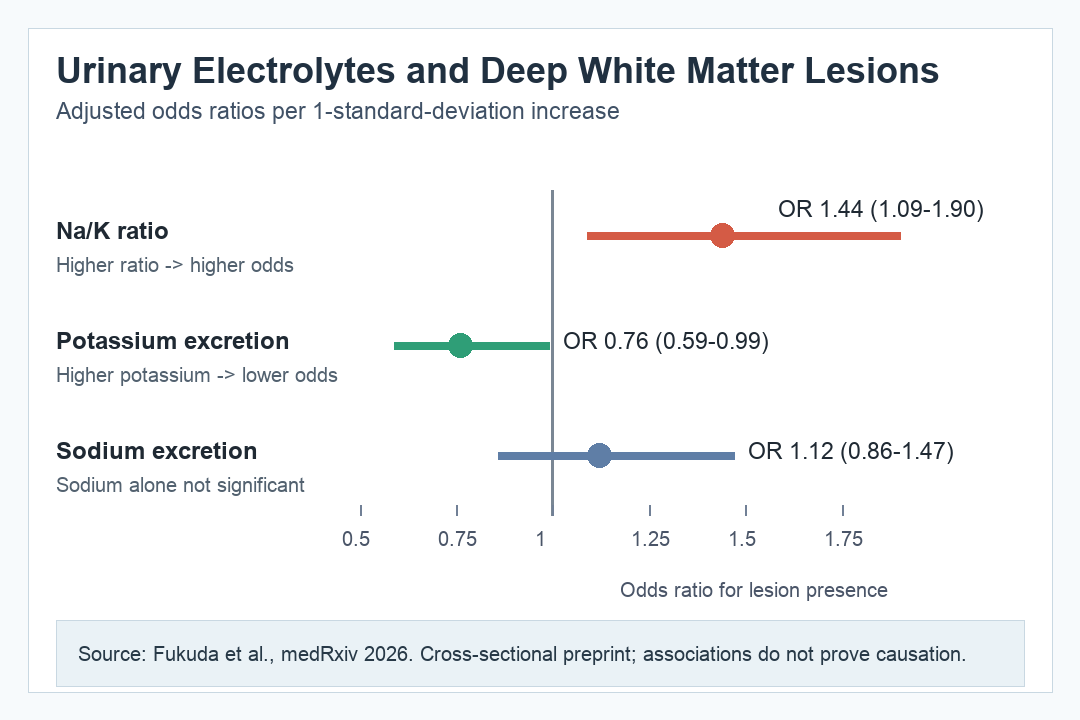
Each 1-standard-deviation increase in the urinary sodium-to-potassium ratio was associated with higher odds of deep white matter lesions:
- Adjusted odds ratio: 1.44
- 95% confidence interval: 1.09 to 1.90
- P value: 0.010
The quartile analysis told a similar story. Participants in the highest sodium-to-potassium quartile, with ratios from 4.44 to 9.67, had 2.48 times higher odds of deep white matter lesions than participants in the lowest quartile, with ratios from 1.09 to 2.74.
A single cutoff cannot diagnose brain small-vessel disease. The higher-ratio group carried more MRI-visible lesion burden after adjustment for several vascular risk factors.
Potassium Looked More Informative Than Sodium Alone
The most useful nuance was that sodium alone did not explain the association. Urinary sodium excretion by itself was not significantly associated with deep white matter lesions.
Urinary potassium moved in the opposite direction. Each 1-standard-deviation increase in potassium excretion was associated with 24% lower odds of deep white matter lesions.
The reported estimate for potassium was:
- Adjusted odds ratio: 0.76
- 95% confidence interval: 0.59 to 0.99
- P value: 0.042
The sodium-to-potassium ratio is not just a salt marker. A high ratio can reflect too much sodium, too little potassium, or both.
In this cohort, the signal appeared to be driven mainly by lower potassium excretion.
Albuminuria showed a weaker pattern. Urinary albumin had a borderline association before the sodium-to-potassium ratio entered the model, but it was no longer statistically significant after further adjustment.
The Association Marks Risk, Not Causation
The cautious interpretation is that the 24-hour urinary sodium-to-potassium ratio may mark dietary and vascular conditions related to cerebral small vessel health.
It should not be read as proof that changing one urine number will reverse white matter lesions. The study design cannot show direction, and the cohort came from rural Japanese communities, which may limit generalization to other populations.
Several limits are important:
- Cross-sectional design: Urine markers and MRI findings were measured at the same time, so causality is unresolved.
- Single urine collection: One 24-hour sample may miss day-to-day diet variation.
- Selection bias: People willing to complete 24-hour urine collection may be more health-conscious than the broader population.
- Lesion grading: The main analysis collapsed Fazekas grades into absent versus present, which may reduce sensitivity to severity differences.
- Preprint status: The paper had not yet been certified by peer review.
The sodium-only contrast narrows the research question. For brain small-vessel research, potassium intake and broader dietary balance may be as important as salt-focused framing.
Why This Could Matter for Brain Aging Research
White matter lesions are not a rare imaging footnote in older adults. They are part of the broader small-vessel disease picture that links vascular health with cognition, mobility, and stroke vulnerability.
A low-cost urine marker would be attractive if future studies show it predicts lesion progression or responds to dietary intervention. This preprint does not get that far, but it gives researchers a concrete candidate marker to test longitudinally.
The next step is not a simple supplement message. The stronger next tests would track sodium-to-potassium ratio over time, measure diet directly, follow MRI lesion progression, and test whether changes in potassium-rich dietary patterns affect small-vessel outcomes.
Citation: DOI: 10.64898/2026.06.29.26356891. Fukuda et al. Association of 24-Hour Urinary Sodium-to-Potassium Ratio with Deep White Matter Lesions in Community-Dwelling Older Adults. medRxiv. 2026.
Study Design: Cross-sectional community-based analysis using brain MRI and 24-hour urine collection.
Sample Size: 296 Japanese adults, mean age 68.7 years.
Key Statistic: Highest urinary sodium-to-potassium quartile had 2.48 times higher adjusted odds of deep white matter lesions than the lowest quartile.
Caveat: Preprint status and cross-sectional design mean this association should not be used to infer causation or guide clinical practice by itself.