TL;DR: A 2026 medRxiv preprint reanalyzed long-term survivors from the AB10015 ALS trial and reported that masitinib-treated patients had higher 5-year survival than historical benchmarks, but the analysis was post hoc, sponsor-supported, and lacked long-term placebo follow-up.
Key Findings
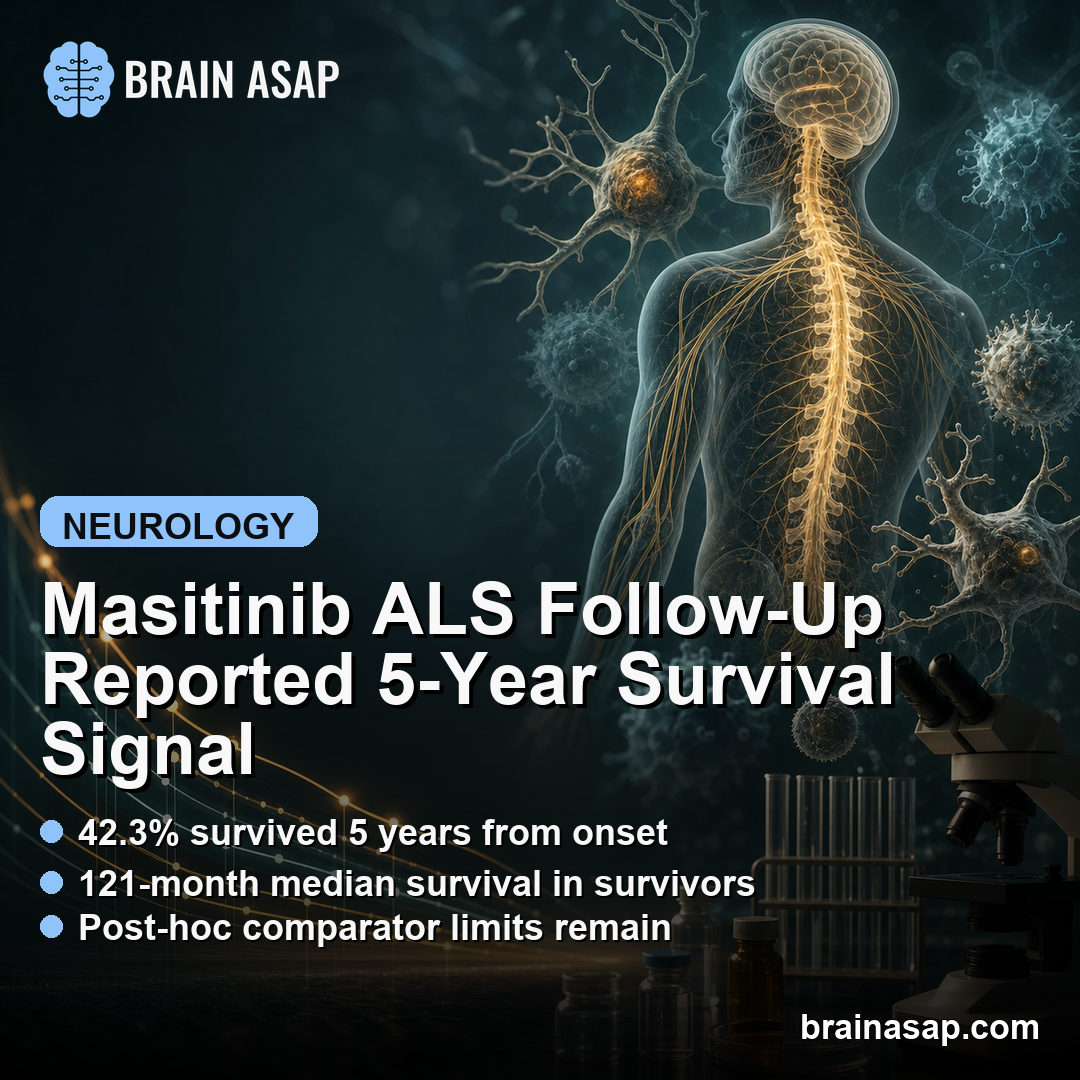
- Five-year survival was 42.3%: 55 of 130 patients assigned to masitinib 4.5 mg/kg/day were alive at least 5 years after ALS symptom onset.
- Slower-progressing patients reached 50.0%: the 5-year survival rate was 53 of 106 among patients with an ALSFRS-R progression rate below 1.1 points per month.
- Median survival exceeded model estimates: long-term survivors had 121 months of observed median survival from onset versus 42 months predicted by the ENCALS model.
- Mechanical assistance still mattered: 49.1% of long-term survivors had no permanent ventilation, gastrostomy, tracheostomy, or wheelchair dependence.
- The evidence boundary is large: the long-term analysis used historical and model-based comparators rather than a long-term randomized placebo group.
Source: Ludolph et al. analyzed long-term survival in the masitinib 4.5 mg/kg/day arm of AB10015, a randomized ALS trial that originally tested masitinib plus riluzole.
Masitinib Follow-Up Focused on ALS Survival Beyond 5 Years
Amyotrophic lateral sclerosis, or ALS, is a progressive motor-neuron disease that usually shortens survival within a few years of symptom onset. The new analysis asked a narrow question: among patients assigned to masitinib 4.5 mg/kg/day in AB10015, how many became long-term survivors?
Masitinib is a tyrosine kinase inhibitor. In ALS, the rationale is not direct motor-neuron replacement.
Researchers describe the drug as targeting immune-related activity, especially microglial and mast-cell signaling, that may contribute to disease progression.
AB10015 tested masitinib as an add-on to riluzole 100 mg/day. The long-term preprint then looked beyond the original 48-week treatment period and included post-study follow-up, including an optional early-access program for patients who stayed on masitinib.
Five-Year Survival Was Higher Than Historical ALS Benchmarks
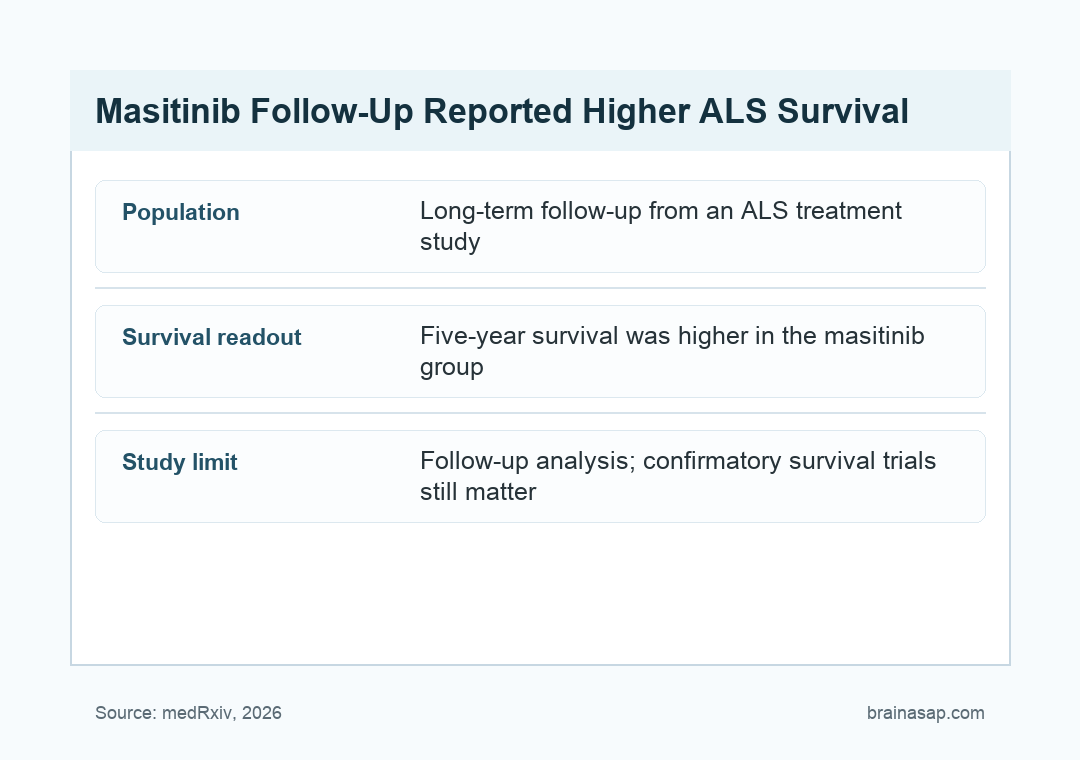
The main survival count was 55 of 130 patients: that many people in the masitinib 4.5 mg/kg/day group survived at least 5 years from ALS symptom onset. That equals a 42.3% 5-year survival rate.
The preprint compared that figure with historical ALS cohorts where 5-year survival ranged from 7.0% to 27.8%, with a weighted average of about 23.5%. Those are indirect comparisons, but they explain why the long-term follow-up drew attention.
Two prespecified or clinically relevant subgroups had higher survival rates:
- Primary efficacy population: 53 of 106 patients with an ALSFRS-R progression rate below 1.1 points per month reached 5 years from onset, a 50.0% survival rate.
- No complete baseline functional loss: 45 of 85 patients who still had at least some function on every ALSFRS-R item reached 5 years, a 52.9% survival rate.
ALSFRS-R is the revised ALS Functional Rating Scale, a clinical scale that tracks motor, swallowing, breathing, and daily-function impairment. In this paper, the progression-rate threshold marked how quickly ALSFRS-R scores had been falling before baseline.
Observed Median Survival Was 121 Months in Long-Term Survivors
The authors also compared observed survival with the ENCALS survival model, a clinical prediction model for ALS survival. For the 55 long-term survivors, observed median survival from symptom onset was 121 months.
The model-predicted median survival for the same group was 42 months. That produced a reported 79-month residual median survival gain.
The patient-level direction was similar. In the 55 long-term survivors:
- 51 patients lived longer than the ENCALS model predicted.
- 3 patients were within about 10% of the model prediction.
- 1 patient had shorter observed survival than predicted.
That model comparison is useful, but it is not the same as keeping a randomized placebo arm under equal long-term observation.
The paper itself notes that the ENCALS model uses a composite survival outcome that includes intensive ventilation and tracheostomy events, while the observed survival endpoint here was death from any cause.
Half of Long-Term Survivors Avoided Major Mechanical Assistance
Survival alone can be misleading in ALS if extra months come with severe loss of independence. The analysis therefore used a practical surrogate for quality of life: no permanent ventilation, gastrostomy, tracheostomy, or wheelchair dependence.
By that definition, 27 of 55 long-term survivors, or 49.1%, had satisfactory quality of life as defined in the preprint. In the slower-progressing primary efficacy population, the same percentage appeared: 26 of 53.
The best-function subgroup looked somewhat stronger. Among patients who had no complete loss of ALSFRS-R function at baseline, 25 of 45 long-term survivors, or 55.6%, avoided those mechanical-assistance markers.
The subgroup pattern matters because masitinib is framed as a progression-slowing treatment, not a restorative therapy. The analysis found fewer long-term survivors among patients who already had complete functional loss on at least one ALSFRS-R item or had fast baseline progression.
The Main Caveat Is the Post-Hoc Comparator
This was not a clean long-term randomized comparison between masitinib and placebo. After the blinded trial period ended, the long-term follow-up centered on patients who had received masitinib and, in some cases, continued through compassionate or early-access use.
The strongest limits are practical:
- No long-term placebo follow-up: historical cohorts and model estimates cannot fully replace randomized long-term controls.
- Post-hoc selection: the analysis focused on long-term survivors after the original trial, which can magnify survivor-related patterns.
- Missing genetic input: C9orf72 mutation status was unavailable for ENCALS modeling and was treated as negative.
- Sponsor role: the work and publication costs were supported by AB Science, and the sponsor was involved in study design, interpretation, writing, and submission.
That does not erase the survival signal. It does mean the reader should treat the result as a strong follow-up signal needing prospective confirmation, not as final proof that masitinib produces 5-year survival rates above 40% in routine ALS care.
Biomarker Selection Is the Next Practical Question
Long-term survivors appeared across several ALS baseline categories, including spinal and bulbar onset, moderate and severe functional impairment, and different age and respiratory-function groups. Fast progression and complete baseline functional loss looked less favorable.
The biological interpretation is that some ALS patients may have disease progression more tied to microglial or mast-cell inflammatory activity, making them better candidates for a drug aimed at those pathways.
That remains a hypothesis. A useful next study would test masitinib prospectively in a clearly defined patient group, use a prespecified biomarker strategy, and keep long-term follow-up comparable across treatment arms.
For now, the finding supports a narrower claim: AB10015 masitinib-treated long-term survivors lived much longer than model expectations, and about half avoided major mechanical assistance, but the evidence still needs a controlled long-term confirmation path.
Citation: DOI: 10.64898/2026.04.10.26350104. Study authors et al. Ludolph et al. Evaluation of Long-Term Amyotrophic Lateral Sclerosis Survivors Treated with Masitinib in Study AB10015. medRxiv . 2026.
Study Design: Post-hoc long-term survival analysis of the masitinib 4.5 mg/kg/day arm of a randomized ALS trial plus post-study follow-up.
Sample Size: 130 masitinib-treated ALS patients, including 55 patients who survived at least 5 years from symptom onset.
Key Statistic: Five-year survival from onset was 42.3%; observed median survival in long-term survivors was 121 months versus 42 months predicted by ENCALS.
Caveat: The long-term comparison relied on historical benchmarks and model prediction rather than a long-term randomized placebo group.