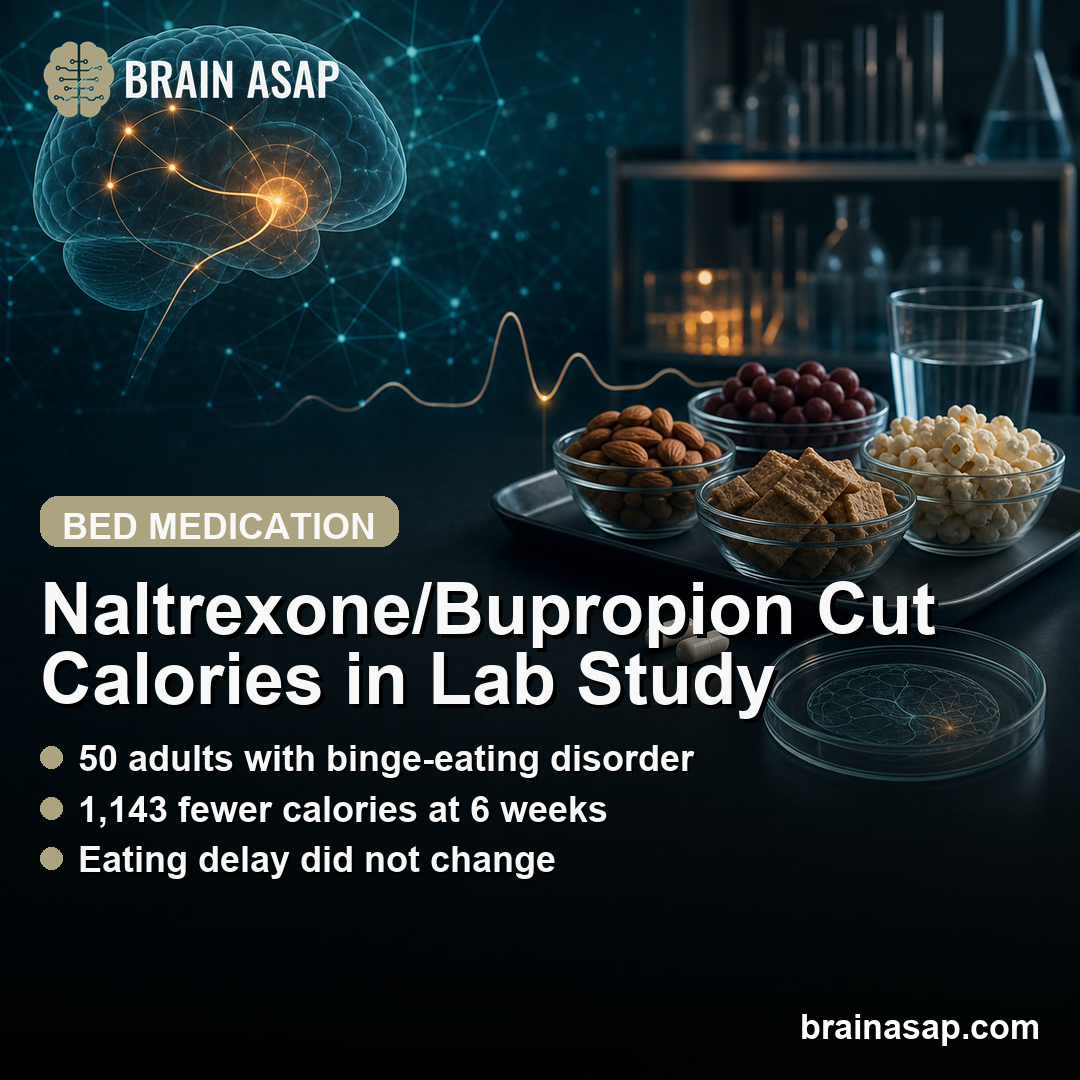
TL;DR: A 2026 human laboratory study in Drug and Alcohol Dependence Reports found that naltrexone/bupropion did not change whether people with binge-eating disorder started eating preferred snacks, but it reduced how many calories they ate once they began.
Key Findings
- Naltrexone/bupropion trial included 50 adults: Participants came from a randomized trial of naltrexone/bupropion, including 23 assigned to medication and 27 assigned to placebo.
- Medication dose was the obesity-treatment combination: Naltrexone/bupropion reached 32 mg/day of sustained-release naltrexone plus 360 mg/day of sustained-release bupropion.
- Eating delay did not significantly change: The medication did not significantly alter latency to begin eating preferred high-calorie snacks during the laboratory task.
- Calories fell after treatment: Among participants who ate, naltrexone/bupropion reduced calories consumed by 1,143 calories at 6 weeks and by 541 calories at 12 weeks versus placebo.
- Sweet-snack craving changed early: Medication reduced craving for preferred sweet snacks and hunger ratings at 6 weeks, but those effects were not sustained at 12 weeks.
Source: Drug and Alcohol Dependence Reports (2026) | McKee et al.
Naltrexone/Bupropion Changed Calories More Than Eating Delay
Binge-eating disorder is not only about whether someone starts eating. Clinically, the harder measure is what happens after eating begins, especially when preferred high-calorie foods are available and stopping is difficult.
Researchers tested that distinction in a human laboratory substudy nested inside a randomized trial of naltrexone/bupropion. The combination pairs an opioid-receptor antagonist with a dopamine/norepinephrine reuptake inhibitor, a mechanism meant to dampen food reward and appetite-related drive.
The study included 50 adults with binge-eating disorder. Most were women, most were White, and 72% met criteria for obesity.
Participants were randomized in the parent trial to placebo or naltrexone/bupropion, then completed laboratory sessions built around preferred snack foods.
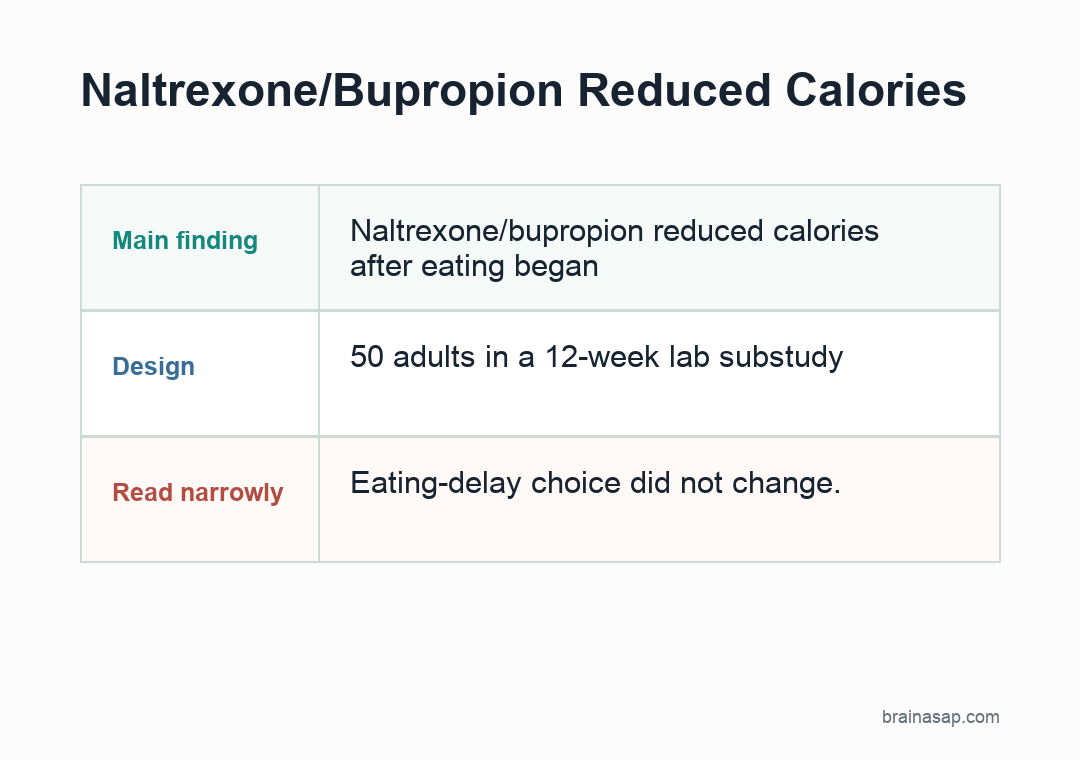
The main result was specific: the medication did not significantly change the decision to begin eating, but it did reduce the amount eaten once participants started.
Snack-Food Task Separated Eating Delay From Calories Consumed
The design split binge-related behavior into two parts. Researchers first measured whether participants could delay eating when preferred foods were sitting in front of them.
After eating began, researchers measured the actual calories consumed.
Each participant had named six preferred high-calorie snacks, three sweet and three salty. During the session, researchers presented about 750 calories of each snack, enough food to support a real ad-libitum eating test rather than a token tasting task.
The task had three important pieces:
- Delay period: Participants could earn money for every minute they resisted eating, up to a 3-hour window.
- Ad-libitum eating period: Once participants started eating, they could eat as much as they wanted from the snack array.
- Repeated treatment timing: Sessions compared baseline, 6 weeks, and 12 weeks of treatment exposure within the parent trial structure.
That setup makes the negative result on eating delay easier to interpret. Naltrexone/bupropion did not appear to improve the ability to hold off from eating in this laboratory context.
The medication effect appeared later, in how much food was consumed.
Calories Dropped by 1,143 at 6 Weeks
Among participants who chose to eat, naltrexone/bupropion reduced calories consumed compared with placebo. The estimated medication effect was 1,143 fewer calories at 6 weeks and 541 fewer calories at 12 weeks.
The 6-week effect was especially large. Compared with baseline, the medication group showed a 68% reduction in calories consumed, while the placebo group showed a 2% increase.
At 12 weeks, the medication group still ate less than baseline, with a 44% reduction, compared with a 22% reduction in placebo.
Plasma medication levels supported the interpretation that both drug components mattered. Higher 6beta-naltrexol, a naltrexone metabolite, and higher bupropion levels were each associated with fewer calories consumed.
Sweet Craving and Hunger Improved Early
The mechanism data pointed toward early reward and appetite effects rather than a broad mood effect. At 6 weeks, naltrexone/bupropion reduced craving for preferred sweet snacks during the self-administration period.
It did not show the same clear effect for salty-snack craving.
Researchers also found reduced hunger ratings at 6 weeks. Those craving and hunger effects were not maintained at 12 weeks, even though the calorie-consumption signal remained directionally favorable.
The pattern fits the pharmacology. Naltrexone blocks opioid signaling involved in reward value, and bupropion changes dopamine and norepinephrine signaling.
In this study, the combination seemed to affect the reinforcing pull of food more than the initial decision to start eating.
The clinical distinction is practical:
- Not a self-control cure: The medication did not significantly improve laboratory resistance to starting preferred-food intake.
- Potential portion-size effect: Once eating began, participants receiving medication consumed fewer calories.
- Early craving marker: Reduced sweet-food craving at 6 weeks may help identify early response, but that marker needs replication.
Medication Pattern Fits Weight Loss More Than Binge-Frequency Control
The laboratory findings line up with the parent randomized trial, where naltrexone/bupropion did not significantly reduce binge-eating frequency but did produce more weight loss. The lab task helps explain that combination of results.
If a medication reduces the size or calorie load of eating episodes without changing whether episodes happen, weight can improve while binge frequency does not.
That is not a complete treatment for binge-eating disorder, but it is still clinically meaningful for some patients, especially when binge eating and obesity overlap.
Behavioral or psychotherapeutic treatment should remain a likely partner rather than something medication replaces. Cognitive behavioral therapy can target binge frequency, loss of control, food rules, and compensatory thought patterns.
Naltrexone/bupropion may be doing a different job: reducing calories, hunger, and reward-driven intake.
A combined approach would therefore make more clinical sense than treating the medication as a standalone answer.
What Limits the BED Medication Finding
This was a 50-person laboratory substudy, not a large standalone efficacy trial. COVID-era scheduling also meant participants did not all complete the same exact sequence of lab sessions, and no participant completed both the 6-week and baseline laboratory pair in the ideal full design.
Generalizability is also limited. The sample was mostly White, most participants had obesity, and the task occurred from late morning into early afternoon.
That may not match the time or emotional context of many real-world binge episodes.
Still, the result narrows the medication effect. Naltrexone/bupropion was not a broad binge-eating cure in this laboratory task.
The medication may reduce caloric intake during high-risk eating episodes, partly through early changes in sweet-food craving and hunger.
That is a narrower claim, but it is a better one.
Citation: DOI: 10.1016/j.dadr.2026.100428. McKee et al. Naltrexone/bupropion for binge-eating disorder: A human laboratory investigation of mechanisms. Drug and Alcohol Dependence Reports. 2026;19:100428.
Study Design: Human laboratory substudy nested inside a 12-week randomized clinical trial of naltrexone/bupropion versus placebo.
Sample Size: 50 adults with binge-eating disorder; 23 assigned to naltrexone/bupropion and 27 assigned to placebo.
Key Statistic: Among participants who ate, naltrexone/bupropion reduced calories consumed by 1,143 at 6 weeks and by 541 at 12 weeks compared with placebo.
Caveat: The task did not show a significant medication effect on the decision to start eating, and the laboratory sample was small and mostly included participants with obesity.