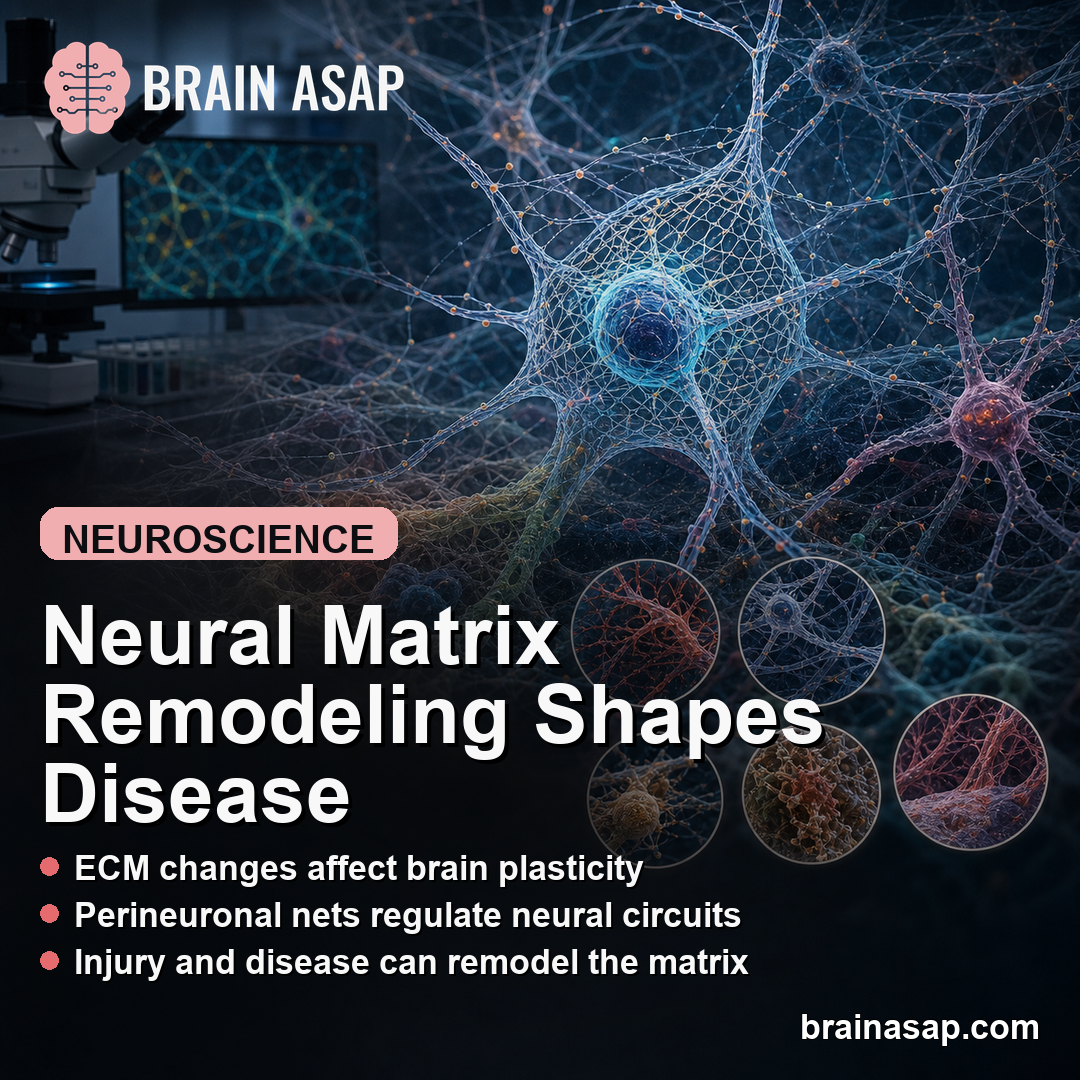
TL;DR: A 2026 review in Nature Reviews Neurology argued that neural extracellular matrix (ECM), the protein-and-glycan scaffold around central nervous system cells, is an active regulator of brain plasticity and neurological disease.
Key Findings
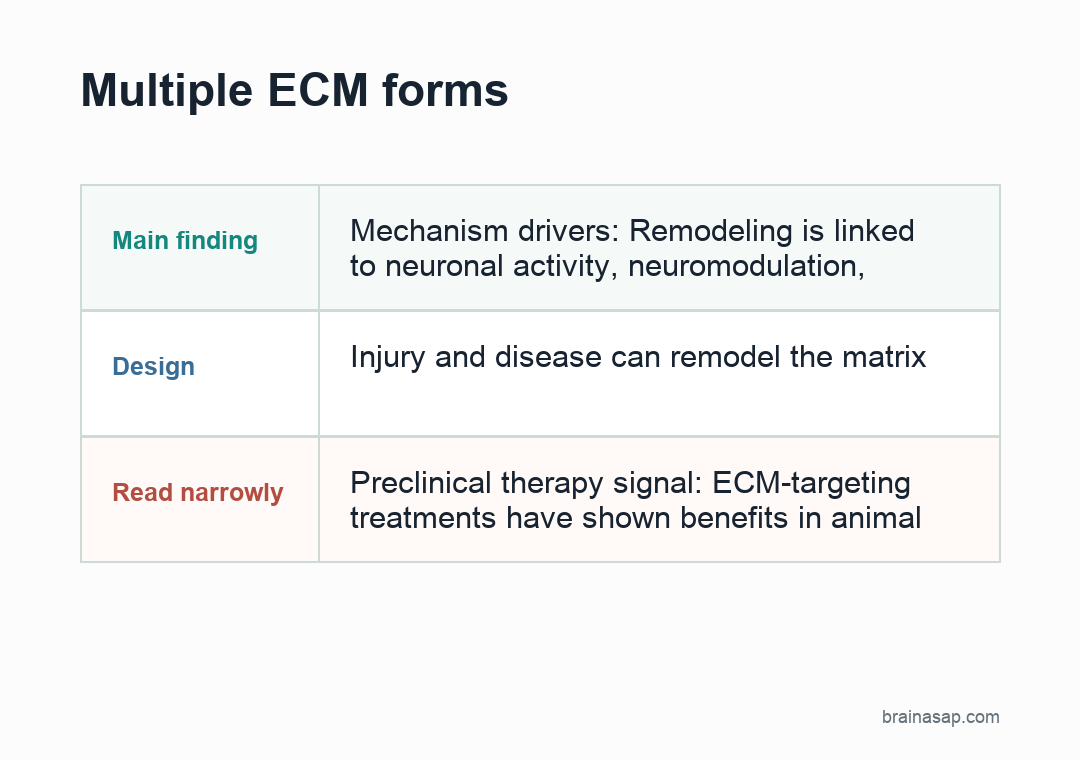
- Multiple ECM forms: The review describes perineuronal nets, perisynaptic ECM, periaxonal coats, and diffuse interstitial ECM.
- Brain function link: Neural ECM helps regulate synaptic stability, plasticity, network excitability, memory engrams, and cognitive flexibility.
- Disease-specific remodeling: ECM changes can range from robust scar formation after trauma or stroke to subtler distributed changes in chronic neurological disease.
- Mechanism drivers: Remodeling is linked to neuronal activity, neuromodulation, neuroinflammation, and disease stage.
- Preclinical therapy signal: ECM-targeting treatments have shown benefits in animal models, but clinical translation remains early.
Source: Nature Reviews Neurology (2026) | Kwok & Dityatev
Neural extracellular matrix (ECM) is not just structural packing around neurons. The review presents it as a dynamic system that helps shape synapses, circuit stability, excitability, vascular permeability, and immune-cell traffic in the central nervous system.
That framing changes how neurological disease mechanisms are interpreted because ECM can either support repair or restrict it. The same broad biological category can mean protective perineuronal nets in one context and scar-like barriers after injury in another.
Neural ECM Includes Perineuronal Nets, Perisynaptic ECM, and Periaxonal Coats
The review separates neural ECM into several forms. Perineuronal nets wrap around certain neurons, perisynaptic ECM sits near synapses, periaxonal coats surround axons, and diffuse interstitial ECM fills extracellular space.
Those structures are chemically diverse, but they share a central role: they influence how cells communicate and how stable or flexible a circuit becomes.
- Synaptic stability: ECM can help stabilize synaptic contacts and constrain excessive remodeling.
- Plasticity control: ECM composition can change how easily circuits reorganize after learning, injury, or disease.
- Network excitability: ECM changes can affect the balance between stable signaling and hyperexcitable networks.
- Barrier and immune roles: ECM can influence vascular permeability and immune-cell movement in the CNS.
This is why ECM biology now belongs in discussions of cognition and disease, not only tissue architecture.
Trauma and Stroke Can Produce Robust ECM Scar Formation
In acute injury, ECM remodeling can be visually and biologically obvious. Trauma and stroke can produce robust scar formation, with ECM molecules accumulating around damaged tissue and influencing repair.
That response can be partly protective. It can wall off injury, stabilize tissue, and organize inflammatory responses.
- Protective role: ECM accumulation can help contain tissue damage after central nervous system injury.
- Repair barrier: Excessive or poorly timed ECM buildup can restrict axon growth and circuit repair.
- Therapeutic challenge: The goal is not simply to remove ECM, but to change the timing, location, and composition of remodeling.
The review treats this as a central reason ECM-targeting therapies are difficult. A blunt intervention could remove a harmful barrier while also removing a stabilizing signal.
Chronic Neurological Disorders Show More Distributed ECM Changes
Chronic disorders may not show the same obvious scar pattern. The review describes ECM remodeling in chronic neurological disease as subtler and more distributed, but still functionally important.
Perineuronal nets are a major example because they help regulate plasticity, memory-related circuit stability, and excitability. Changes in these nets have been discussed in relation to epilepsy, neurodegeneration, cognitive flexibility, and disease-linked circuit dysfunction.
- Epilepsy context: ECM degradation or altered perineuronal nets can affect excitability and seizure susceptibility in models.
- Neurodegeneration context: ECM changes may interact with proteinopathy spread, glial activation, and synaptic dysfunction.
- Cognition context: ECM composition can influence memory engrams and the ability of networks to update.
The review’s key point is that ECM remodeling is not uniform across disorders. It depends on disease type, stage, brain region, neuronal activity, and inflammatory status.
ECM-Targeting Treatments Are Mostly Preclinical
Therapeutic strategies include enzymes that degrade ECM components, inhibitors of ECM synthesis, proteinases, glycosidases, and receptor-targeting approaches. The review describes benefits in multiple preclinical CNS disease models.
Reported effects include restraining proteinopathy spread, modulating glial activation, and improving metabolic, synaptic, vascular, or cognitive functions in animal models.
The treatment question is therefore more specific than “increase or decrease ECM.” Researchers need to know which ECM component is changing, where it is changing, and whether that change is protective or restrictive at that disease stage.
- Degradation control: Enzyme-based strategies can loosen restrictive ECM structures when excessive accumulation blocks repair.
- Protection control: Inhibitors of metalloproteinases or hyaluronidases can be used when preventing ECM breakdown is the goal.
- Translation boundary: Most therapeutic evidence remains in models, not routine human neurology care.
This is a treatment-development field rather than a clinical recommendation. The useful message is that ECM has become a modifiable disease mechanism worth testing carefully.
New ECM Biomarkers Could Improve Neurological Disease Monitoring
The review also highlights measurement. Glycan profiling, spatial ECM mapping, and detection of proteolytic modifications could help researchers track ECM composition and remodeling more precisely.
Better measurement is necessary because ECM changes are highly context-specific. A biomarker that captures injury-stage ECM breakdown might not mean the same thing as a marker of chronic perineuronal-net remodeling.
- Biochemical profiling: Glycan and proteomic methods can identify ECM composition changes.
- Spatial mapping: Tissue-level maps can show where ECM remodeling occurs in relation to neurons, glia, vessels, and lesions.
- Modification tracking: Proteolytic fragments may reveal active remodeling rather than static ECM abundance.
The clinical direction is clear: ECM biology is moving from a background scaffold concept toward disease monitoring and targeted intervention. The evidence is broad, but translation depends on matching the right ECM change to the right disease stage.
Citation: DOI: 10.1038/s41582-026-01209-8. Kwok and Dityatev. Extracellular matrix remodelling in neurological diseases. Nature Reviews Neurology. 2026.
Study Design: Narrative review of neural ECM biology, disease remodeling, therapeutic targets, and biomarker technologies.
Sample/Model: Review of CNS disease evidence across animal models, human disease contexts, and emerging measurement platforms.
Key Statistic: Not an outcome trial; the core result is the review’s synthesis of ECM remodeling as a shared but disease-specific feature of CNS disorders.
Caveat: Many ECM-targeting therapeutic claims remain preclinical and need disease-stage-specific human validation.