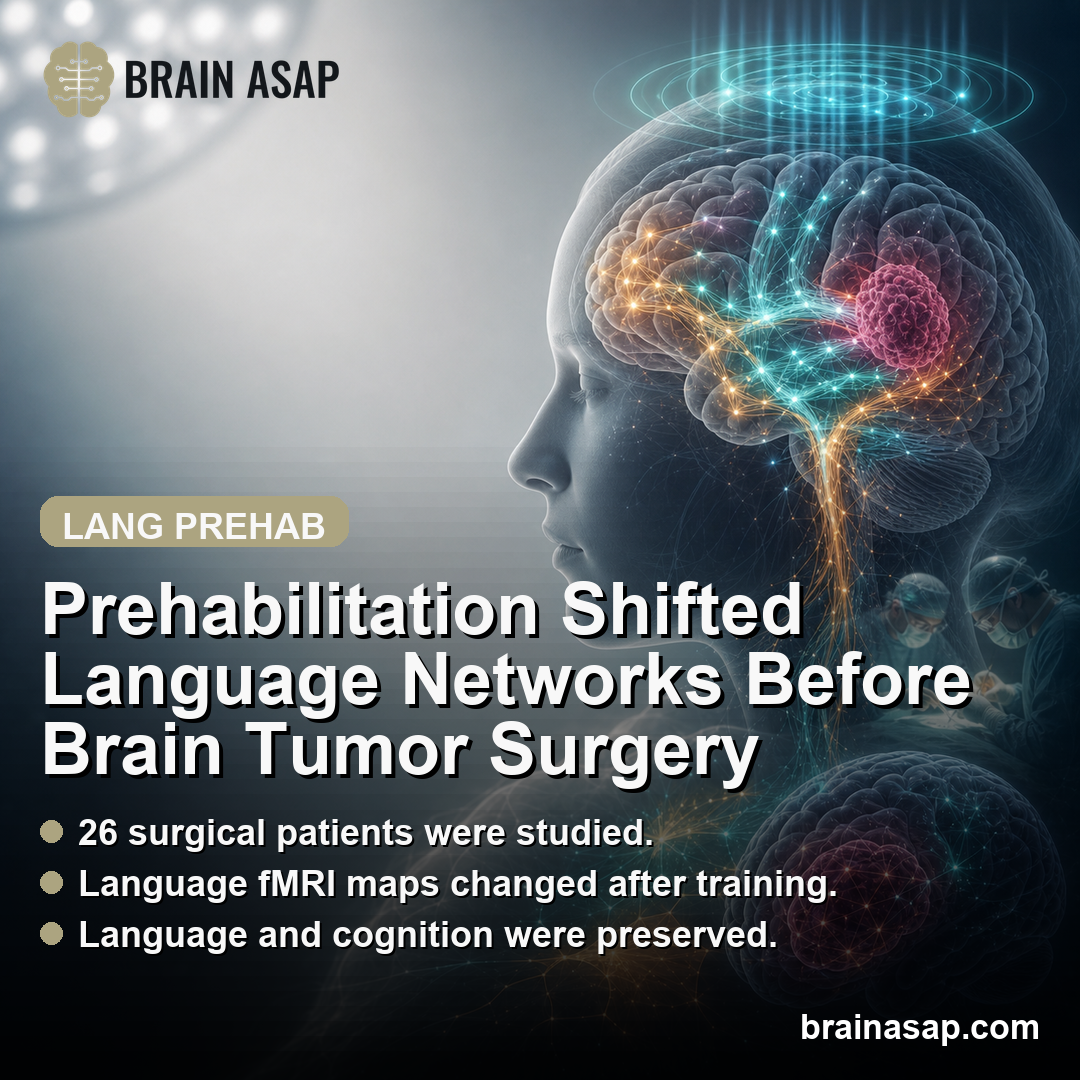
TL;DR: A 2026 preprint neurosurgery neuroplasticity study in medRxiv found that language-targeted prehabilitation selectively changed language-network topography, while language and cognitive performance were preserved after the intervention.
Key Findings
- Study type: a prehabilitation study using neuromodulation, language training, task-based functional MRI (fMRI), and neuropsychological testing.
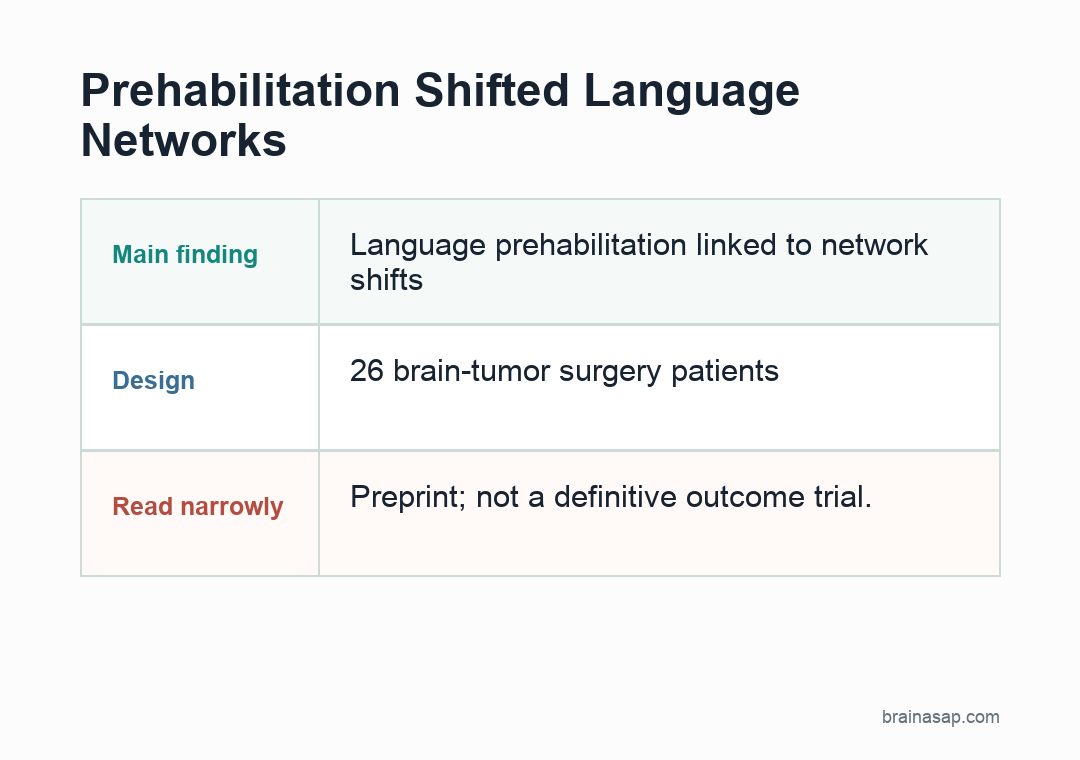
- People studied: 26 patients with operable brain tumors affecting language or motor regions.
- Main result: Language-targeted prehabilitation selectively changed language-network topography.
- Second result: Language and cognitive performance were preserved after the intervention.
- Caution: The sample was small and the design was not a definitive surgical-outcome trial.
Source: medRxiv (2026) | Brault-Boixader et al.
Brain tumors near language-critical regions create a surgical dilemma: remove as much tumor as possible while avoiding speech and language harm.
This preprint tested non-invasive neuromodulation-induced prehabilitation, combining stimulation and training to encourage adaptive brain network reorganization before surgery.
Core result: this is a surgical-planning signal: language-targeted prehabilitation selectively changed language-network topography while language and cognitive performance were preserved.
Brain Tumor Patients Received Network-Targeted Prehabilitation
Design: a prehabilitation study using neuromodulation, language training, task-based functional MRI (fMRI), and neuropsychological testing. People studied: 26 patients with operable brain tumors affecting language or motor regions.
The study combined neuromodulation, language training, fMRI mapping, and neuropsychological testing before brain tumor surgery. This keeps it a network-plasticity study, not a definitive outcomes trial.
- Language group: 11 patients received language-targeted prehabilitation.
- Control networks: Fourteen patients received non-language, mainly motor, targeting.
- Imaging: Task-based functional MRI mapped language activation.
- Behavior: Language and cognitive tests checked safety.
Language fMRI Maps Changed After Targeted Training
Main finding: language maps changed after targeted prehabilitation. Control networks did not show the same pattern, which supports a language-specific effect.
Preserved language and cognitive performance are central to the safety interpretation. Network movement would be much less persuasive if function clearly worsened.
The main comparison was between targeted language prehabilitation and stimulation aimed outside the language network. A broad practice effect would be less relevant for surgical planning than a selective shift in language-related activation.
- Targeted network: Language patients received a protocol aimed at language cortex rather than a general stimulation plan.
- Mapping test: Task-based fMRI checked whether the language map changed after the intervention.
- Behavior check: Neuropsychological testing checked whether language or cognition worsened while the map shifted.
- Clinical boundary: The study did not prove that surgeons could remove more tumor or prevent postoperative language deficits.
Measurement detail: Task fMRI can show functional-network topography, but it does not directly prove better resection margins, survival, or long-term cognitive protection.
Interpretation: Prehabilitation may shift language networks before neurosurgery. The surgical-outcome value still needs larger trials.
Next test: Larger studies need to test whether prehabilitation changes resection planning, postoperative language, and longer-term quality of life.
Interpretation: The language-specific comparison is the main comparison.
Language-targeted prehabilitation changed language-network topography while language and cognitive performance were preserved.
Language-network prehabilitation is the important term here: stimulation and training were aimed at moving function before surgery, not at treating the tumor directly.
The sample was small, and the design was not a definitive surgical-outcome trial.
Surgical context: Language mapping is central because tumor surgery often forces a tradeoff between resection extent and function. Prehabilitation is relevant only if network movement eventually translates into safer surgical planning.
Clinical interpretation: Preserved language testing keeps the mapping change from looking like a tradeoff where plasticity is bought at the cost of function.
Larger studies need to connect network movement with resection planning, postoperative language, and quality of life.
Until then, the study is best read as evidence that pre-surgical language maps may be modifiable in selected patients. It is not evidence that every tumor near language cortex should receive the same protocol.
Use the result as early evidence of targeted language-network plasticity.
It should not be treated as proof that prehabilitation already improves tumor surgery outcomes.
Motor Networks Did Not Show the Same Language-Targeted Effect
Task fMRI can show functional-network topography, but it does not directly prove better resection margins, survival, or long-term cognitive protection.
The restrained interpretation is that prehabilitation may shift language networks before neurosurgery. The surgical-outcome value still needs larger trials.
The finding is relevant in functional neurosurgery, where clinicians balance tumor access against language preservation.
In practical terms, this is a planning result first: it asks whether language networks can be nudged before surgery, not whether the approach has already changed survival or standard surgical care.
The practical distinction is between network movement and surgical benefit. A changed language fMRI map suggests the brain’s functional layout may be adjustable before surgery, but the outcome question is whether that adjustment gives the surgeon more room, protects language after resection, or improves recovery.
Preserved cognition belongs beside the mapping result for that reason. Network plasticity would be much less reassuring if language testing worsened after training.
The stronger future study would connect prehabilitation, surgical planning, postoperative language, and tumor-control outcomes in the same protocol.
Preserved Cognition Was Central to the Safety Claim
Main limitation: the sample was small and the design was not a definitive surgical-outcome trial. The sample was small, and the design was not built to prove definitive surgical benefit.
That limit should stay visible.
Prehabilitation May Expand Functional Neurosurgery Planning
Practical takeaway: prehabilitation may become part of functional neurosurgery planning if larger studies confirm it.
- Best use: Use the result as early evidence of targeted language-network plasticity.
- Do not overread: Do not claim the intervention has proven better tumor surgery outcomes.
- Next test: Test whether prehabilitation changes resection planning, postoperative language, and longer-term quality of life.
That keeps the result relevant for a general audience: a plausible planning tool, still early.
Citation: DOI: 10.64898/2026.04.13.26350473. Brault-Boixader et al. Non-invasive prehabilitation before neurosurgery modifies the topography of brain language networks without compromising function. medRxiv. 2026.
Study Design: A prehabilitation study using neuromodulation, language training, task-based functional MRI (fMRI), and neuropsychological testing.
Sample Size: 26 patients with operable brain tumors affecting language or motor regions.
Key Statistic: Language-targeted prehabilitation selectively changed language-network topography.
Caveat: Small preprint sample; the study was not a definitive surgical-outcome trial.