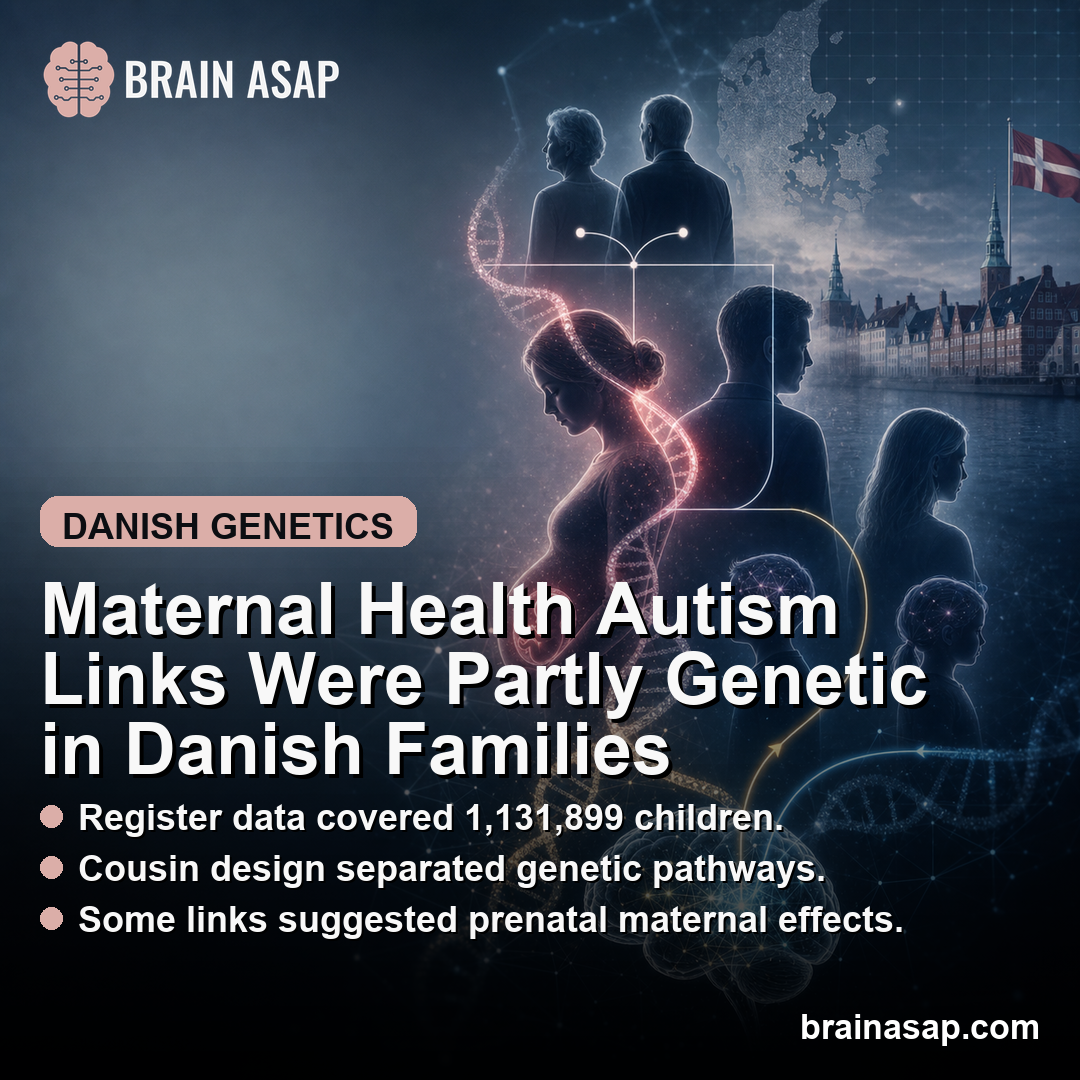
TL;DR: A 2026 preprint registry-family study in medRxiv found that some maternal diagnosis-autism associations fit shared direct genetic effects, while other diagnoses showed stronger parallel-cousin associations, suggesting indirect genetic effects through the prenatal environment.
Key Findings
- Study type: a three-generation Danish register study comparing full maternal parallel and cross cousin pairs.
- People studied: 1,131,899 children born in Denmark from 1998 to 2015.
- Main result: Some maternal diagnosis-autism associations fit shared direct genetic effects.
- Second result: Other diagnoses showed stronger parallel-cousin associations, suggesting indirect genetic effects through the prenatal environment.
- Caution: The design infers pathways from family structure and does not identify one biological mechanism.
Source: medRxiv (2026) | Arildskov et al.
Maternal health conditions are often linked to autism risk, but the reason for those links can be hard to separate. A diagnosis may reflect inherited liability, prenatal biology, family context, or clinical ascertainment.
The study used Danish national registers and a cousin design to separate direct genetic patterns from indirect maternal genetic pathways. The method is valuable because it asks what kind of family pattern each association follows.
Core result: mechanism separation: some maternal diagnosis-autism associations fit shared direct genetic effects, while other links suggested indirect prenatal pathways.
Danish Registers Linked Three Generations for Autism Risk
Design: a three-generation Danish register study comparing full maternal parallel and cross cousin pairs. People studied: 1,131,899 children born in Denmark from 1998 to 2015.
The Danish register design compared parallel and cross cousins across three generations. That family structure helps separate shared inherited liability from maternal pathways that may operate through pregnancy.
- Index diagnosis: The exposure was a diagnosis in the index child’s mother.
- Cousin autism: The outcome was autism diagnosis in cousins of the index child.
- Parallel cousins: Stronger links can suggest indirect maternal-genetic pathways.
- Cross cousins: Links in both cousin types can suggest shared direct genetics.
Parallel and Cross Cousins Separated Genetic Pathways
Main finding: some maternal health associations looked consistent with direct genetic effects shared by mothers and children. The reason is not every maternal diagnosis link should be read as a pregnancy exposure.
Other diagnoses showed stronger parallel-cousin associations, suggesting indirect genetic effects through the prenatal environment. The design therefore points to more than one pathway.
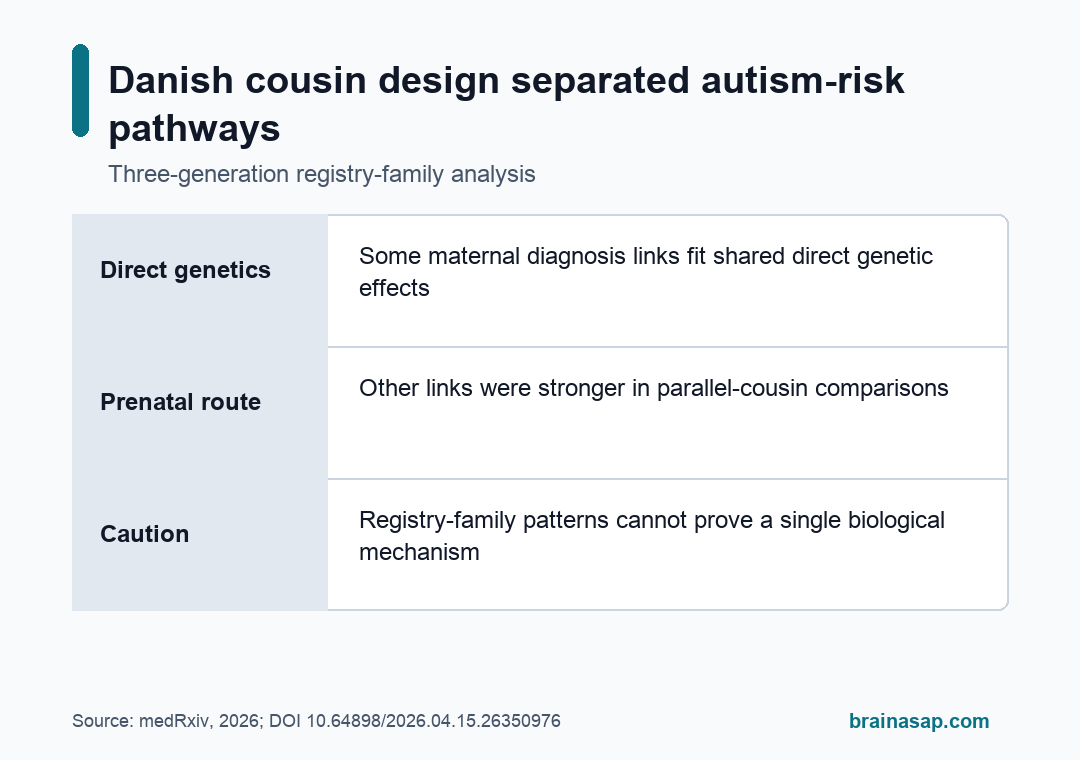
The register design can separate several familial pathways, but it estimates inherited and maternal effects rather than proving that any diagnosis directly caused autism.
- Population or model: 1,131,899 children born in Denmark from 1998 to 2015.
- Design: a three-generation Danish register study comparing full maternal parallel and cross cousin pairs.
- Primary anchor: Some maternal diagnosis-autism associations fit shared direct genetic effects.
- Second layer: Other diagnoses showed stronger parallel-cousin associations, suggesting indirect genetic effects through the prenatal environment.
- Boundary: The design infers pathways from family structure and does not identify one biological mechanism.
Measurement detail: Register data can reveal family-pattern logic at large scale. It cannot identify the exact biological mechanism behind each diagnosis association.
Follow-up: Pair register designs with biological measures that can test specific prenatal pathways. This would show whether the finding holds when the sample, method, or setting changes.
Interpretation: The cousin-design contrast is the central evidence.
Some maternal diagnosis links fit shared direct genetics, while other stronger parallel-cousin links point toward indirect prenatal pathways.
Terms like autism, maternal health, Danish registers get fuzzy when separated from the evidence. Here, they stay tied to the reported sample, the measurement strategy, and the specific outcome being described.
The design infers pathways from family structure.
It does not identify a specific biological mechanism, so genotype or prenatal biomarker studies are still needed.
Family-design context: Parallel cousins share the maternal line in a different way than cross cousins. Comparing those patterns helps separate shared inherited liability from pathways that operate through the prenatal environment.
Interpretation limit: The design can narrow the pathway class, but it cannot name the prenatal exposure, timing, tissue, or molecular process responsible for the association.
Use the parallel-versus-cross-cousin contrast to separate possible pathways.
The next step is pairing register designs with biological measures that can test prenatal mechanisms.
Some Maternal Diagnoses Fit Direct Genetic Autism Effects
Register data can reveal family-pattern logic at large scale. It cannot identify the exact biological mechanism behind each diagnosis association.
Best reading: maternal health-autism associations are not all the same kind of signal. Some may reflect shared genetics, while others may involve prenatal pathways.
The cousin design is the key contribution because it pressures simpler explanations that treat all maternal diagnoses as direct pregnancy effects.
Other Maternal Health Links Suggested Prenatal Pathways
Main limitation: the design infers pathways from family structure and does not identify one biological mechanism.
- No genotype data: The study inferred pathways from family relationships rather than measured DNA.
- Registry diagnoses: Coding may miss severity, timing, and subclinical symptoms.
- Autism heterogeneity: Different autism pathways may be mixed in one outcome category.
- Preprint status: The findings need peer review and replication.
The design infers pathways from family relationships and diagnoses. It does not measure fetal biology, placental function, or specific molecular mechanisms.
Maternal Health-Autism Studies Need Genetic Designs
Practical takeaway: autism-risk studies need genetic designs before interpreting maternal health links.
- Best use: Use the parallel-versus-cross-cousin contrast to separate possible pathways.
- Do not overread: Do not blame individual maternal diagnoses or infer a single prenatal mechanism.
- Next question: Pair register designs with biological measures that can test specific prenatal pathways.
This keeps the interpretation clearer and fairer: family patterns first, causal language later.
Citation: DOI: 10.64898/2026.04.15.26350976. Arildskov et al. Maternal health and autism risk: parsing direct and indirect genetic effects using 3-generation family linkage. medRxiv. 2026.
Study Design: A three-generation Danish register study comparing full maternal parallel and cross cousin pairs.
Sample Size: 1,131,899 children born in Denmark from 1998 to 2015.
Key Statistic: Some maternal diagnosis-autism associations fit shared direct genetic effects.
Caveat: Family-structure modeling can narrow pathway classes, but it does not identify one prenatal biological mechanism.