Nitric Oxide’s Hidden Link to Autism Behavior
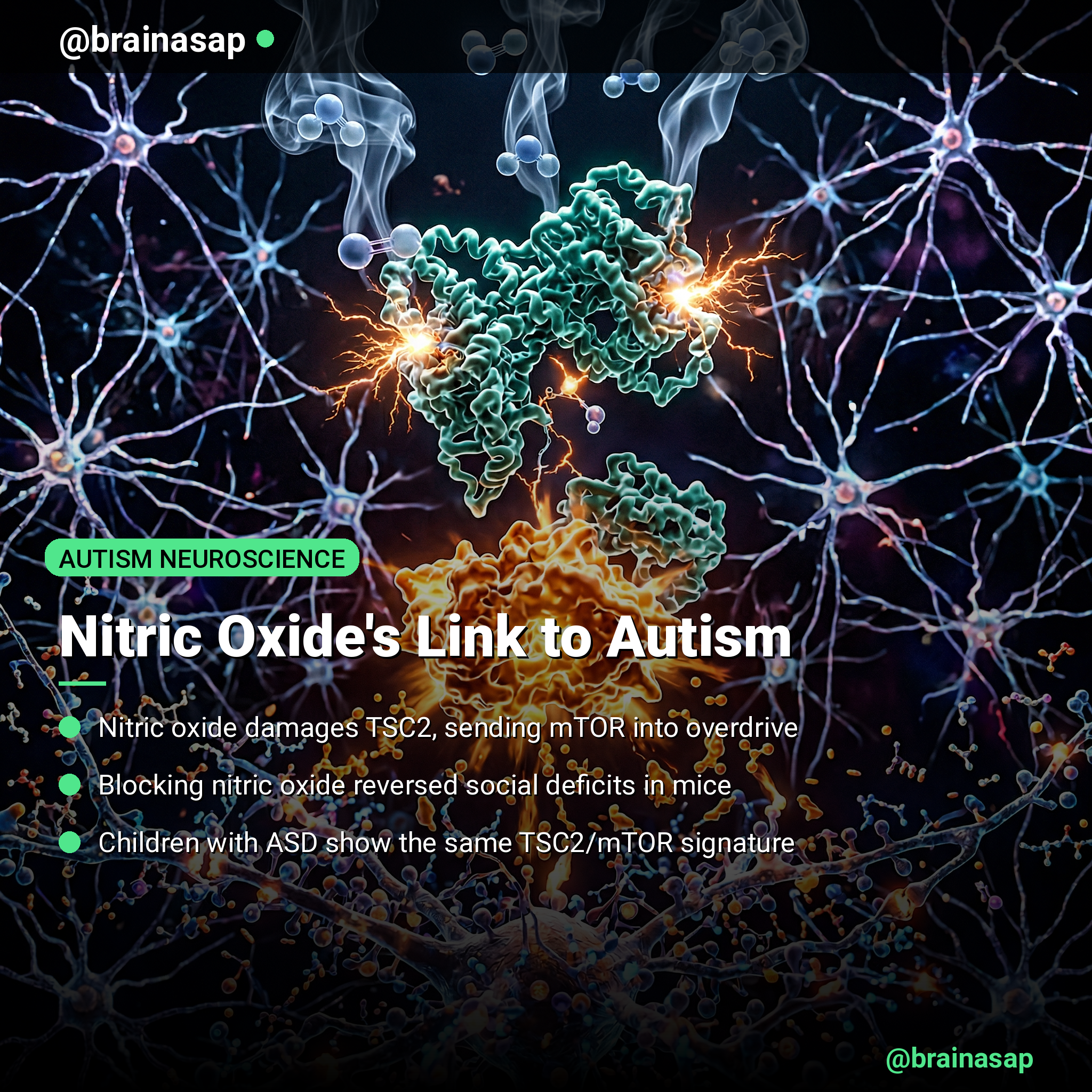
TL;DR: A chemical messenger called nitric oxide triggers protein damage that sends the mTOR pathway into overdrive in autism-related mouse models, driving social deficits and repetitive behaviors—and blocking this mechanism reverses both the molecular dysfunction and autistic-like behaviors.
Autism spectrum disorder involves dozens of genetic variants, yet many converge on a single pathway: mTOR, a master controller of cell growth and protein synthesis. Two of the most studied autism genes—Shank3 and Cntnap2—point directly to mTOR dysregulation. The question has always been: what pulls the trigger? A new study published in Molecular Psychiatry reveals a surprising culprit: nitric oxide-mediated chemical damage to a protein called TSC2, which normally acts as the mTOR pathway’s brake.
Key Findings
- TSC2 S-nitrosylation increases: In both Shank3 and Cntnap2 knockout mice, nitric oxide chemically modifies TSC2 through a process called S-nitrosylation, which occurs in inhibitory neurons and can be detected in autism patient blood samples.
- mTOR pathway overactivation: S-nitrosylated TSC2 loses its ability to suppress mTOR, leading to elevated phosphorylated mTOR (p-mTOR) and downstream signaling dysregulation in both mouse models compared to wild-type controls.
- nNOS inhibition rescues the phenotype: Blocking nitric oxide production with a selective nNOS inhibitor (7-NI) restored TSC2 stability, normalized p-mTOR levels, and prevented increased S-nitrosylation in both Shank3 and Cntnap2 mutants.
- Behavioral reversal in vivo: Mice treated with nNOS inhibitor showed reduced repetitive behavior and improved social interaction in three-chamber sociability tests and elevated plus maze tasks, reversing autism-like phenotypes.
- TSC2 mutation blocks S-nitrosylation: A engineered TSC2 variant resistant to S-nitrosylation (C203S) prevented nitric oxide-driven mTOR overactivation and reversed social and anxiety-like deficits in both knockout models when expressed in the prefrontal cortex.
- Human biomarker validation: Children with autism spectrum disorder showed decreased total TSC2 levels and increased p-mTOR/p-RPS6 ratios in blood plasma compared to typically developing controls, supporting the clinical relevance of the mouse model findings.
Source: Molecular Psychiatry (2026) | Ojha et al.
The mTOR Paradox in Autism
The mTOR protein sits at the intersection of growth, energy, and synaptic plasticity. It should be tightly regulated—overactive, it drives excessive protein synthesis and cell growth; underactive, it impairs learning and memory. In autism, particularly in individuals with Shank3 or Cntnap2 mutations, the pathway runs hot.
Both genes encode synaptic proteins critical for communication between neurons. Their loss leads to impaired social behavior, repetitive actions, and anxiety-like responses in mice. Yet why mTOR activation leads to these specific behavioral outcomes has remained unclear. The assumption had been that genetic disruption alone drives mTOR overactivity. This study suggests a different mechanism entirely.
Nitric Oxide as the Molecular Spark
Nitric oxide (NO) is a gaseous signaling molecule produced by neurons, endothelial cells, and immune cells. It regulates blood vessel function, neural transmission, and synaptic plasticity. But NO can also damage proteins through a reactive modification called S-nitrosylation, in which NO covalently attaches a chemical group to cysteine residues on target proteins.
The researchers hypothesized that dysregulated NO signaling might be driving TSC2 modification in autism models. They used a proteomics technique called SNOTRAP to identify S-nitrosylated proteins in the prefrontal cortex—a brain region implicated in social behavior—of Shank3 and Cntnap2 knockout mice. TSC2 stood out prominently.
In mutant mice, S-nitrosylated TSC2 levels were markedly elevated compared to wild-type controls. Treatment with a selective inhibitor of neuronal NO synthase (7-nitroindazole, or 7-NI) significantly reduced S-nitrosylation, restored TSC2protein levels, and normalized phosphorylated mTOR (p-mTOR) intensity in both models. The effect was specific: nNOS inhibition lowered aberrant NO-driven modifications without blocking all NO signaling.
From Protein Damage to Behavior
The behavioral experiments tested whether correcting the NO-TSC2-mTOR axis could rescue autism-like phenotypes. Shank3 and Cntnap2 knockout mice typically show reduced sociability, increased anxiety, and heightened repetitive behavior. When these mice received nNOS inhibitor treatment for 14 days, the results were striking.
In three-chamber sociability tests, nNOS-inhibited knockouts spent significantly more time interacting with unfamiliar mice compared to vehicle-treated counterparts. In elevated plus maze tasks, they spent more time in the open arms—a sign of reduced anxiety. Open field exploration also improved. The data suggest that blocking nitric oxide-driven TSC2 damage reverses core ASD-related behavioral deficits.
To solidify the TSC2-specific mechanism, the researchers engineered a mutant TSC2 protein (C203S) that cannot be S-nitrosylated at the critical cysteine residue. When this mutation was expressed in the prefrontal cortex of Shank3 and Cntnap2 knockouts via viral delivery, it reproduced the benefits of nNOS inhibition: normalized mTOR signaling, restored social interaction, and reduced anxiety-like behavior.
[Insert image: pathway diagram showing nitric oxide → TSC2 S-nitrosylation → mTOR overactivation → autism behaviors]
A Bridge to Human Autism
Findings in mice only matter if they point toward human biology. The researchers analyzed blood plasma from children with autism spectrum disorder and age-matched typically developing controls. ASD samples showed significantly decreased total TSC2 and increased p-mTOR and p-RPS6 (downstream mTOR targets) compared to controls.
Critically, they also measured TSC2 levels in children with ASD who carried SHANK3 mutations—the genetic subtype they studied in mice. This subgroup exhibited the most pronounced TSC2 reduction and mTOR pathway elevation, validating the translational relevance. The findings suggest that nitric oxide-mediated TSC2 damage may not be limited to genetic mutants but could represent a broader dysregulation affecting multiple autism presentations.
Implications and Limitations
The work opens a therapeutic avenue: NO-mediated redox signaling disruption might be targetable across different autism-related mutations that all converge on mTOR. Selective nNOS inhibitors already exist, and the specificity of neuronal NO synthase (compared to endothelial NOS) suggests potential to minimize systemic side effects.
The study focused on two genetic models and male mice, which is typical for initial mechanistic work but leaves open questions about female-specific effects and generalizability to other autism-associated genes. The TSC2 biomarker findings in plasma are promising, though the sample size was limited and would benefit from larger, stratified validation. The behavioral improvements were robust, but the translation to clinical outcome measures (e.g., standardized autism rating scales) remains to be tested in any potential human trial.
What This Means for Autism Research
This study exemplifies a shift in autism neurobiology: moving from identifying genes to mapping the biochemical events that link genetic disruption to circuit dysfunction and behavior. The nitric oxide-TSC2-mTOR axis is now a defined molecular target, with a reversible mechanism and both preclinical and preliminary human validation.
For families and clinicians, the immediate takeaway is that better understanding of these mechanisms can accelerate drug discovery. For researchers, the finding that S-nitrosylation is dysregulated in autism models raises the question: are other redox-sensitive proteins affected, and could targeting this broader network yield more robust therapeutic effects?
The study also suggests that biomarkers based on TSC2 and mTOR signaling status might help stratify autism populations and predict who would benefit most from mTOR-pathway-targeting interventions. If validated in larger cohorts, such markers could make precision medicine approaches to autism more tractable.
Citation: Ojha SK, Kartawy M, Hamoudi W, Tripathi MK, Aran A, Amal H. Nitric oxide-mediated S-nitrosylation of TSC2 drives mTOR dysregulation across Shank3 and Cntnap2 models of autism spectrum disorder. Molecular Psychiatry. 2026. DOI: 10.1038/s41380-026-03514-6
Authors’ affiliations: Institute for Drug Research, School of Pharmacy, Faculty of Medicine, Hebrew University of Jerusalem, Israel; Department of Pediatrics and Translational Neuroscience Center, Boston Children’s Hospital, Harvard Medical School, Boston, Massachusetts, USA.