How Ketamine Rewires Receptors to Beat Depression
TL;DR: Using PET imaging to directly visualize AMPA receptors in the living human brain, researchers discovered that ketamine’s rapid antidepressant effect works by reshuffling these receptors across specific brain regions in patients with treatment-resistant depression — and where they go predicts who will respond to the drug.
Nearly one in three people with depression fail to respond to standard antidepressants. For them, ketamine offers something unprecedented: symptom relief in hours or days instead of weeks. Yet neuroscientists have been unable to directly observe how ketamine achieves this feat in human brains. A landmark study published in February 2026 changed that, revealing the molecular choreography behind ketamine’s rapid rescue of treatment-resistant depression.
Key Findings
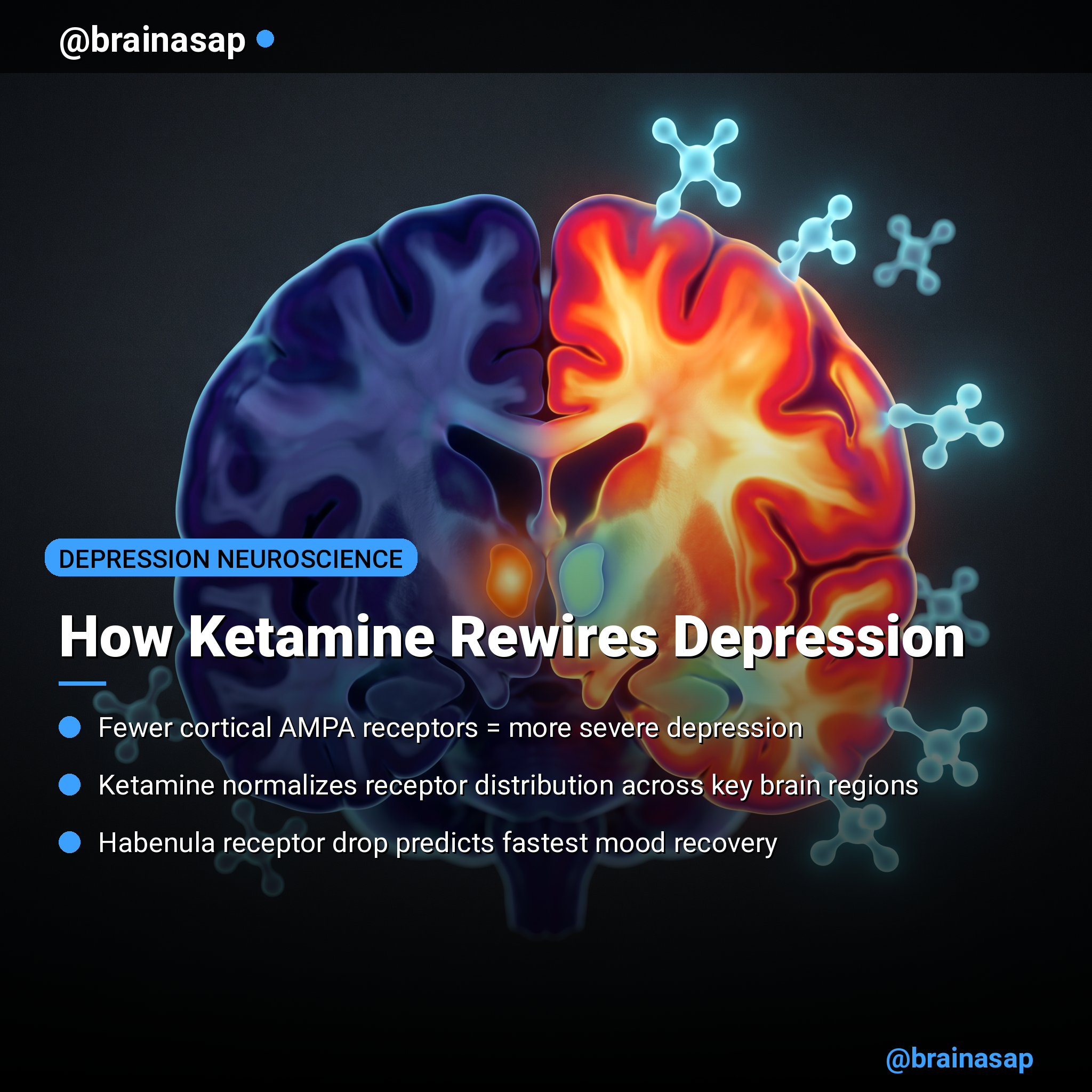
- AMPA receptor density drops with illness severity: In treatment-resistant depression patients, lower levels of AMPA receptors on brain cell surfaces correlated strongly with symptom severity, particularly in frontal, temporal, parietal, and occipital regions (correlation coefficient = -0.4856).
- TRD shows distinct receptor abnormalities: Compared to healthy controls, treatment-resistant patients exhibited reduced AMPA receptor density in the anterior insula, cingulate cortex, and frontal-parietal regions, but elevated density in the cerebellum, thalamus, and basal ganglia.
- Ketamine increases receptors where they’re needed: In 15 treatment-resistant patients receiving ketamine, increases in AMPA receptor density in the parietal lobe, occipital lobe, and middle cingulate cortex correlated with symptom improvement (correlation coefficient = 0.7536).
- Habenula reduction drives antidepressant effect: A key finding unique to ketamine: decreased AMPA receptor density in the habenula (a reward-processing region) showed the strongest correlation with rapid mood improvement, matching animal studies of ketamine’s mechanism.
- Baseline receptor distribution predicts response: Pre-treatment AMPA receptor levels in the frontal, temporal, parietal, and occipital lobes predicted which patients would respond to ketamine, offering a potential biomarker for treatment selection (correlation coefficient = 0.6361).
- Placebo produced no AMPAR changes: The same correlation between receptor density shifts and symptom improvement was completely absent in the placebo group, confirming the effect was specific to ketamine’s biological action.
Source: Molecular Psychiatry (2026) | Nakajima et al.
The Imaging Breakthrough That Made This Possible
For two decades, researchers knew that AMPA receptors — protein gatekeepers that let signals jump between neurons — had to be involved in ketamine’s antidepressant action. Animal studies repeatedly showed that blocking these receptors prevented ketamine from working. But nobody could see this happening in living human brains.
The obstacle was technical: existing brain imaging tools couldn’t specifically visualize AMPA receptors. They could map blood flow, glucose metabolism, electrical activity — but not the precise location and density of a single receptor type. That changed when Takuya Takahashi’s team developed [11C]K-2, a PET tracer that lights up AMPA receptors with remarkable specificity.
The tracer works by binding to all four subtypes of AMPA receptors, including the calcium-permeable variants that carry particular weight in depression and reward circuits. Once injected, it concentrates on the cell surface where receptors actually do their work, then images quiet enough that researchers could map regional differences with millimeter precision.
What Treatment-Resistant Depression Looks Like at the Receptor Level
The researchers imaged 34 people with treatment-resistant depression and 49 healthy controls. The pattern that emerged was striking. People struggling with depression had fewer AMPA receptors in broad expanses of cortex — the thinking regions spanning frontal, parietal, temporal, and visual areas. But paradoxically, they had more receptors in deep reward circuits like the cerebellum, basal ganglia, and thalamus.
This wasn’t incidental variation. The loss of receptors in cortical regions correlated directly with symptom severity: the fewer receptors someone had in their frontal lobe, the more depressed they were. Importantly, these abnormalities appeared unique to treatment-resistant depression; previous work on patients who respond well to standard antidepressants showed no such differences from healthy people.
The specificity suggested something crucial: this receptor abnormality isn’t just “being depressed” — it’s the signature of a brain that has learned to resist conventional treatment.
How Ketamine Rewires the System
Participants then received four intravenous ketamine infusions over two weeks (0.5 mg/kg each), while a control group received saline placebo. PET scans taken 3.2 days after the final dose revealed where ketamine had reshaped receptor distribution.
In responders, ketamine systematically normalized the receptor landscape. Where cortical regions had too few AMPA receptors, ketamine increased them. Changes in the parietal lobe, occipital lobe, and middle cingulate cortex showed the strongest correlation with symptom improvement — the more receptors ketamine inserted into these regions, the more depression lifted.
The effect was regionally specific and directional, like a molecular therapist targeting the exact circuits that had gone wrong. Even more striking: in reward-related areas like the habenula, ketamine did the opposite — it decreased receptor density — and that decrease predicted benefit.
The habenula finding deserves emphasis. This small brain region acts as an anti-reward center, firing strongly when expectations are violated or pain looms. In depression, habenula neurons become overactive, driving anhedonia and hopelessness. Animal studies showed ketamine silences this hyperactivity by reducing AMPA receptors there. The PET data confirmed the same thing happens in humans.
[Insert image: PET brain scans showing AMPA receptor density in treatment-resistant depression (reduced cortical, elevated reward circuits) and after ketamine (reversed pattern)]
Predicting Who Will Respond Before Treatment Starts
A striking finding emerged: pre-treatment AMPA receptor distribution predicted who would benefit from ketamine. People with certain baseline receptor patterns in frontal, parietal, and occipital regions — patterns that differed measurably from their healthy peers — showed the strongest treatment response.
This opens a clinical door. If researchers can validate [11C]K-2 imaging in larger cohorts, a single PET scan before ketamine infusion might predict treatment success with reasonable accuracy. That could spare patients unsuitable for ketamine from multiple infusions while fast-tracking those likely to respond.
Such a biomarker would be transformative. Ketamine’s drawbacks are real: dissociative side effects, addiction potential with repeated use, and the need for expensive IV administration in medical settings. Knowing in advance who will benefit could reshape depression care, especially for the millions trapped in the treatment-resistant category.
Why This Bridge Between Animal and Human Science Matters
For two decades, the habenula story in depression existed almost entirely in rodent models. Ketamine silences habenula burst-firing in depressed mice; that silence depends on AMPA receptor reduction. The circuit made sense theoretically, but the human relevance remained speculative.
This study proves the mechanism translates. In humans with actual treatment-resistant depression, ketamine reduced habenula AMPA receptors, and that reduction predicted rapid symptom relief — the same causal link seen in animals. That congruence across species is rare and valuable. It suggests ketamine’s antidepressant action isn’t some quirk of rodent neurobiology but taps into something fundamental about how human reward circuits contribute to depression.
The same pattern held for visual cortex changes. Depression often comes with perceptual deadening — colors fade, the world feels flat. Ketamine restored AMPA receptor density in visual processing regions, and that restoration correlated with symptom improvement. Functional brain imaging had hinted at this before; PET receptor imaging made the molecular story explicit.
The Limits and Next Steps
The study enrolled 34 people with treatment-resistant depression, a modest sample for imaging research. The findings were robust — the correlation patterns held even after controlling for age, sex, illness duration, and medication history — but larger, more diverse cohorts across multiple ethnic and geographic populations would strengthen confidence in the results.
All participants were Japanese, which may limit generalizability. Replication in other populations matters for any biomarker intended to guide clinical practice. Additionally, the depression severity in the study remained in a moderate range; future work should test whether AMPAR dynamics shift similarly in profoundly treatment-resistant or acute suicidal crises.
The researchers acknowledge that this study was powered for clinical outcomes, not imaging analysis, so subtle regional effects may have been missed. Dedicated imaging studies with larger N could reveal finer structure in how ketamine reshapes receptor landscapes across the brain.
What This Means for Depression Treatment
One of depression’s cruelties is its resistance to prediction. Doctors prescribe antidepressants and wait weeks to see if they work. For a third of patients, they never do. Ketamine disrupted that waiting game — it works fast — but was still mystery. Why ketamine? Why does it work in some but not others? How long does the effect last?
This research supplies molecular answers. It shows that AMPA receptor dynamics — the trafficking and density of these pivotal synaptic proteins — underlie ketamine’s antidepressant power. It illuminates a circuit-level explanation for why reward-processing regions matter in depression and why visual perception can be a casualty of depressive illness.
Most importantly, it offers a roadmap for improvement. If ketamine works by normalizing AMPA receptor distribution, then drugs that mimic that effect without ketamine’s side effects could be designed. And if [11C]K-2 imaging becomes clinically available, it could guide treatment selection, potentially allowing doctors to predict who will benefit before infusions begin.
For the 30% of depressed people trapped in the treatment-resistant category, that convergence — better understanding plus better tools for matching patients to treatments — could be transformative.
Citation: Nakajima W, Hatano M, Ohtani Y, et al. The dynamics of AMPA receptors underlies the efficacy of ketamine in treatment resistant patients with depression. Molecular Psychiatry. 2026;Published online 5 March 2026. DOI: 10.1038/s41380-026-03510-w
Authors’ affiliations: Department of Physiology, Yokohama City University Graduate School of Medicine; Department of Neuropsychiatry, Keio University School of Medicine; National Institute for Physiological Sciences; Division of Neural Dynamics, Department of System Neuroscience; Radioisotope Research Center; Department of Psychiatry and Behavioral Health, Stony Brook University; Department of Anesthesiology, Keio University School of Medicine; Department of Radiology, Keio University School of Medicine; Department of Health Policy and Management, Keio University School of Medicine; The International Research Center for Neurointelligence, University of Tokyo.