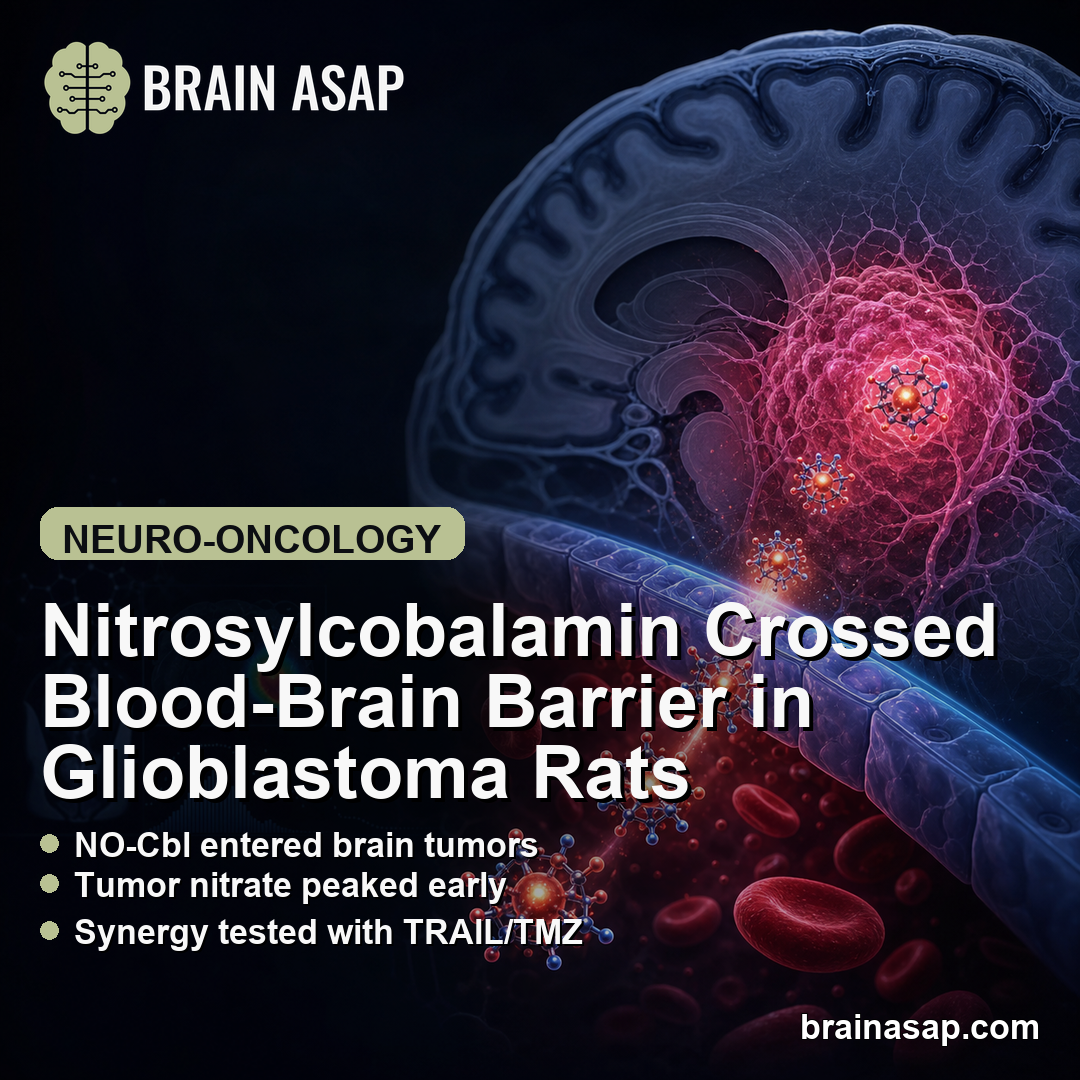
TL;DR: A 2026 study in Oncoscience reported that nitrosylcobalamin, a nitric-oxide-releasing vitamin B12 analog, crossed the blood-brain barrier in glioblastoma-bearing rats and accumulated in tumor tissue.
Key Findings
- NO-Cbl defined: Nitrosylcobalamin is a cobalamin-based nitric oxide donor designed to exploit the transcobalamin II receptor CD320.
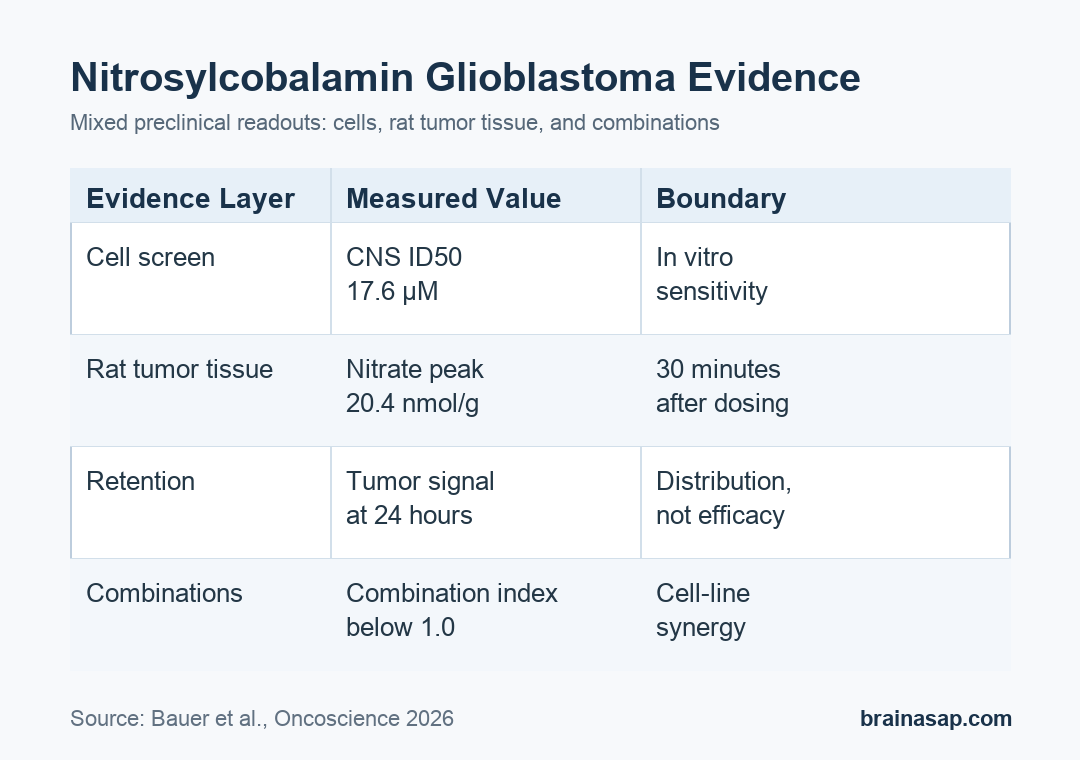
- 17.6 µM ID50: Central nervous system tumor cell lines in the NCI-60 panel showed intermediate sensitivity to NO-Cbl.
- 20.4 nmol/g tumor nitrate: Glioblastoma-bearing rats showed peak tumor nitrate levels 30 minutes after NO-Cbl dosing.
- 24-hour retention: Tumor nitrate remained elevated at 24 hours while some normal-tissue levels declined more quickly.
- Combination index < 1.0: NO-Cbl showed synergy with TRAIL and temozolomide in human glioma cell-line assays.
Source: Oncoscience (2026) | Bauer et al.
Nitrosylcobalamin (NO-Cbl) is a modified vitamin B12 compound that releases nitric oxide. The rationale is that some tumor cells overuse cobalamin transport pathways, giving a B12-like drug a possible route into cancer tissue.
In glioblastoma, that delivery problem is especially important because the blood-brain barrier blocks many anticancer agents from reaching tumor tissue at useful concentrations.
NO-Cbl Targeted a Brain-Tumor Delivery Problem
Glioblastoma remains difficult to treat partly because tumor cells infiltrate brain tissue and resist standard therapy. The paper notes that median survival often remains under 15 months despite surgery, radiation, and temozolomide.
The study tested whether NO-Cbl could combine 2 properties that matter for glioblastoma drug development: blood-brain barrier penetration and tumor-selective nitric oxide delivery.
- Drug concept: NO-Cbl uses a cobalamin scaffold and releases nitric oxide.
- Transport target: The proposed uptake route involves transcobalamin II receptor CD320.
- Therapy context: The experiments tested standalone activity plus combinations with TRAIL and temozolomide.
TRAIL stands for tumor necrosis factor-related apoptosis-inducing ligand, a pro-apoptotic signaling approach. Temozolomide is the standard alkylating chemotherapy used in many glioblastoma treatment regimens.
NCI-60 Screening Put CNS Tumor Sensitivity in the Midrange
The first screen used the NCI-60 tumor panel, a broad set of human cancer cell lines. NO-Cbl showed antiproliferative activity across multiple tumor types.
Central nervous system tumor cell lines were not the most sensitive group, but they were not resistant outliers. The paper reported a mean ID50 of 17.6 µM for CNS tumor cell lines.
- NCI-60 screen: Broad tumor-panel testing established baseline antiproliferative activity.
- CNS response: Brain-tumor cell lines showed intermediate sensitivity rather than absent response.
- Next step: The study then tested whether the compound could reach brain tumor tissue in animals.
The screening result alone would not be enough for a glioblastoma claim. Many compounds inhibit cells in a dish but fail when the blood-brain barrier and tumor distribution are tested in vivo.
That sequence made the rat biodistribution experiment the key translational bridge.
Tumor Nitrate Peaked at 20.4 nmol/g After Systemic Dosing
The animal pharmacokinetic experiment was the main brain-delivery result. In glioblastoma-bearing rats, NO-Cbl crossed the blood-brain barrier after systemic administration.
Tumor nitrate levels peaked at 20.4 nmol/g 30 minutes after dosing and remained elevated at 24 hours. Those measurements supported selective tumor accumulation and sustained nitric oxide-related exposure inside tumor tissue.
- Administration route: The pharmacokinetic study used intraperitoneal NO-Cbl dosing.
- Measured readouts: Researchers quantified nitrate and cobalamin-related measures in tissues, serum, and cerebrospinal fluid.
- Clearance contrast: Serum nitrate showed a shorter half-life of about 4-5 hours, while B12-related measures cleared more slowly.
The paper also reported serum and cerebrospinal-fluid B12 clearance estimates of about 21-26 hours and 11-12 hours, respectively. Those values fit a slower cobalamin-distribution profile than nitrate alone.
The tumor-versus-systemic distinction is the pharmacology point. A compound can cross the blood-brain barrier yet still fail as a therapy if it disappears quickly, distributes mostly to normal organs, or cannot maintain tumor exposure long enough to affect cancer-cell survival.
NO-Cbl Synergized With TRAIL and Temozolomide in Glioma Cells
The combination experiments used human U87 and D54 glioma cell lines. Researchers assessed antiproliferative effects with SRB assays and Chou-Talalay combination analysis.
Combination index values below 1.0 indicated synergy with TRAIL and temozolomide. The paper frames this as a possible way to increase treatment sensitivity in glioblastoma models.
- TRAIL combination: NO-Cbl may prime apoptosis-related signaling.
- Temozolomide combination: The compound also improved antiproliferative effects with the standard chemotherapy context.
- Resistance angle: D54 cells were described as temozolomide-resistant, making that model relevant but still preclinical.
The synergy result should not be read as a clinical response result. It came from cell-line assays, not a randomized animal survival study or human trial.
Pilot Rat and Cell-Line Data Limit the Glioblastoma Claim
The paper itself describes the work as a pilot investigation that prioritized distribution and translational feasibility over mechanistic depth. The claim should stay limited to early delivery and combination evidence.
The study used well-characterized glioblastoma cell lines and glioblastoma-bearing rats, but it did not establish survival benefit, optimal dosing, long-term toxicity, or efficacy in orthotopic models with full clinical treatment schedules.
- Preclinical stage: The evidence comes from cell lines and animal biodistribution experiments.
- Mechanistic depth: Future work needs apoptosis, NF-kappaB, protein nitrosylation, and resistance endpoints.
- Translation gap: Blood-brain barrier penetration is necessary for glioblastoma therapy, but it is not sufficient by itself.
The specific conclusion is that NO-Cbl reached glioblastoma tissue in a rat model and showed combination activity in glioma cells, making it a plausible candidate for deeper preclinical testing.
Citation: DOI: 10.18632/oncoscience.654. Bauer et al. Selective blood-brain barrier penetration and tumor targeting of nitrosylcobalamin in glioblastoma: Pharmacokinetics, tissue distribution, and synergistic activity with TRAIL and temozolomide. Oncoscience. 2026;13:120-129.
Study Design: Preclinical glioblastoma study using tumor-panel screening, rat pharmacokinetics and biodistribution, and human glioma cell-line combination assays.
Sample/Model: NCI-60 tumor panel, glioblastoma-bearing rats, and human U87 and D54 glioma cell lines.
Key Statistic: Tumor nitrate peaked at 20.4 nmol/g 30 minutes after dosing, and CNS tumor cell lines had mean ID50 of 17.6 µM.
Caveat: The study did not test clinical survival benefit, long-term safety, or optimized dosing in patients with glioblastoma.