TL;DR: A 2026 randomized trial in Molecular Autism found that a culturally adapted parent-implemented social communication program was linked to language, social-functioning, parent self-efficacy, and stress gains in Chinese-speaking autistic preschoolers, with no consistent advantage for therapist-led online groups over self-study across most outcomes.
Key Findings
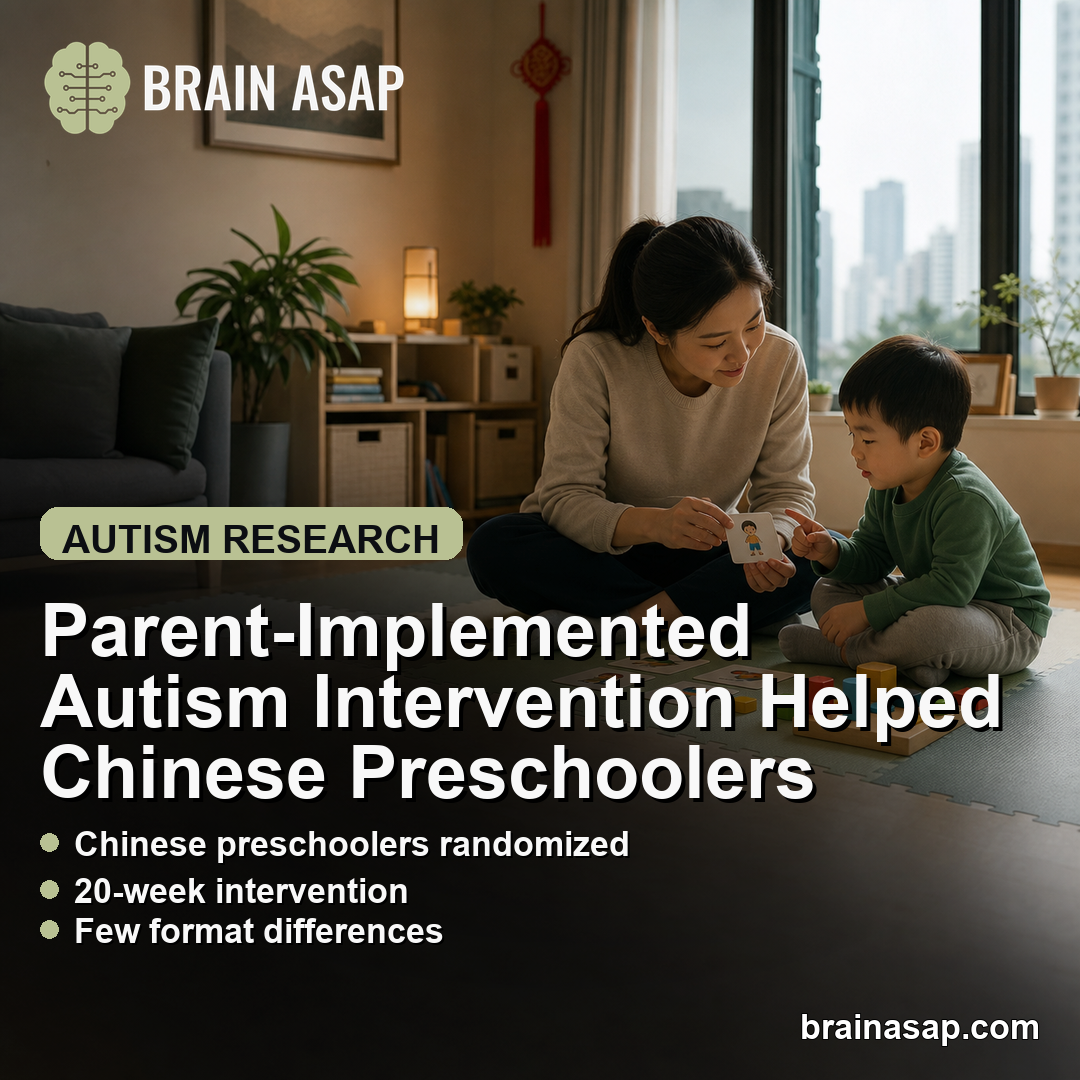
- Chinese preschoolers randomized: 112 autistic children aged 24-60 months were assigned to SLT-led online groups or a self-study format.
- 20-week intervention: Both formats taught the same parent-implemented social communication strategies over about 20 weeks.
- Few format differences: No consistent differences between delivery formats appeared across most measured child and parent outcomes.
- Language gains in both formats: Expressive and receptive language improved over time, along with parental self-efficacy and stress.
- Higher self-study dropout: Dropout was higher in the self-study group (OR 3.31; p=0.003), suggesting engagement support matters for lower-intensity delivery.
Source: Molecular Autism (2026) | Wang et al.
Parent-implemented interventions (PIIs) teach caregivers to support communication and social engagement during daily routines. This trial tested whether the same culturally adapted program worked differently when delivered by speech-language therapist (SLT)-led online groups or through a flexible self-study format.
The children were autistic preschoolers in China with limited spontaneous expressive language. The study is useful because autism services are unevenly distributed, and scalable parent-training formats may help families who cannot easily access specialist care.
112 Autistic Preschoolers Entered a 20-Week Parent-Led Program
Researchers recruited children aged 24 to 60 months who had a clinical autism diagnosis or high likelihood of autism, met Autism Diagnostic Observation Schedule, Second Edition (ADOS-2) autism-spectrum criteria, and had limited spontaneous expressive language.
The final randomized sample included 112 families, with 56 assigned to SLT-led online groups and 56 assigned to self-study. Both groups received the same core intervention content.
- SLT-led format: Parents joined online groups, completed 20 lessons, and submitted weekly parent-child videos for therapist feedback.
- Self-study format: Families received the same learning materials about every 2 weeks without therapist support or video-submission requirements.
- Strategy set: The program taught 7 social communication strategies, including pausing and observing, imitation, comments, communication temptations, turn taking, expansion, and recasting.
- Follow-up schedule: Children and parents were assessed at baseline, after intervention, and 12 months after baseline.
The adaptation was not just a translation. The program used structured examples and explicit play routines because many Chinese parents are less familiar with play-based developmental intervention styles.
Therapist-Led Groups Did Not Clearly Beat Self-Study Across Most Outcomes
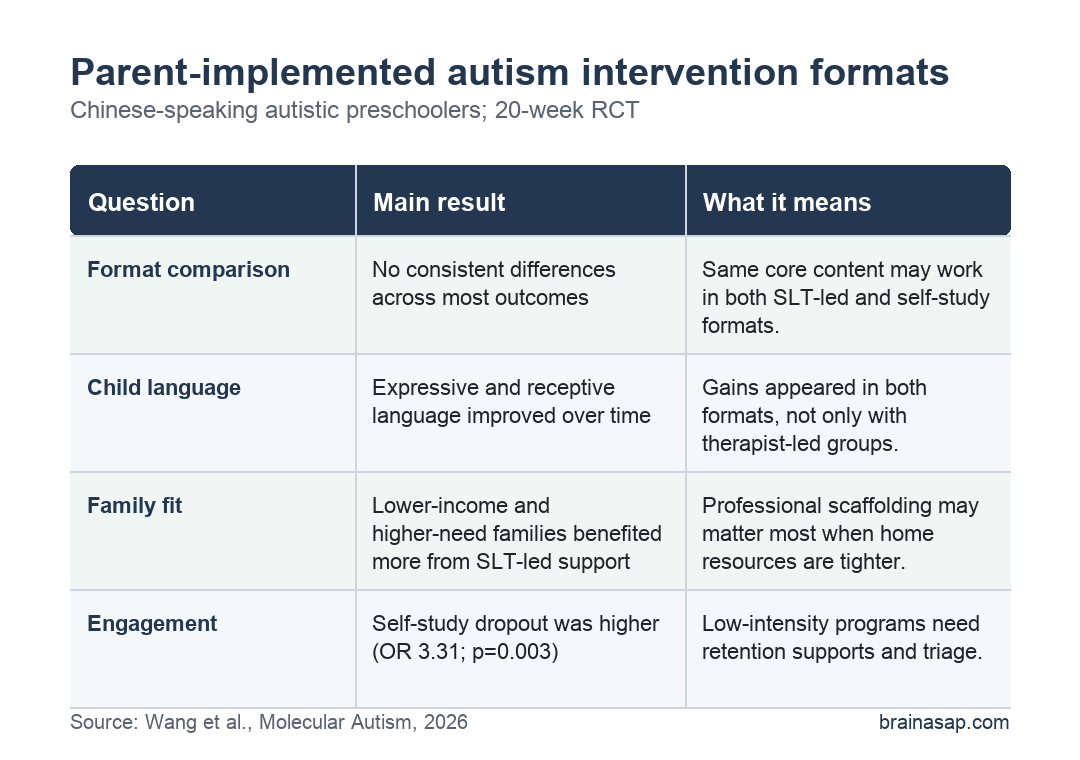
Across most outcomes, the trial found no consistent between-format differences. Neither delivery format clearly dominated the other.
Only one significant format-by-time interaction appeared, on the Social Communication Scale (SCS), but post-hoc contrasts were not statistically significant at individual time points. Sensitivity analyses also did not support treating the SCS result as a firm format advantage.
For service design, a well-structured self-study format can be enough for some families when the content is clear, culturally adapted, and usable at home.
Therapist support still appeared useful for some families. The individual-response and dropout analyses suggested that some families benefited more from professional scaffolding.
Language, Parent Self-Efficacy, and Stress Improved Over Time
When the researchers looked at change over time, both formats showed gains in several child and parent outcomes. Expressive and receptive language measures improved, and parent stress decreased while self-efficacy increased.
The language findings were supported across multiple measures. Mean length of utterance (MLU), Mullen Scales of Early Learning (MSEL) expressive language, and Vineland Adaptive Behavior Scales, Third Edition (VABS-3) expressive and receptive language scores all showed improvement patterns.
- Expressive language: MSEL expressive language improved from baseline to 12 months in both formats.
- Communication samples: MLU improved in both formats from baseline to post-intervention and remained improved at 12 months.
- Adaptive language: VABS-3 expressive and receptive scores improved in both formats.
- Parent outcomes: Parental Stress Scale scores fell and parenting self-efficacy increased in both formats.
Overall autism severity did not significantly change on the ADOS-2 calibrated severity score. Broad autism severity is usually less sensitive to short behavioral interventions than language, social-affect, or parent-level outcomes.
Lower-Income and Higher-Need Families Appeared to Benefit More From SLT Support
The trial also used exploratory machine-learning analyses to estimate which families benefited more from each delivery format. These findings should be treated as hypothesis-generating, not definitive clinical rules.
Household income was the most consistent family-level predictor. Lower-income families, using the paper’s cutoff of 25,500 RMB per month, tended to show greater benefit from the SLT-led format across social-affect, expressive-language, and receptive-language outcomes.
Children with greater developmental needs also often appeared to benefit more from SLT support. That included children with weaker baseline socialization or expressive-language skills.
- Lower-income families: SLT-led support may have helped offset fewer home resources or less familiarity with intervention methods.
- Greater developmental needs: Therapist feedback may have helped parents adjust strategies for children with weaker social or language skills.
- Stronger baseline capacity: Families with stronger child skills and more resources often showed comparable or greater gains with self-study.
A stepped-care service model would fit these results. Some families may start with self-study materials, while families with higher support needs may need therapist-led coaching earlier.
Self-Study Had Higher Dropout, Especially When Child and Parent Readiness Was Lower
Engagement was a major difference between formats. Dropout was higher in the self-study group, with an odds ratio of 3.31 and p=0.003.
Predictors of dropout differed by format. In the SLT-led group, higher overall autism symptom severity predicted dropout.
In the self-study group, dropout was linked to higher ADOS-2 Social Affect scores, lower VABS-3 receptive language, lower parent use of engagement-promoting strategies, and lower Broad Autism Phenotype scores.
The dropout predictors point to a practical screening problem. Families assigned to low-intensity self-study may need early check-ins when the child has lower receptive language or when parents start with fewer engagement strategies.
Small Format Differences and Exploratory Subgroups Limit the Autism Trial
The trial was one of the larger parent-implemented intervention studies in China, but it still had limits. The sample was better powered for within-format change than for small between-format differences.
The individualized analyses also used a modest sample for machine-learning estimation. Cross-validation and sensitivity checks helped, but the subgroup patterns still need replication in larger trials.
- Two formats only: The study compared SLT-led online groups with self-study, not individual coaching, classroom delivery, or stepped-care sequences.
- Self-study fidelity: Researchers could not directly observe how consistently self-study families used the strategies at home.
- Assessment context: Video-based social communication measures may have been influenced by families’ comfort with recording interactions.
- Masking limits: Assessors were masked to format assignment but not to time point for in-person assessments.
For families and service planners, the trial supports flexibility rather than a single default format. Parent-led autism programs may work through shared core content, but the amount of therapist scaffolding should match child needs, family resources, and dropout risk.
Citation: DOI: 10.1186/s13229-026-00725-0. Wang et al. Who benefits most? A randomized controlled trial for Parent-implemented social communication intervention for Chinese-speaking autistic preschoolers. Molecular Autism. 2026;17:29.
Study Design: Randomized controlled trial comparing SLT-led online groups with a self-study format for a culturally adapted parent-implemented social communication program.
Sample Size: 112 Chinese-speaking autistic preschoolers aged 24-60 months and their participating parents.
Key Statistic: No consistent between-format differences were found across most outcomes, while self-study dropout was higher (OR 3.31; p=0.003).
Caveat: Subgroup findings from individualized machine-learning analyses were exploratory and need replication in larger samples.