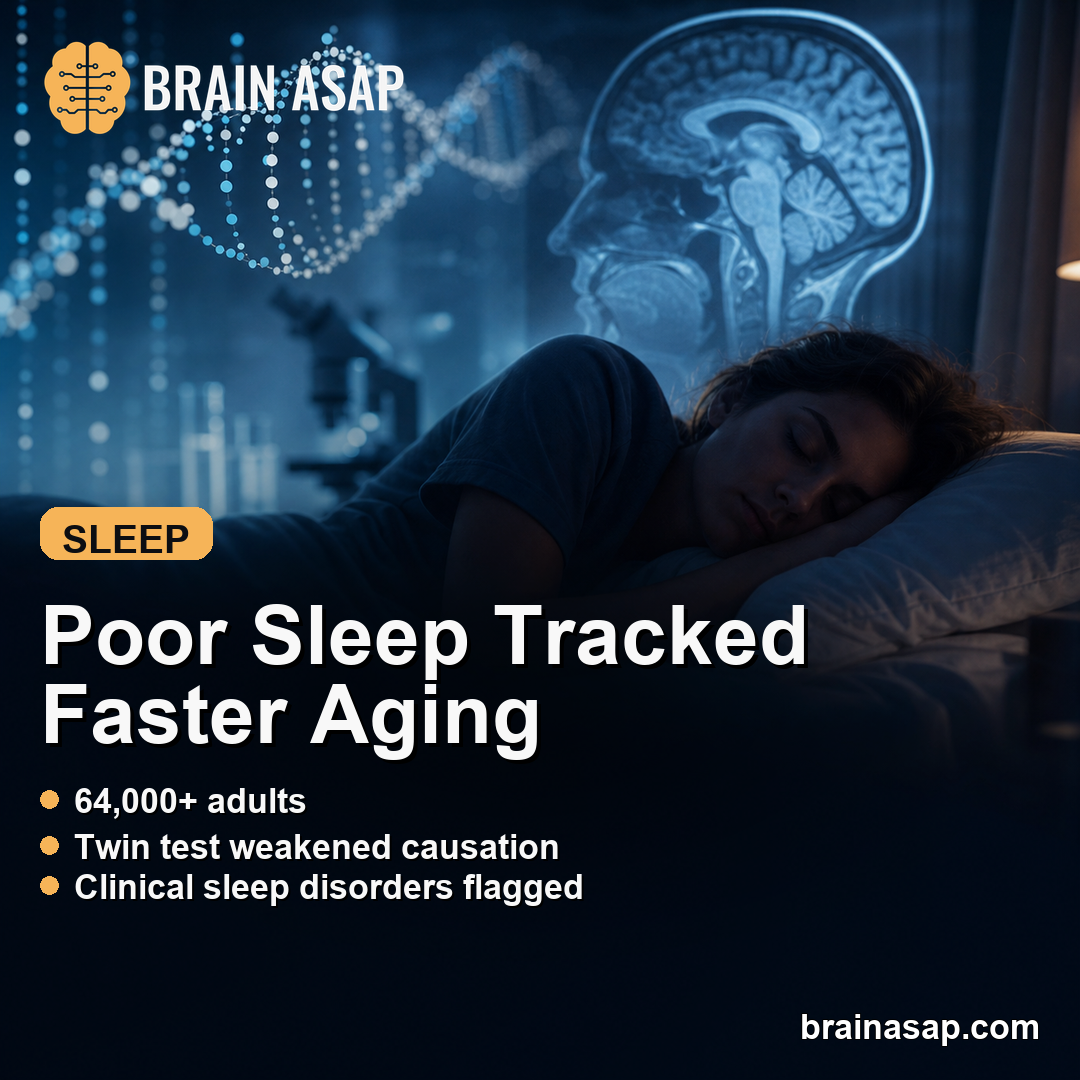
TL;DR: A 2026 preprint in medRxiv found that poor sleep tracked faster biological aging across more than 64,000 adults, but twin and genetic analyses left the causal claim mixed rather than settled.
Key Findings
- 64,000+ adults: Researchers tested sleep and aging biomarkers across five independent datasets spanning young, middle, and late adulthood.
- Poorer sleep quality: Worse Pittsburgh Sleep Quality Index scores were associated with faster DunedinPACE or DunedinPACNI aging measures in several cohorts.
- Short and long sleep: In UK Biobank, both short sleep and long sleep were linked with faster neuroimaging-based aging than 7-9 hour sleep.
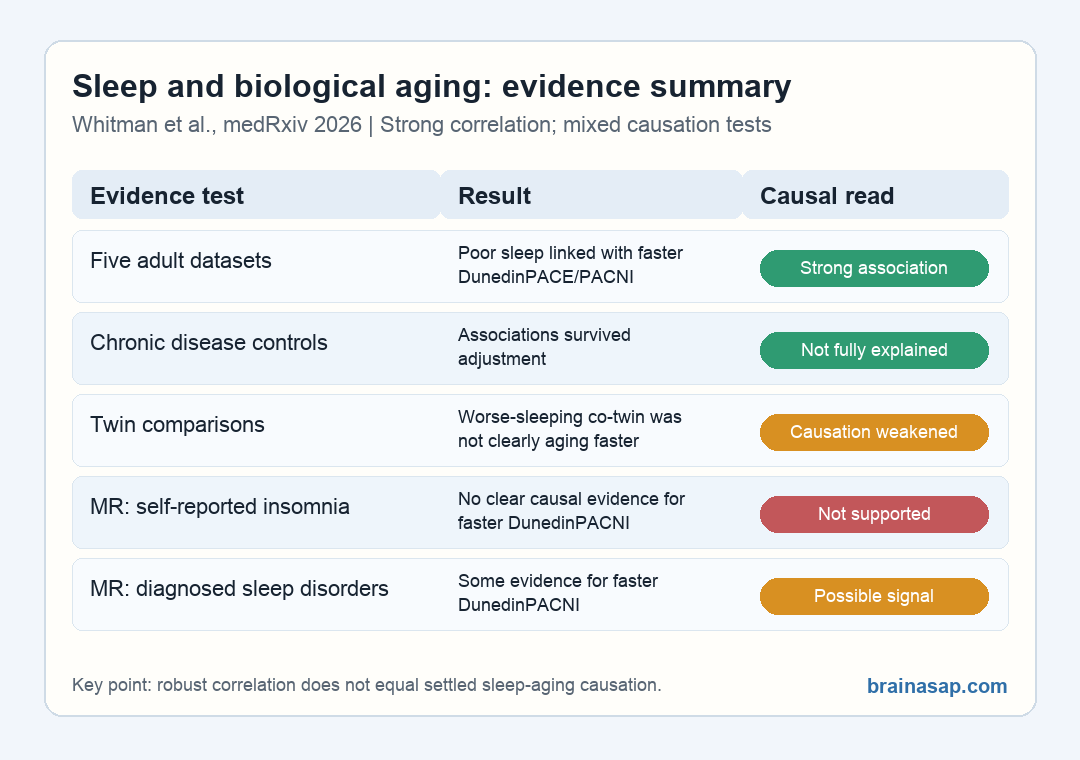
- Twin analyses weakened causation: Within-family comparisons did not show that the worse-sleeping twin was aging faster than the better-sleeping co-twin.
- Mendelian randomization was mixed: Self-reported insomnia did not show causal evidence, while diagnosed sleep disorders showed some evidence for faster aging.
Source: medRxiv (2026) | Whitman et al.
Poor sleep was associated with faster biological aging in this preprint, but twin and genetic analyses did not establish that poor sleep caused the faster aging measures.
The researchers did not simply compare sleep complaints with one biological clock. They tested sleep against two related pace-of-aging measures: DunedinPACE, based on blood DNA methylation, and DunedinPACNI, based on structural brain MRI.
Both measures estimate how quickly a person’s body or brain appears to be aging relative to chronological time. The two-marker design is more informative than a single clock result, but it still does not turn poor sleep into a proven cause of accelerated aging.
Poor Sleep Tracked Faster Aging Across Five Adult Cohorts
The analysis used five datasets: MIDUS, UK Biobank, ADNI, the Human Connectome Project, and the E-Risk Longitudinal Twin Study. Together, they covered more than 64,000 adults.
In MIDUS, poorer global sleep quality on the Pittsburgh Sleep Quality Index (PSQI), a self-report sleep-quality scale, was associated with faster blood-based DunedinPACE. The age- and sex-adjusted association was beta = 0.23.
In UK Biobank, sleep duration had a U-shaped pattern with brain-based DunedinPACNI. The fastest aging scores appeared at both shorter and longer sleep durations, while the model’s lowest point was around 7.1 hours.
- MIDUS: 1,207 adults linked poorer PSQI scores with faster DunedinPACE.
- UK Biobank: 59,844 adults showed faster DunedinPACNI with short sleep and long sleep.
- ADNI: Informant-rated sleep impairment rose stepwise with faster DunedinPACNI in older adults.
- HCP and E-Risk: Young-adult samples also showed poor-sleep/faster-aging associations.
The young-adult replication is useful because it reduces one obvious explanation. Chronic disease is less common at ages 18 to 37, so the association cannot be explained only by older adults being sick and sleeping poorly.
Disease Burden Did Not Fully Explain the Sleep Aging Link
The researchers then asked whether chronic disease accounted for the pattern. Poor sleep, cardiovascular disease, diabetes, dementia, and other age-linked conditions often cluster together, so this was a necessary check.
After adjustment for chronic disease in MIDUS and UK Biobank, the sleep-aging associations were only modestly reduced. In ADNI, adjustment for mild cognitive impairment and dementia reduced the brain MRI association more strongly, which makes sense for a neuroimaging aging marker.
The disease-adjusted analyses support a narrower claim: chronic disease did not fully explain the association. Disease burden may still contribute, and the adjusted models do not prove that sleep disruption was the initiating cause.
Twin Comparisons Weakened the Direct Causation Claim
The twin analyses were the main reason the paper avoided a simple “poor sleep causes aging” conclusion. Twin comparisons help control for shared genes and early family environments that ordinary observational models cannot measure directly.
Researchers compared 478 siblings and twins from the Human Connectome Project and 1,466 twins from E-Risk. Within monozygotic and dizygotic twin pairs, the worse-sleeping twin was not clearly aging faster than the better-sleeping co-twin.
- Monozygotic twins: Identical twins share essentially all measured inherited genetic variation and much of the early environment.
- Dizygotic twins: Fraternal twins share the same household environment and about half their segregating genetic variation.
- Interpretation: If the within-pair association fades, shared genetic or early environmental factors may be contributing to both sleep and aging measures.
That does not show sleep is harmless. It does suggest that the same background factors may make some people more likely to sleep poorly and show faster biological aging.
Genetic Causal Tests Split by Sleep Definition
The Mendelian randomization results were also mixed. Mendelian randomization (MR) uses genetic variants as instruments to test whether a trait is likely to have a causal influence on another trait.
For self-reported insomnia, the MR analyses did not support a causal effect on faster DunedinPACNI. That was true for a UK Biobank insomnia GWAS and a larger 23andMe insomnia GWAS.
For diagnosed sleep disorders, the pattern changed. Genetic instruments for medical-record sleep disorder diagnoses in FinnGen and the Million Veteran Program showed some evidence for faster DunedinPACNI.
- Self-reported insomnia: No clear MR evidence that it caused faster neuroimaging-based aging.
- Diagnosed sleep disorders: Some MR evidence pointed toward faster aging, including an inverse-variance weighted beta of 0.07 in the FinnGen/MVP analysis.
- Sensitivity checks: Some biologically informed exclusions weakened the sleep-disorder estimate, so the genetic evidence remains uncertain.
One practical explanation is measurement quality. Brief self-report insomnia items may be noisier than medical-record sleep disorder diagnoses, while clinical diagnoses may also capture more severe sleep disruption.
The Preprint Supports Caution, Not Sleep Fatalism
The clearest finding is that poor sleep and faster aging biomarkers were linked across multiple adult samples and two aging-marker modalities. The weaker claim is that ordinary poor sleep, by itself, has been proven to accelerate aging.
Sleep still has established roles in cognition, mood, cardiovascular function, immune function, and metabolic health. This preprint adds biomarker-aging evidence, but it does not prove that improving sleep will slow biological aging in a clinical sense.
Future intervention studies would be needed to test that directly. For now, the evidence supports treating sleep as a serious health marker while keeping the aging-causation claim conditional.
Citation: DOI: 10.64898/2026.07.02.26357135. Whitman et al. Poor sleep is robustly correlated with accelerated aging but the evidence for causation is mixed. medRxiv. 2026.
Study Design: Multi-cohort observational analysis, twin comparison, and two-sample bidirectional Mendelian randomization using adult sleep and aging-biomarker datasets.
Sample Size: More than 64,000 adults across five cohort datasets, plus GWAS summary statistics for insomnia, diagnosed sleep disorders, and DunedinPACNI.
Key Statistic: In UK Biobank, sleep duration showed a U-shaped association with DunedinPACNI, with the model vertex near 7.1 hours.
Caveat: The source is a preprint, and the causal evidence was mixed across twin and Mendelian randomization analyses.