TL;DR: A 2026 conceptual paper in Integrative Psychological and Behavioral Science argued that heavy reliance on AI-generated language can create “Protein Shake Brain,” a state where thoughts are fluent and available but not fully owned by the person using them.
Key Findings
- Protein Shake Brain is a proposed cultural-psychological label for AI-assisted thinking that feels coherent but personally unprocessed.
- Alpha-function, a psychoanalytic term for turning raw experience into usable thought, is the model’s central mechanism.
- The cascade moves from AI as an assumed authority, to evasion of thinking, to a “Transmissive Self” that passes ideas along without owning them.
- Ownership alarms include hollow success, brittle confidence, and cognitive lag when a person cannot reconstruct their own reasoning.
- The 4Ps protocol asks users to Pause, Probe, Process, and Possess AI output before treating it as their own understanding.
Source: Integrative Psychological and Behavioral Science (2026) | Ezra and Mishali.
Protein Shake Brain Describes Fluent but Unowned AI Thinking
Ezra and Mishali use Protein Shake Brain to describe a modern cognitive problem: a person can produce polished language with AI help while feeling little ownership over the reasoning behind it.
The term is intentionally concrete. A protein shake can deliver nutrients without chewing; in the same way, an AI answer can deliver ready-made structure without the slower work of forming, testing, and integrating an idea.
The model’s central claim is not that AI use is automatically harmful. The risk appears when frictionless fluency replaces the mental effort that normally turns information into personal understanding.
- Not just speed: The concern is the loss of reasoning ownership, not ordinary productivity gains.
- Reasoning access: The concern is being unable to reconstruct why a conclusion made sense.
- Not a diagnosis: Protein Shake Brain is a conceptual label that still needs empirical testing.
Alpha-Function Is the Model’s Main Thinking Mechanism
Ezra and Mishali build the model around alpha-function, Wilfred Bion’s term for the mind’s ability to metabolize raw impressions into thoughts that can be held, revised, and used.
In Ezra and Mishali’s language, an AI response can become a kind of undigested material when the user accepts it too quickly. The words may be clear, but the person has not yet done the mental work needed to make the idea usable.
This distinction is important for learning, writing, strategy, and clinical or professional judgment. A person may have a good-sounding answer in front of them and still lack internal access to the chain of reasoning.
- Raw output arrives: The model supplies coherent language, outline logic, or a finished explanation.
- Friction is skipped: The user avoids confusion, doubt, and slow revision.
- Ownership weakens: The final product can feel correct but psychologically foreign.
The AI Cascade Runs From Authority to Evasion
Ezra and Mishali describe a four-layer cascade. First, AI can function as a Subject Supposed to Know, meaning the user treats the system as an outside authority that already has the answer.
Second, the user may slide into what Ezra and Mishali call minus-K, or the active evasion of knowing. Instead of using AI to sharpen a question, the person uses it to avoid the discomfort of not knowing yet.
Third, repeated evasion can produce the Transmissive Self. This is a self that moves ideas efficiently from one place to another but does not fully inhabit them.
Fourth, the experience becomes noticeable. Ezra and Mishali call these signals ownership alarms: hollow success, brittle confidence, and the lag that appears when someone is questioned about work they supposedly completed.
The 4Ps Protocol Adds Friction Back Into AI Use
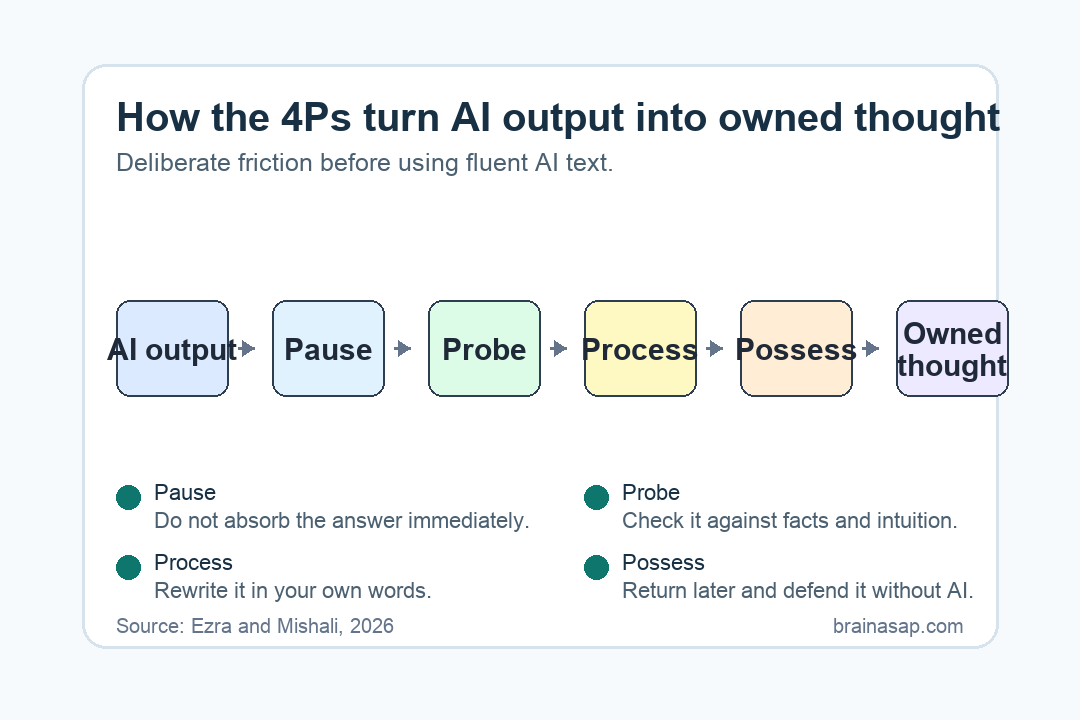
The practical proposal is the 4Ps protocol: Pause, Probe, Process, and Possess. It is meant to restore enough friction for the user to test whether an AI-generated idea has become personally understood.
- Pause: Stop before absorbing the answer and ask whether you are thinking or only receiving.
- Probe: Compare the AI output with what you know, feel, and can verify.
- Process: Rewrite or explain the idea in your own words before using it.
- Possess: Step away, return, and check whether you can defend the idea without the AI output.
The protocol turns a broad complaint about AI into a concrete behavioral test.
If a person cannot explain the point without returning to the prompt thread, the idea has probably not been processed enough.
The Model Is Conceptual, Not Clinical Evidence
The study design is important. This was an integrative conceptual paper, not an experiment measuring AI users over time.
Ezra and Mishali synthesize psychoanalytic theory, cultural psychology, cognitive-control ideas, and a brief autoethnographic vignette.
That means the strongest claim is limited: Protein Shake Brain is a proposed model for a recognizable experience, especially in ambiguous tasks where authorship matters. It is not evidence that every AI-assisted task weakens thinking.
The model is most relevant when work requires identity investment or genuine sensemaking: writing, coding, therapy notes, strategic planning, research synthesis, or any task where the person needs to stand behind the reasoning.
- Higher-risk setting: Ambiguous work where the user needs to explain and defend the conclusion.
- Lower-risk setting: Routine transactional work where personal authorship is not central.
- Next research need: Empirical studies should test whether the 4Ps protocol improves recall, reasoning ownership, or later explanation quality.
The most useful takeaway is practical: AI output should be treated as material for thinking, not as a finished substitute for thinking.
The checkpoint is simple. If you cannot rephrase, question, and defend the idea yourself, it is not fully yours yet.
Citation: DOI: 10.1007/s12124-026-09998-9. Ezra and Mishali. “Protein Shake Brain” and the Alpha Function: Restoring Authorship in Engineered Epistemic Ecologies. Integrative Psychological and Behavioral Science. 2026;60:36.
Study Design: Integrative conceptual paper using psychoanalytic theory, cultural psychology, technology studies, and a phenomenological vignette.
Sample Size: No participants or datasets; the paper proposes a theoretical model rather than testing a cohort.
Key Statistic: The main framework is the 4Ps protocol: Pause, Probe, Process, and Possess.
Caveat: Protein Shake Brain and the 4Ps protocol need empirical validation before they can be treated as measured clinical or educational effects.