TL;DR: A 2026 Scientific Reports study of 6,805 English-language media reports found that psychedelic-treatment coverage for depression and PTSD used more positive tone than antidepressant coverage, while antidepressant coverage used more risk and negative-emotion language.
Key Findings
- 6,805 media reports: Researchers analyzed English-language newspaper coverage from 2017 to 2024 using LexisNexis and natural language processing.
- Paragraph-level comparison: Paragraphs were classified as mentioning psychedelics, FDA-approved antidepressants, both, or neither.
- Positive tone: Psychedelic-related paragraphs were more strongly associated with positive-emotion language and positive sentiment.
- Risk framing: Antidepressant-related paragraphs were more strongly associated with risk language and LIWC negative-emotion language.
- Caution: The study measured media language, not whether psychedelic treatments or antidepressants work better clinically.
Source: Scientific Reports (2026) | Evers et al.
Psychedelic treatments are often discussed as a new psychiatric frontier. Antidepressants are usually discussed as established, prescribed medications with familiar benefits and drawbacks.
Researchers tested whether that difference showed up in ordinary media language. They compared coverage of psychedelic treatments for major depressive disorder (MDD) and posttraumatic stress disorder (PTSD) with coverage of FDA-approved antidepressants for those conditions.
The analysis was not a clinical effectiveness comparison. It measured public-facing language that can shape expectations before a patient enters a clinic or trial.
Media Reports Were Analyzed at the Paragraph Level
The dataset included 6,805 English-language media reports from 2017 through 2024. Researchers used LexisNexis, then extracted article text and split the coverage into paragraphs.
Each paragraph was classified by whether it mentioned psychedelic treatments, FDA-approved antidepressants, both treatment types, or neither. Paragraph-level classification prevents one broad article from being treated as if every sentence made the same treatment claim.
- Psychedelic paragraphs: 26,748 paragraphs mentioned psychedelic-related terms.
- Antidepressant paragraphs: 19,637 paragraphs mentioned FDA-approved antidepressant terms.
- Both-treatment paragraphs: 2,382 paragraphs mentioned both categories.
- Neither-treatment paragraphs: 127,411 paragraphs mentioned neither category directly.
Search terms were refined before the final analysis. In a rated subset, 90% of articles were judged related to using psychedelics or antidepressants to treat depression or PTSD.
Researchers also excluded categories likely to distort the sample, including web-only publications, letters to the editor, academic journal material, clinical-trial registrations, and unrelated uses of the word depression. The final dataset was meant to capture edited newspaper coverage rather than every online mention of psychedelic science.
Psychedelic Coverage Used More Positive Treatment Language
The planned analysis found that psychedelic-related paragraphs were more strongly associated with positive-emotion word use than antidepressant-related paragraphs. The standardized beta was 0.21, with p < .001.
Positive sentiment also favored psychedelic-related coverage. The NRC sentiment analysis showed a larger association with positive sentiment, with beta 0.67 and p < .001.
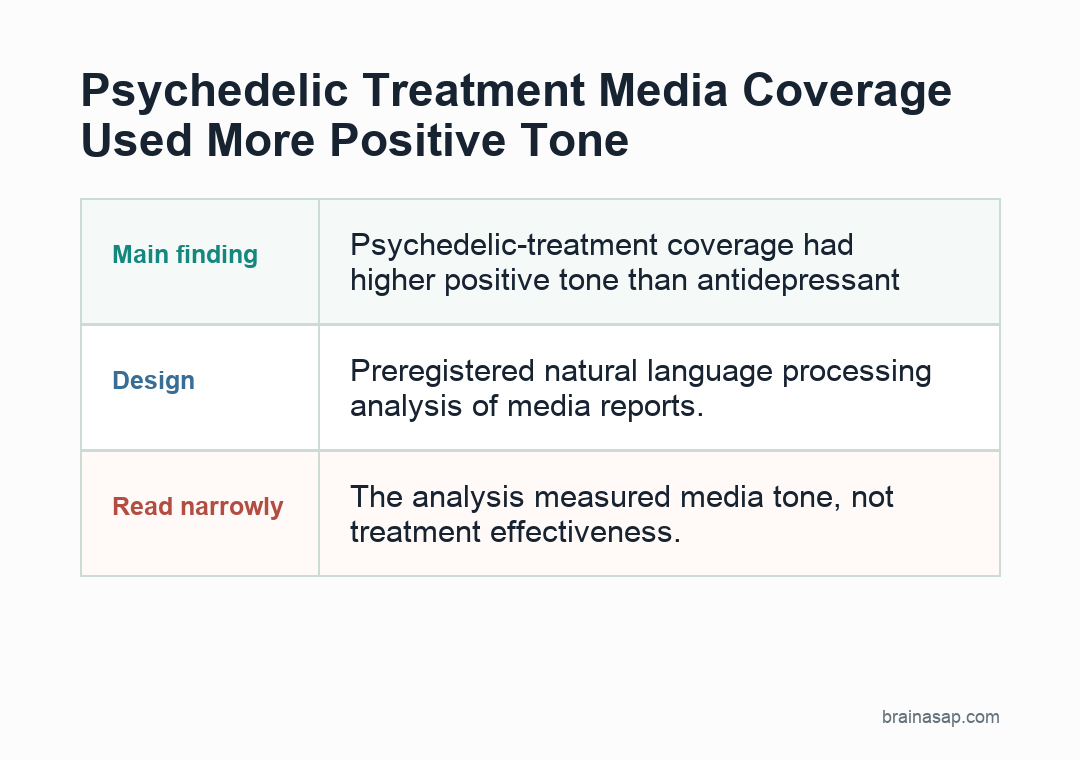
The main interpretation is straightforward: media paragraphs about psychedelics leaned more toward promise, approval, therapy, trials, and potential. Some articles were still critical or cautious.
Researchers also found that NRC negative sentiment was more strongly related to psychedelic paragraphs than expected. The mixed negative-sentiment result suggests some coverage also discussed risk, controversy, or disease severity around novel treatments.
Antidepressant Coverage Carried More Risk and Negative-Emotion Language
FDA-approved antidepressant coverage showed a different language profile. Antidepressant-related paragraphs were more strongly associated with risk language, beta 0.23, and negative-emotion language, beta 0.25; both results had p < .001.
Risk-language findings do not prove media outlets were wrong to discuss antidepressant risks. Established treatments have withdrawal concerns, side effects, prescribing debates, and long-running public arguments about mechanisms.
- Risk words: Antidepressant paragraphs were more tied to words such as dangerous, difficult, and risk.
- Negative-emotion words: Antidepressant paragraphs were more tied to serious, difficult, and similar terms in LIWC.
- Reward words: Contrary to the preregistered expectation, antidepressant paragraphs were also more tied to reward language, beta 0.19.
The reward-language result prevents a simple one-sided reading. Media coverage did more than praise psychedelics and criticize antidepressants.
Still, the overall pattern fits the concern that newer psychedelic treatments are often framed around possibility, while older antidepressant treatments are often framed around limitations.
The Study Measured Narratives, Not Clinical Superiority
The researchers were explicit about the boundary. Identifying media hype does not show whether psychedelic treatments are effective, ineffective, safe, or unsafe.
The study also did not compare outcomes for psilocybin, MDMA, SSRIs, SNRIs, or psychotherapy. It compared language around those treatment categories in media reports.
- Main risk: Overly positive treatment narratives can inflate expectations before evidence is mature.
- Clinical effect: Expectations can affect trial enrollment, placebo and nocebo effects, adherence, and patient requests.
- Media boundary: Newspaper language is one public-facing channel, not the full information environment.
- Method boundary: Dictionary-based sentiment tools can classify illness-severity language differently from human clinical judgment.
Dictionary boundaries are important. A paragraph about severe depression can sound negative because the illness is severe, not because the treatment is being criticized.
Better Psychedelic Reporting Needs Balanced Evidence Language
Practical takeaway: coverage of psychiatric treatments should separate promise from proof. Psychedelic therapy studies may be important, but early enthusiasm can outrun trial quality, regulatory decisions, and safety evidence.
The same standard applies to antidepressants. Risk and withdrawal coverage can be necessary, but established medications also have benefits for many patients and should not be reduced to drawbacks alone.
A balanced article should tell readers three things at once: what the evidence showed, what remains uncertain, and what kind of patient or setting the evidence actually fits.
For clinicians, the study points to a communication issue. Patients may arrive with expectations shaped by headlines before they hear the measured evidence.
For researchers, the result supports tracking public narratives alongside clinical trial results. Media framing can influence recruitment, disappointment, self-medication, and pressure around regulatory decisions.
Citation: DOI: 10.1038/s41598-026-50186-x. Evers et al. Media hype regarding psychedelic treatments for depression and PTSD from 2017 to 2024. Scientific Reports. 2026.
Study Design: Preregistered natural language processing analysis of media reports.
Sample Size: 6,805 English-language media reports from 2017 to 2024.
Key Statistic: Psychedelic-related paragraphs were more tied to positive-emotion language, beta 0.21, while antidepressant-related paragraphs were more tied to risk language, beta 0.23.
Caveat: The analysis measured media language and sentiment, not comparative treatment effectiveness or safety.