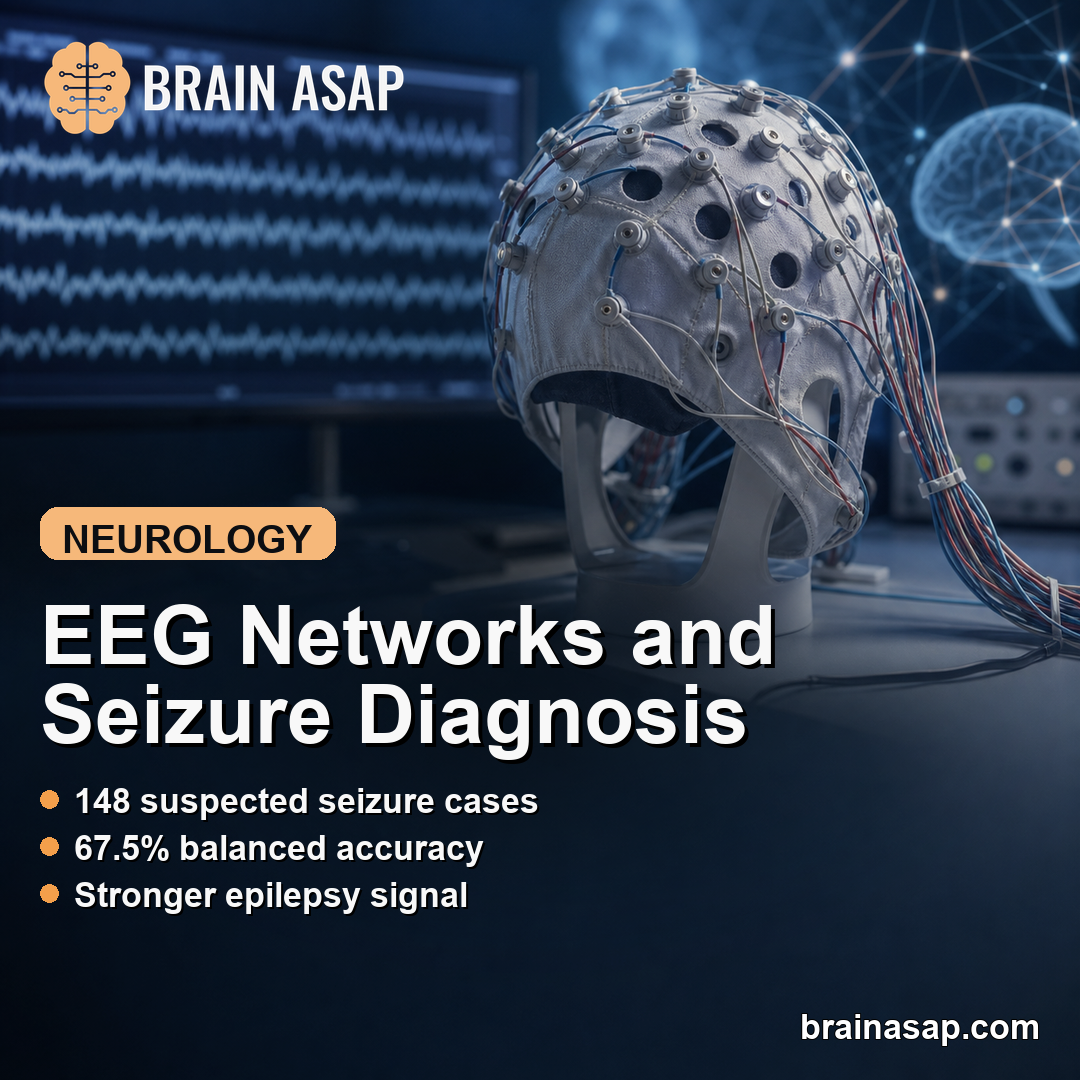
TL;DR: A 2026 medRxiv preprint found that multivariate resting-state electroencephalography (EEG) network markers separated non-lesional epilepsy from functional/dissociative seizures above chance, but the best model was stronger at identifying epilepsy than at identifying functional/dissociative seizures.
Key Findings
- 148 suspected seizure cases: Researchers analyzed medication-free, visually normal, eyes-closed EEG recordings from 75 people later diagnosed with non-lesional epilepsy and 73 later diagnosed with functional/dissociative seizures.
- Low-alpha network markers: The main analysis focused on 6-9 Hz EEG network features, including network efficiency, trophic incoherence, and mean functional connectivity.
- 67.5% balanced accuracy: The best configuration used at least four EEG epochs, no dimensionality reduction, and a support vector machine with a radial-basis-function kernel.
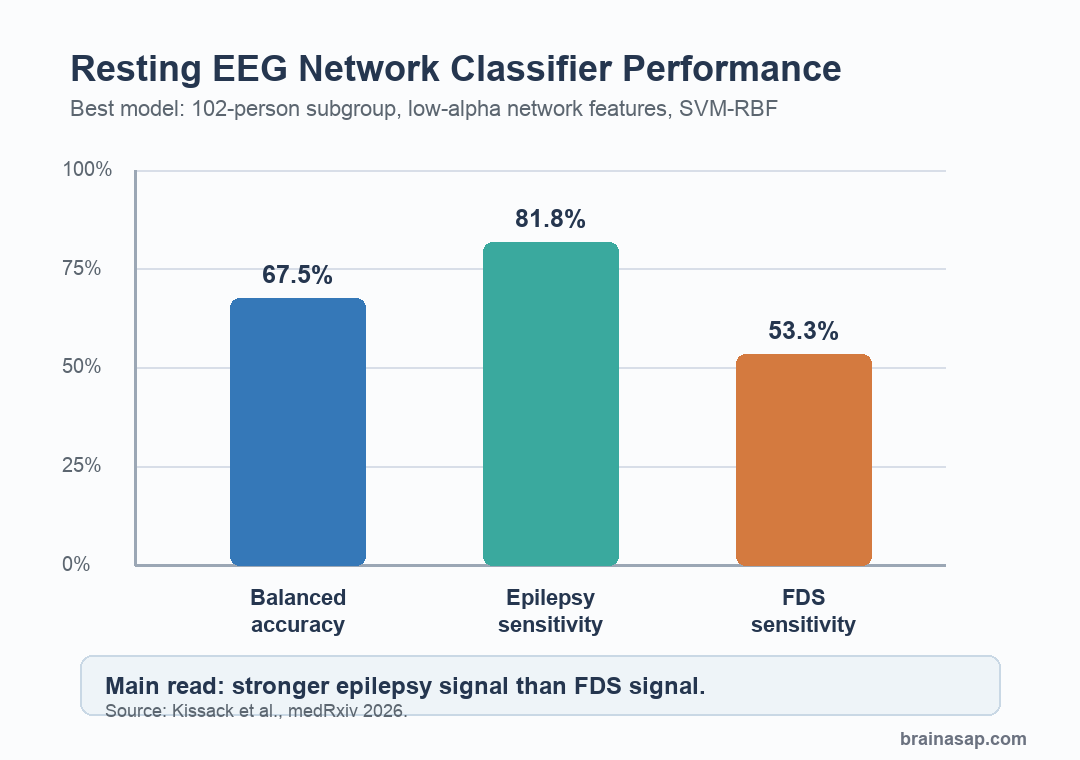
- Epilepsy signal was stronger: The best model identified epilepsy with 81.8% sensitivity but functional/dissociative seizures with 53.3% sensitivity.
- Epoch averaging helped: Averaging several EEG segments improved balanced accuracy from 62.6% to 67.5%, suggesting more stable features contained more diagnostic information.
Source: medRxiv preprint (2026) | Kissack et al.
Normal-Looking EEG Still Contained Network Information
Seizure diagnosis can be difficult when the clinical question is not simply whether an event looked dramatic. Epileptic seizures and functional/dissociative seizures (FDS), seizure-like episodes not caused by epileptic brain discharges, can overlap in outward appearance.
Video-EEG remains central when it captures a typical event, but diagnostic delays and misdiagnosis still happen. The researchers asked whether ordinary resting EEG, after visual review looked normal, might still contain network-level information for decision support.
The analysis used 148 people who were being evaluated for suspected seizure disorders before treatment initiation. Later specialist diagnosis classified 75 as non-lesional epilepsy and 73 as FDS.
All analyzed EEG segments were eyes-closed resting data, visually normal, and recorded while participants were medication-free. The design matters because the study was not just detecting obvious spikes, medication effects, or established long-term epilepsy treatment history.
Three EEG Network Features Drove the Main Classifier
The model did not read EEG as a clinician would scan a trace. Researchers converted low-alpha EEG activity, in the 6-9 Hz range, into functional network measures.
Feature selection most often kept three measures:
- Network efficiency: a measure of how easily information could move across the inferred EEG network.
- Trophic incoherence: a measure related to hierarchical organization in a directed network.
- Mean functional connectivity: the average coupling strength between EEG channels or regions in the model.
Those features are plausible for epilepsy because seizure risk is tied to abnormal synchronization, communication dynamics, and network organization. They are not direct seizure recordings.
In practical terms, the study tested whether quiet EEG background activity contained enough structure to shift diagnostic probability between epilepsy and FDS.
The Best Model Reached 67.5% Balanced Accuracy
The best-performing configuration narrowed the sample to people with at least four EEG epochs available for averaged feature estimation. That subgroup included 102 people: 57 with epilepsy and 45 with FDS.
Using the three-feature set, no dimensionality reduction, and a support vector machine with a radial-basis-function kernel, the model reached 67.5% balanced accuracy.
Balanced accuracy is the average of performance across the two diagnostic classes, so it helps when one class might otherwise dominate the score. Here, the class-specific results were uneven:
- Epilepsy sensitivity: 81.8%, meaning the model more often recognized people later diagnosed with epilepsy.
- FDS sensitivity: 53.3%, only slightly above chance for the FDS class.
- Permutation comparison: models above 60% balanced accuracy exceeded the maximum balanced accuracy reached when diagnostic labels were permuted.
That split is the main clinical interpretation. The network markers identified epilepsy-related physiology more clearly than they identified a positive FDS diagnosis.
Averaging EEG Epochs Improved the Signal
One of the cleaner technical findings was that feature stability mattered. When researchers averaged network features across multiple EEG epochs, performance improved from 62.6% to 67.5% balanced accuracy.
The improvement came despite reducing the sample from 148 to 102 participants. The authors interpreted that as a sign that stable network information may be easier to detect when transient EEG fluctuations are averaged out.
Model choice also mattered. The strongest approaches were nonlinear models:
- SVM with RBF kernel: the most consistently strong model, with 81.4% of people receiving the same label across repeated split iterations.
- Random Forest: another high-performing nonlinear model, with 74.5% label consistency.
- k-Nearest Neighbours: often informative but more sensitive to training-data changes, with 60.8% label consistency.
Across the three best-performing model types, the most frequent classification label agreed for 77.5% of participants. That consistency supports the idea that the features contained diagnostic information, even though the models were not ready for standalone clinical use.
Why This Should Not Be Read as an FDS Test
The finding has potential clinical value, but the direction matters. A model that is better at detecting epilepsy than FDS should not be marketed as a positive FDS biomarker.
People with FDS and other comorbidities were more likely to be misclassified as epilepsy than people with FDS alone. The study also excluded people with major neurological and psychiatric comorbidities, which limits real-world generalizability.
Several limits keep the result in model-development territory:
- Preprint status: the work has not yet completed peer review.
- Retrospective sampling: the dataset came from existing clinical data rather than a new prospective diagnostic trial.
- Incomplete video-EEG support: diagnosis was video-EEG supported in 80% of FDS cases and 59% of epilepsy cases, leaving some residual diagnostic uncertainty.
- No external validation yet: the strongest configuration still needs replication in independent, multi-center samples.
The most reasonable takeaway is modest and practical. Resting-state EEG network analysis may help update diagnostic probability when epilepsy versus FDS is already the clinical question.
It does not replace clinical history, specialist review, or event-capturing video-EEG, and it does not prove that quiet EEG can diagnose FDS directly.
Citation: DOI: 10.64898/2026.04.14.26350505. Kissack et al. Multivariate resting-state EEG markers differentiate people with epilepsy and functional seizures. medRxiv. 2026.
Study Design: Diagnostic-accuracy machine-learning analysis of medication-free, visually normal, resting-state EEG recordings.
Sample Size: 148 people with suspected seizure disorders; 75 were later diagnosed with non-lesional epilepsy and 73 with functional/dissociative seizures.
Key Statistic: The best model reached 67.5% balanced accuracy, with 81.8% sensitivity for epilepsy and 53.3% sensitivity for FDS.
Caveat: This was a retrospective preprint model-development study without independent external validation.