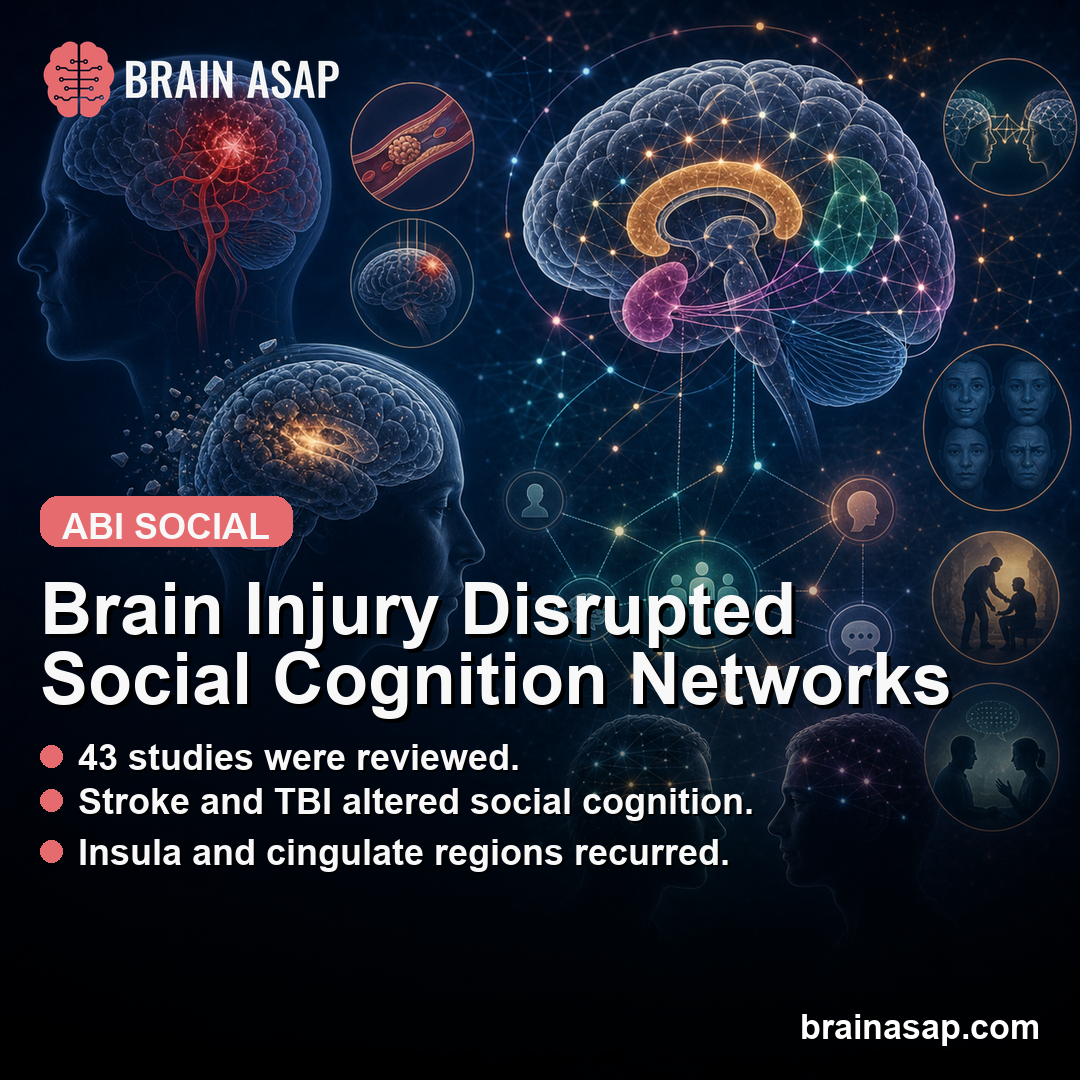
TL;DR: A 2026 systematic review in Cognitive, Affective, & Behavioral Neuroscience found that stroke and traumatic brain injury populations showed consistent social cognition alterations across domains, while insula, cingulate cortex, middle frontal gyrus, and corpus callosum were repeatedly implicated.
Key Findings
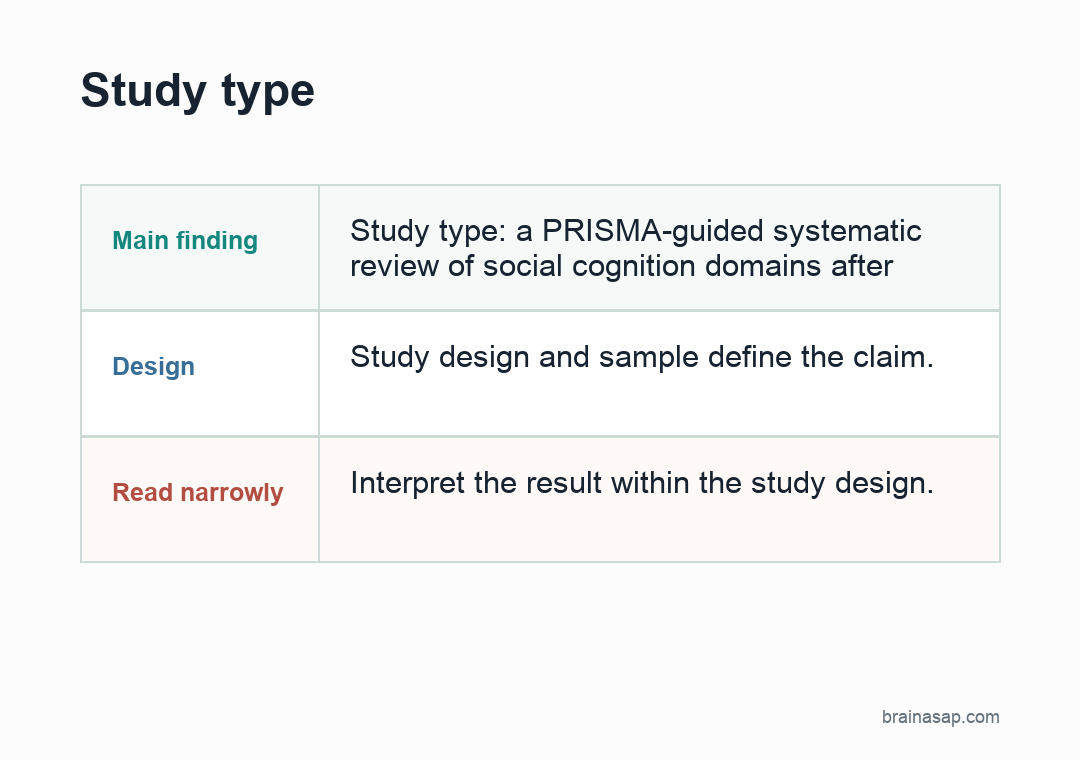
- Study type: a PRISMA-guided systematic review of social cognition domains after stroke and traumatic brain injury.
- Review evidence: The review included 43 behavioral and neuroimaging studies of social cognition after acquired brain injury.
- Main result: Stroke and traumatic brain injury populations showed consistent social cognition alterations across domains.
- Second result: Insula, cingulate cortex, middle frontal gyrus, and corpus callosum were repeatedly implicated.
- Caution: The review found heterogeneous tasks and uneven evidence across domains and injury types.
Source: Cognitive, Affective, & Behavioral Neuroscience (2026) | Cavallo et al.
Social cognition includes how people infer emotion, intention, perspective, and empathy during interaction. After acquired brain injury, these skills can affect relationships, work, independence, and rehabilitation.
This review summarized behavioral and neuroimaging studies across stroke and traumatic brain injury, focusing on emotion recognition, Theory of Mind, perspective taking, and empathy.
Core result: this is a domain map: stroke and traumatic brain injury populations showed consistent social cognition alterations across domains, with several brain networks repeatedly implicated.
Acquired Brain Injury Studies Covered Four Social Cognition Domains
Design: a PRISMA-guided systematic review of social cognition domains after stroke and traumatic brain injury. Sample: 43 behavioral and neuroimaging studies of social cognition after acquired brain injury.
The review covered emotion recognition, theory of mind, perspective taking, and empathy after acquired brain injury. The domain structure is important because social cognition is not one skill.
- Emotion recognition: Identifying others’ emotional expressions.
- Theory of Mind: Inferring beliefs, intentions, and mental states.
- Perspective taking: Representing another person’s viewpoint.
- Empathy: Sharing or understanding another person’s emotional state.
Stroke and Traumatic Brain Injury Both Showed Social Cognition Deficits
Main finding, specific to acquired brain injury: social cognition alterations appeared across stroke and traumatic brain injury studies.
Insula, cingulate cortex, middle frontal gyrus, and corpus callosum appeared repeatedly. Those regions support a distributed-network view rather than a single social-cognition spot.
Measurement detail: The review compared heterogeneous tasks and imaging methods. This keeps convergence valuable, but it limits precise domain-by-domain conclusions.
- Evidence base: 43 behavioral and neuroimaging studies of social cognition after acquired brain injury.
- Design: PRISMA-guided systematic review of social cognition domains after stroke and traumatic brain injury.
- Primary anchor: Stroke and traumatic brain injury populations showed consistent social cognition alterations across domains.
- Second layer: Insula, cingulate cortex, middle frontal gyrus, and corpus callosum were repeatedly implicated.
- Boundary: The review found heterogeneous tasks and uneven evidence across domains and injury types.
Interpretation: Social cognition deficits after acquired brain injury involve distributed networks. Rehabilitation should not treat social cognition as one generic outcome.
Standardized tasks would test whether domain-specific deficits predict rehabilitation needs across injury types and settings.
The review is most useful as a map of affected domains and recurring networks, not as a single imaging biomarker.
Insula and Cingulate Networks Appeared Across Domains
The review compared heterogeneous tasks and imaging methods. This keeps convergence valuable, but it also limits precise domain-by-domain conclusions.
Best reading: social cognition deficits after acquired brain injury involve distributed networks. Rehabilitation should not treat social cognition as one generic outcome.
The domain split is clinically useful because emotion recognition problems may require different supports than theory-of-mind or perspective-taking problems.
That is why a rehabilitation plan may need separate measures for emotion recognition, inference about other people, and everyday social participation.
Network findings add a second layer. The insula and cingulate cortex support salience, emotion, self-other processing, and cognitive control, so repeated involvement of those regions fits the behavioral domains.
The middle frontal gyrus and corpus callosum point to executive and interhemispheric components. Social cognition after brain injury is therefore unlikely to depend on one isolated lesion site.
For assessment, a patient may perform well on basic cognitive screening while still struggling with emotion recognition, sarcasm, perspective taking, or social judgment in daily life.
Domain-specific testing can identify those problems earlier and give rehabilitation teams a clearer target than a broad label such as social functioning.
The review also shows why social cognition should not be treated as a late add-on to motor or language rehabilitation. Social inference, emotion recognition, and empathy often determine whether a person can return to work, maintain relationships, and navigate daily interactions after brain injury.
When those domains are not measured directly, deficits can be misread as personality change, poor motivation, or family conflict rather than a treatable cognitive consequence of injury.
That distinction affects care planning, caregiver education, and return-to-work decisions.
Heterogeneous Tasks Limited Direct Comparison
Main limitation: the review found heterogeneous tasks and uneven evidence across domains and injury types.
- Task variation: Studies used different social cognition measures.
- Injury mix: Stroke and traumatic brain injury evidence was stronger than other causes.
- Neuroimaging coverage: Not every domain had equal imaging evidence.
- Rehabilitation: Evidence for targeted intervention still needs development.
Uneven task quality and injury heterogeneity limit direct comparisons across studies. Better standardized measures would make the network findings more actionable.
Social Cognition Needs Domain-Specific Brain Injury Rehabilitation
Practical takeaway: acquired brain injury rehabilitation should assess social cognition by domain.
- Best use: Use the review to identify recurring networks and affected social-cognition domains.
- Do not overread: Do not treat the evidence as a single validated imaging biomarker.
- Next question: Use standardized tasks to test whether domain-specific deficits predict rehabilitation needs.
That gives the review a clear clinical point: social cognition is measurable, distributed, and too important to leave vague.
Citation: DOI: 10.3758/s13415-026-01438-w; Cavallo et al.; Neural correlates of social cognition in acquired brain injury; Cognitive, Affective, & Behavioral Neuroscience; 2026.
Study Design: A PRISMA-guided systematic review of social cognition domains after stroke and traumatic brain injury.
Sample Size: 43 behavioral and neuroimaging studies of social cognition after acquired brain injury.
Key Statistic: Stroke and traumatic brain injury populations showed consistent social cognition alterations across domains.
Caveat: Tasks, imaging methods, and injury types varied across studies, limiting direct domain-by-domain comparison.