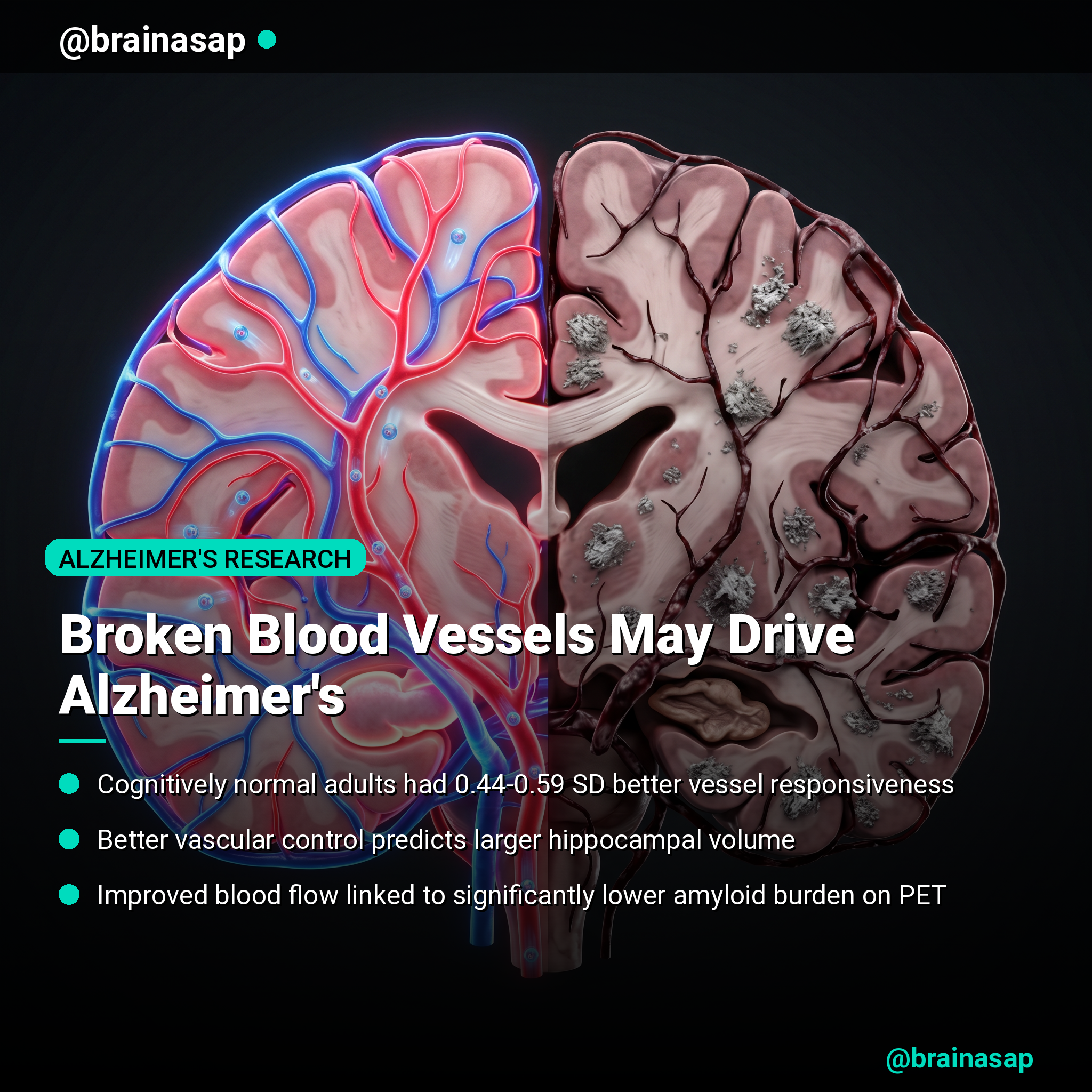
Broken Blood Vessels May Drive Alzheimer’s Decline

TL;DR: A new study reveals that impaired cerebrovascular function—the brain’s ability to regulate blood flow—correlates strongly with Alzheimer’s symptoms, offering a potential non-invasive way to detect early cognitive decline. Alzheimer’s disease has long been framed as a problem of toxic protein accumulation: amyloid plaques and tau tangles strangling neurons into silence. But what if the …

Read more

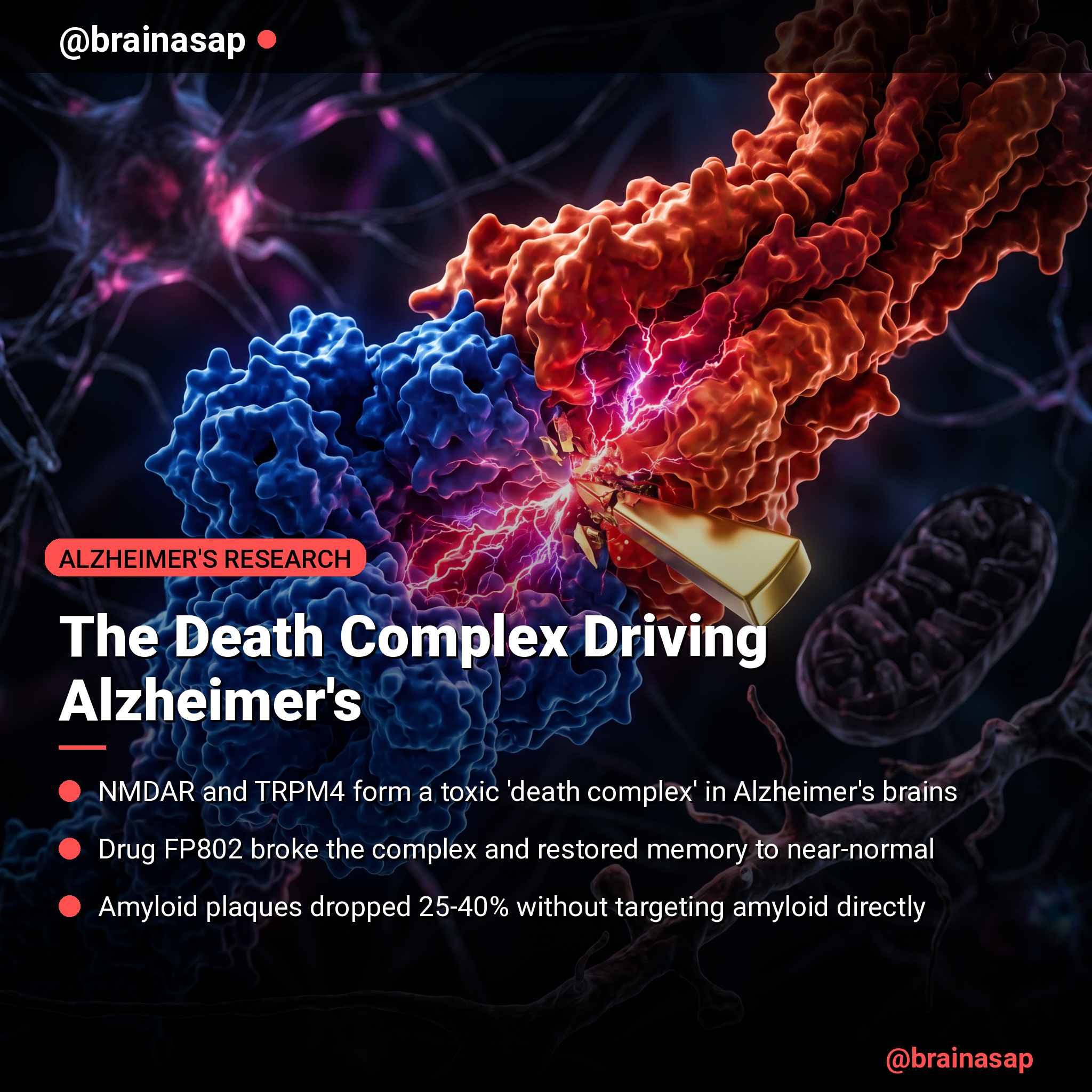
How FP802 Targets the NMDAR/TRPM4 Death Complex to Reverse Alzheimer’s

TL;DR: Researchers discovered a toxic interaction between two brain proteins—NMDAR and TRPM4—that drives neurodegeneration in Alzheimer’s disease, and a small molecule called FP802 that blocks this “death complex” and prevents cognitive decline in mice. Alzheimer’s disease devastates the brain through multiple pathways, but the exact triggering mechanisms remain frustratingly unclear. A new study in Molecular …

Read more

New Blood Test Detects Alzheimer’s Disease with 83% Accuracy Years Before Symptoms

TL;DR: A new blood test using three misfolded plasma proteins can identify Alzheimer’s disease with 83.44% accuracy, outperforming conventional biomarkers and offering a non-invasive screening tool years before cognitive symptoms appear. The holy grail of Alzheimer’s research isn’t a cure—yet. It’s catching the disease before memory starts to fade. By the time someone notices confusion, …

Read more

Omega-3 Fatty Acids & Souvenaid® May Slow Cognitive Decline in Alzheimer’s Disease (2024 Review)

Omega-3 supplements and Souvenaid® show potential in slowing cognitive decline in Alzheimer’s patients, though the evidence remains inconclusive. Highlights: Cognitive Decline Reduction: The CDR scale showed a significant reduction in cognitive decline progression with Omega-3 supplementation (SMD = −0.4127, 95% CI: [−0.5926; −0.2327]). Mixed Cognitive Outcomes: 58% of studies reported positive cognitive effects from Omega-3 …

Read more

ACOT7 Biomarker May Help in Early Diagnosis of Alzheimers Disease (2024 Study)

ACOT7 shows promise as a non-invasive serum biomarker for Alzheimer’s disease (AD) with high diagnostic accuracy. Highlights: Increased Expression: ACOT7 levels were significantly elevated in AD patients and animal models compared to controls. Correlation with Cognitive Decline: A strong negative correlation was observed between serum ACOT7 levels and MMSE scores (r = -0.85; p < …

Read more

Blood Urea Nitrogen (BUN) & Creatinine Ratio vs. Cognition & Depression (2024 Study)

Elevated blood urea nitrogen and creatinine ratio (BUNCr) is associated with decreased cognitive function and increased depressive symptoms, with depressive symptoms mediating part of the relationship between BUNCr and cognitive decline. Highlights: BUNCr has a negative association with cognitive function, with higher BUNCr levels linked to lower cognitive performance. BUNCr is positively associated with depressive …

Read more

High Stress in Midlife Linked to Dementia in Women (2024 Study)

Women experiencing midlife stress-related exhaustion have a higher risk of developing dementia at a younger age and exhibit long-term cognitive impairments. Highlights: Higher Dementia Risk: Women with midlife stress-related exhaustion had a nearly threefold increased risk of developing dementia before age 75. Earlier Onset: The average age of dementia onset was younger for women with …

Read more

Hypertension Linked to Impaired Cognition & Gait in Older Adults (2024 Study)

Hypertension in older adults leads to poorer cognitive and walking performance due to the need for more brain resources to manage dual tasks. Highlights: Older adults with hypertension show higher brain activation in motor and sensory areas when performing dual cognitive-walking tasks compared to healthy peers. Hypertensive individuals have worse cognitive performance on single cognitive …

Read more

Peptide PHDP5 May Reverse Cognitive Impairment in Alzheimers Disease (2024 Research)

TLDR: Researchers demonstrated that intranasal administration of the peptide FITC-PHDP5-CPP reverses early cognitive impairment in Alzheimer’s disease (AD) model mice, showing potential as a treatment for AD-associated cognitive decline. Highlights: PHDP5, derived from the pleckstrin homology domain of dynamin 1, inhibits the interaction between dynamin and microtubules, rescuing synaptic dysfunction caused by tau accumulation. The …

Read more

Marijuana & Early-Onset Dementia (Age 34): Case Report Involving Cannabis Abuse

A recent case report describes a 34-year old man who developed a rare form of early onset dementia after two years of heavy marijuana use. While concerning, experts say more research is needed to understand the potential risks of cannabis on the developing brain. Key Facts: The man developed frontotemporal dementia, a disorder causing personality …

Read more