TL;DR: A 2026 mouse and rat study in Molecular Psychiatry reported that 25C-NBF, a selective serotonin 2A receptor agonist from the 2C-X phenethylamine series, produced rapid antidepressant-like effects, increased dendritic spines and Bdnf expression in the prefrontal cortex, and showed no rewarding or reinforcing properties at the tested doses.
Key Findings
- Despair behavior fell after a single dose: 25C-NBF (10 mg/kg, i.p.) reduced tail-suspension immobility 24 hours and 7 days after acute restraint stress in male Swiss CD-1 mice.
- Sucrose preference was restored after chronic corticosterone: a single 25C-NBF dose lifted sucrose preference 24 hours after 21 days of stress-mimicking corticosterone, the study’s anhedonia-like model.
- Dendrites grew and Bdnf rose: 25C-NBF increased dendritic length, spine density in the anterior cingulate and prelimbic prefrontal cortex, and Bdnf mRNA in primary cortical neurons.
- No reward or reinforcement signal appeared: 25C-NBF did not produce conditioned place preference at 1, 3, or 10 mg/kg, did not raise nucleus accumbens dopamine in rats, and did not maintain self-administration after methamphetamine.
- Sensorimotor gating and locomotion were preserved: 25C-NBF did not impair pre-pulse inhibition (PPI) at 1 or 10 mg/kg and did not reduce open-field locomotion, with greater than 100-fold selectivity for the 5-HT2A receptor over the 5-HT2B receptor.
Source: Molecular Psychiatry (2026) | Nadal-Gratacós et al.
25C-NBF Is a Selective 5-HT2A Phenethylamine Cousin of LSD-Style Compounds
25C-NBF is a synthetic phenethylamine in the 2C-X family. Researchers describe it as an N-(2-fluorobenzyl) analog of 2C-C, an analytic cousin of the better-known NBOMe series.
Unlike NBOMe drugs, which carry abuse risk in rodent models, NBFs were screened to combine antidepressant-relevant pharmacology with a cleaner safety profile.
The team at the University of Barcelona ran in vitro receptor assays on three NBFs (25C-NBF, 25B-NBF, and 25I-NBF) and then focused behavioral and plasticity work on 25C-NBF, the analog with the highest affinity and selectivity for the serotonin 2A receptor (5-HT2A).
Receptor profiling showed three properties that mattered for the safety story:
- 5-HT2A selectivity: all three NBFs bound 5-HT2A with high affinity and showed greater than 100-fold selectivity over 5-HT2B. The 5-HT2B receptor is linked to heart-valve risk, so the FDA flags it during psychedelic drug development.
- Low dopamine transporter activity: NBFs barely inhibited the dopamine transporter (DAT), and the DAT-to-serotonin-transporter ratio was low, a profile associated with reduced abuse liability.
- Balanced 5-HT2A signaling: 25C-NBF activated both Gq and β-arrestin pathways at 5-HT2A with bias factors close to serotonin itself, similar to LSD but slightly less potent.
A Single Dose Reduced Despair and Restored Sucrose Preference
Researchers used two complementary mouse models of depression-like behavior:
- Acute restraint stress (ARS): mice were physically restrained, then injected with vehicle or 25C-NBF (10 mg/kg, i.p.) and tested in the tail suspension test, where shorter immobility times indicate less despair-like behavior.
- Chronic corticosterone (CORT) model: mice received daily subcutaneous injections of 20 mg/kg corticosterone for 21 days to produce a depression-like and anhedonia-like phenotype, then a single dose of vehicle or 25C-NBF (10 mg/kg, i.p.). Sucrose preference and tail-suspension immobility were measured.
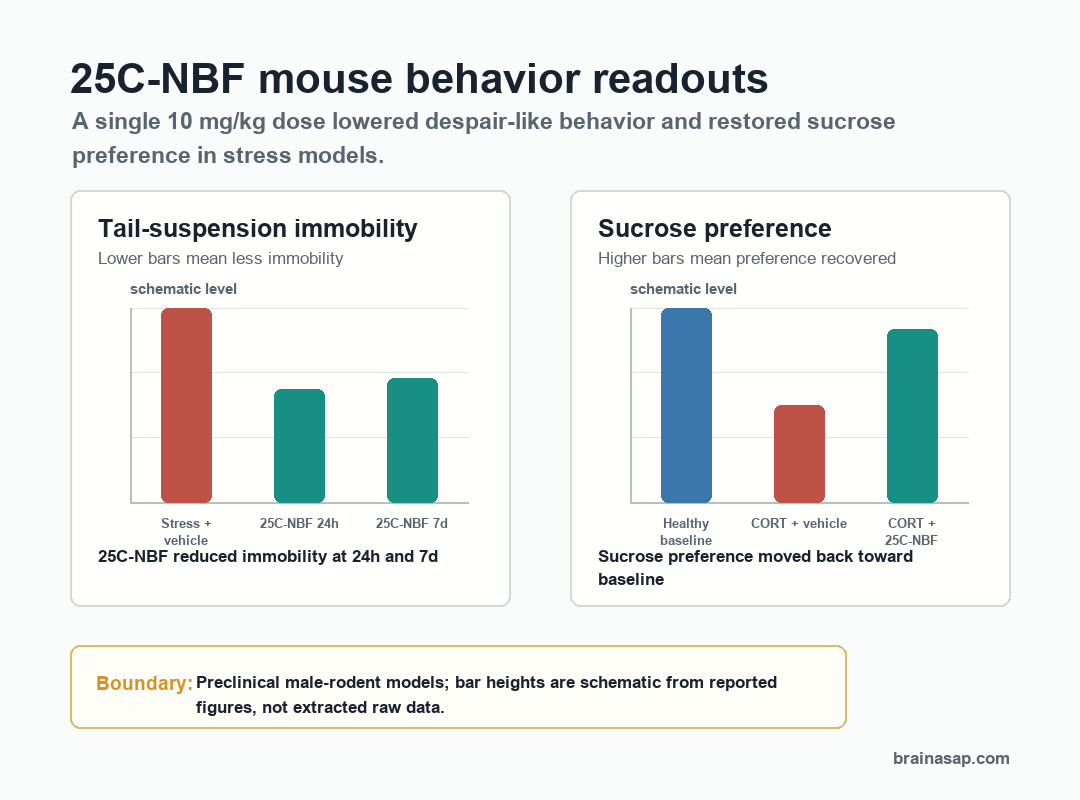
In the ARS model, 25C-NBF significantly reduced tail-suspension immobility compared with vehicle-treated stressed mice both 24 hours and 7 days after the single injection. In the CORT model, 25C-NBF restored sucrose preference 24 hours after administration to a level closer to healthy baseline.
For comparison, the team noted that the size of the antidepressant-like effect resembled what other groups have reported for 5-MeO-DMT and N,N-dimethyltryptamine (DMT) at similar doses in equivalent models.
25C-NBF Promoted Dendritic Growth and Raised Bdnf in Prefrontal Neurons
Antidepressant effects in this study tracked plasticity changes that have become a signature of fast-acting compounds like ketamine and psilocybin. Researchers measured three plasticity markers:
- Dendritic complexity in vitro: primary mouse cortical neurons treated with 25C-NBF (1, 5, or 10 µM) at day-in-vitro 4 showed more dendritic crossings, more total branches, and longer total dendritic length, measured by Sholl analysis at day-in-vitro 7.
- Bdnf mRNA in vitro: brain-derived neurotrophic factor (Bdnf) mRNA increased in cortical neurons exposed to 25C-NBF, indicating engagement of a plasticity-related transcriptional program.
- Dendritic spines in vivo: Golgi-Cox staining 24 hours after a single 10 mg/kg dose showed higher spine density in the anterior cingulate cortex and prelimbic prefrontal cortex, two mood-regulating regions.
The pattern matches the broader psychoplastogen idea, which proposes that fast-acting antidepressants restore lost dendritic structure in the prefrontal cortex, a region where reduced spine density is a recognized feature of depression.
No Reward, No Reinforcement, and No PPI Disruption at the Tested Doses
The team also screened 25C-NBF for the abuse-liability and safety signals that have limited related compounds:
- Conditioned place preference (CPP): mice did not develop a place preference for the 25C-NBF-paired chamber at 1, 3, or 10 mg/kg.
- Nucleus accumbens dopamine: microdialysis in awake rats showed no significant rise in accumbal dopamine after a 3 mg/kg subcutaneous dose, contrasting with several 2C-X analogs that do raise dopamine.
- Methamphetamine self-administration substitution: when 25C-NBF replaced methamphetamine, lever pressing dropped to levels comparable with saline substitution.
- Pre-pulse inhibition (PPI): 25C-NBF at 1 or 10 mg/kg did not reduce PPI of the startle reflex, a measure of sensorimotor gating that LSD and several NBOMe analogs have been shown to disrupt in mice.
- Locomotion: 25C-NBF did not reduce open-field locomotion or increase center avoidance, in contrast to NBOMe drugs that suppress activity.
The head-twitch response, a rodent proxy for hallucinogen-like effects mediated by 5-HT2A, was significant at 3 and 10 mg/kg but moderate. Researchers reported approximately 15 head twitches in 10 minutes for NBFs versus roughly 30 for 5-MeO-DMT under matched conditions in their earlier work.
Male-Only Mice and Rats, Acute Dosing, and Preclinical Models Limit Translation
The findings sit at the early end of the drug-development pipeline. Several constraints matter for how far the result should travel:
- Male animals only: all behavioral, plasticity, and pharmacology experiments used male Swiss CD-1 mice and male Sprague-Dawley rats. Women carry a higher lifetime risk of depression, and prior psilocybin and ketamine work in female mice has shown comparable or larger plasticity effects, but 25C-NBF has not yet been tested in females.
- Acute dosing: the antidepressant tests followed a single injection. Repeated-dose safety, tolerance, and durability beyond 7 days were not measured.
- Preclinical models: the tail suspension test and sucrose preference test capture despair- and anhedonia-like behavior in rodents. They do not equal a clinical depression endpoint, and translation to humans has often proven uneven.
- Rapid restraint-stress recovery clouded a 7-day readout: in the corticosterone model, vehicle-treated stressed mice no longer showed despair behavior at 7 days, which made it impossible to test whether 25C-NBF’s effect would have outlasted the model itself.
- Hallucinogen-like activity is still present: moderate head-twitch responses suggest 25C-NBF would likely produce subjective psychedelic effects in humans. Whether non-hallucinogenic doses retain plasticity and antidepressant effects was not addressed.
Why the 5-HT2A Versus 5-HT2B Profile Is the Cleanest Argument for Further Work
The most novel piece of the safety package is the receptor selectivity profile. The greater-than-100-fold selectivity for 5-HT2A over 5-HT2B addresses one of the FDA’s standing concerns about psychedelic chemistry, namely the cardiovascular risk linked to chronic 5-HT2B activation.
The combined picture is a small molecule that activates the receptor most associated with rapid antidepressant signaling, drives plasticity markers in mood-regulating cortical regions, and does not show the dopamine-driven reward fingerprint that has limited the closely related NBOMe series.
Researchers framed 25C-NBF and its analogs as candidates for further study in treatment-resistant depression, with dose optimization, repeat-dosing safety, female-mouse experiments, and tests of non-hallucinogenic dosing as the next logical steps.
Citation: DOI: 10.1038/s41380-025-03341-1. Nadal-Gratacós N, Puigseslloses P, Guzmán L, et al. The psychedelic phenethylamine 25C-NBF, a selective 5-HT2A agonist, shows psychoplastogenic properties and rapid antidepressant effects in male rodents. Molecular Psychiatry. 2026;31:1909–1922.
Study Design: Preclinical pharmacology and behavior. In vitro receptor binding and signaling assays in HEK293 and CHO cells; in vivo behavior in male Swiss CD-1 mice and male Sprague-Dawley rats; microdialysis in awake rats; Golgi-Cox spine analysis; Sholl analysis of cortical neurons; ARS and 21-day CORT depression-like models.
Sample Size: Approximately 12–21 mice per behavioral group; 5 in vitro replicates per uptake/binding condition; 6 mice per group for spine analysis.
Key Statistic: 25C-NBF (10 mg/kg, i.p.) reduced tail-suspension immobility at 24 hours and 7 days after acute restraint stress (p < 0.05 to p < 0.001) and restored sucrose preference 24 hours after 21 days of corticosterone (p < 0.01 vs CORT + vehicle).
Caveat: Male rodents only; preclinical depression models; acute single-dose paradigm; moderate head-twitch responses indicate hallucinogen-like activity is preserved.