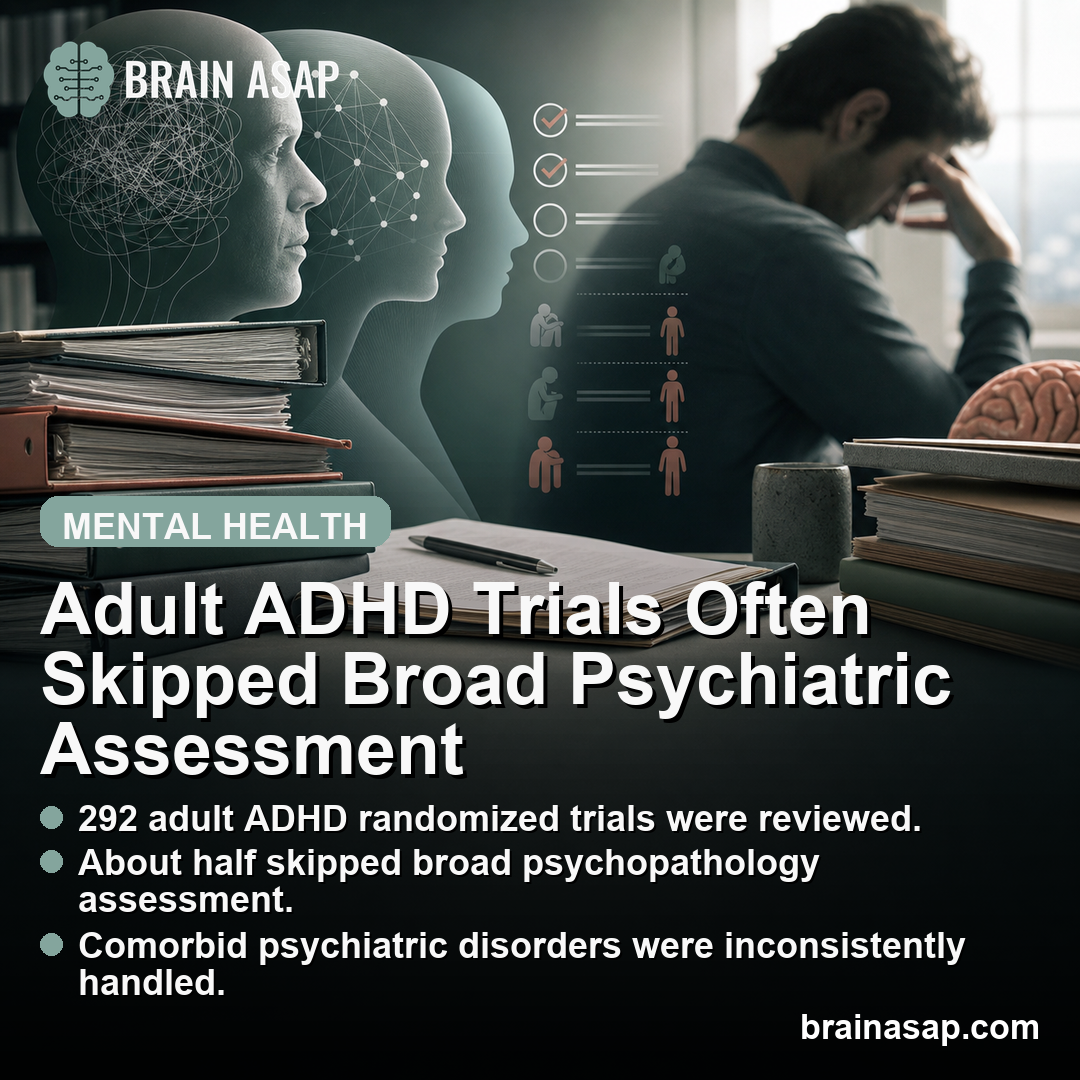
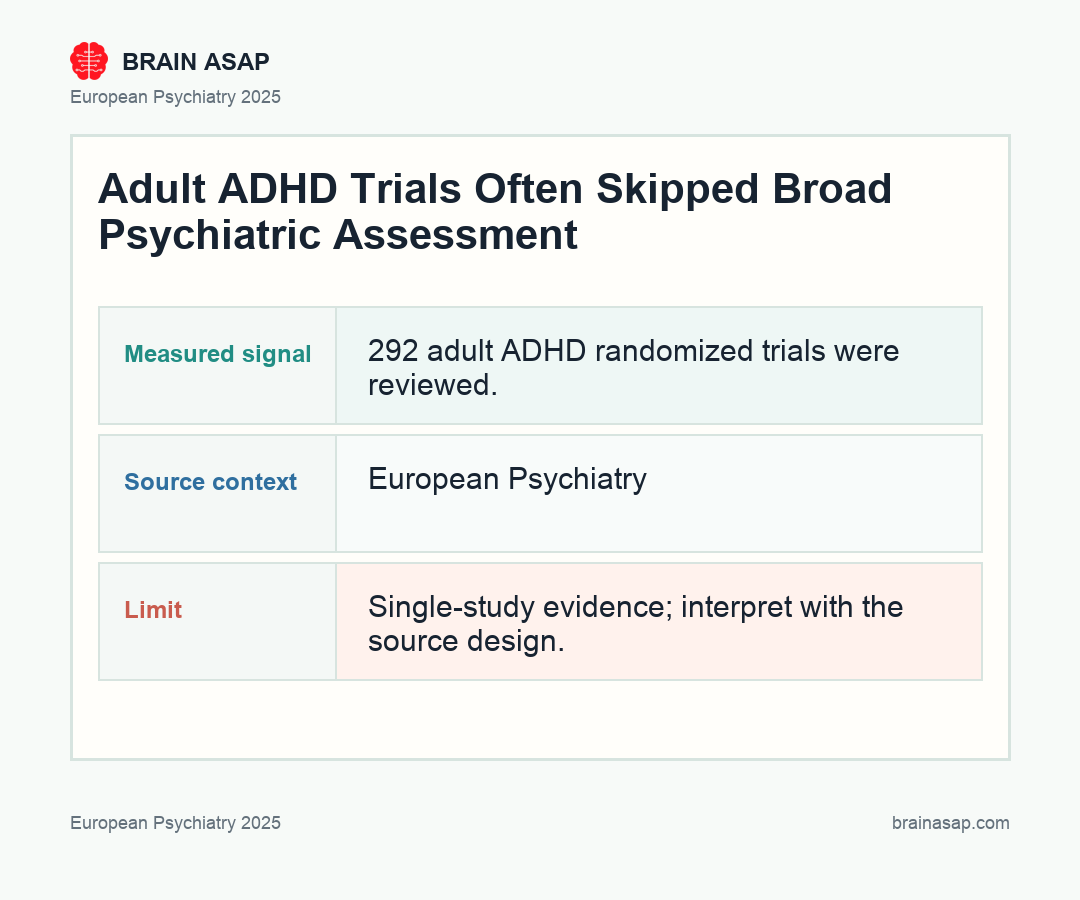
TL;DR: A 2025 scoping review in European Psychiatry screened 292 randomized trials of adults diagnosed with attention-deficit/hyperactivity disorder (ADHD) and reported that 49.7% did not assess general psychopathology and only 35% had the ADHD diagnosis allocated by a psychiatrist or psychologist.
Key Findings
- Half of the trials skipped a general psychopathology check: 49.7% of the 292 included randomized controlled trials allocated an adult ADHD diagnosis without an assessment of general psychopathology.
- Only 35% used a psychiatrist or psychologist as the diagnoser: 102 of 292 trials (35%) reported that a clinician allocated the ADHD diagnosis; 61% were unknown or computer-allocated, and 3% used a trained rater.
- More than half allowed psychiatric comorbidities in the sample: 157 of 292 trials (53.8%) accepted patients with co-occurring psychiatric diagnoses, while 87.7% claimed they applied a diagnostic hierarchy that should rule out ADHD when symptoms are better explained by another disorder.
- Semi-structured psychopathology interviews were rare: only 12.7% of trials used a semi-structured interview for general psychopathology, the format that ADHD diagnostic researchers often consider closer to a clinical gold standard than a structured rater-administered tool.
- Diagnostic methods varied widely: across 292 trials, no single method dominated, and 49.7% of trials relied on a clinical-diagnosis label without any structured or semi-structured psychopathology interview to support it.
Source: European Psychiatry (2025) | Studart et al.
Why a Scoping Review of Adult ADHD Diagnostic Methods Was Needed
Adult ADHD diagnoses have grown sharply over the past decade. The 2021 World Federation of ADHD International Consensus Statement put the rate at 2.5% of adults, but a more recent global meta-analysis estimated 6.75% of adults had symptomatic adult ADHD in 2020, equivalent to more than 366 million people worldwide.
The diagnostic criteria for ADHD were originally written for children, with parents and teachers providing observed-behavior reports. Applying the same criteria to adults has shifted those items from observed signs to self-reported experiences, a change researchers in this review describe as the “subjectivization” of the criteria.
That shift creates two practical problems for adult assessment. First, retrospective recall of childhood ADHD symptoms is unreliable.
Second, attention complaints are non-specific and overlap with depression, anxiety, trauma-related conditions, substance use, and the early stages of psychotic disorders. Without a broader psychopathology assessment, an ADHD-only screening can sweep up patients whose attention problems are a feature of another condition.
292 Adult ADHD Trials Were Screened From PubMed
Researchers from the Institute of Psychiatry at the University of São Paulo and the University of Copenhagen searched PubMed on December 5, 2024 with the string “ADHD OR Hyperkinetic Disorder AND Adult,” restricted to humans and randomized controlled trials. The search returned 706 records.
After title and abstract screening, 330 reports went to full-text review, and 38 were excluded.
The final sample was 292 randomized trials of adult ADHD. The team focused on the diagnostic procedures, not the trial findings.
For each trial, two reviewers extracted four pieces of information:
- Diagnostic methods: the specific instruments used to allocate ADHD, including ADHD-specific rating scales, clinical-diagnosis labels, and structured or semi-structured interviews for general psychopathology.
- Differential diagnosis approach: whether the trial described a hierarchical exclusion process that prioritized organic, psychotic, and mood disorders before ADHD.
- Comorbidity policy: whether the trial allowed participants with co-occurring psychiatric diagnoses such as anxiety or depression.
- Diagnoser qualifications: whether the trial reported that a psychiatrist, psychologist, trained rater, or computer-allocated method made the ADHD diagnosis.
Half of the Trials Did Not Assess General Psychopathology
The main quantitative result was that 49.7% of the 292 trials did not describe any procedure for assessing general psychopathology. That group was made up of three sub-categories:
- Clinical diagnosis plus an ADHD-specific rating scale: 86 trials (29.5%) reported a clinical ADHD label plus a self-report or clinician-rated ADHD scale, but no general psychopathology interview.
- Clinical diagnosis only: 37 trials (12.7%) reported only that patients had met DSM or ICD criteria for ADHD, with no structured assessment described.
- ADHD-specific interview or rating scale only: 22 trials (7.5%) used only an ADHD-specific interview or rating scale, with no clinical diagnosis or general psychopathology check.
Among the trials that did assess general psychopathology, structured interviews dominated. The Structured Clinical Interview for DSM (SCID) and similar instruments appeared in 134 of the 292 trials (45.9%) on their own or in combination with an ADHD-specific rating scale.
Only 37 trials (12.7%) used a semi-structured interview for general psychopathology, the conversational format in which a clinician steers the interview toward relevant psychopathology rather than reading preset items. Researchers have argued that semi-structured interviews administered by clinicians produce better diagnostic agreement than structured interviews administered by trained raters.
Only 35% of Trials Reported That a Clinician Made the ADHD Diagnosis
The team also asked who actually allocated the ADHD diagnosis in each trial:
- Psychiatrist or psychologist: 102 trials (35%).
- Unknown: 179 trials (61%) did not report the diagnoser’s qualifications.
- Trained rater: 10 trials (3%).
- Computer-allocated, confirmed by a neurologist or psychiatrist: 1 trial (0.5%).
The distribution affects trial validity because comparison studies have repeatedly shown that diagnoses allocated by trained raters using structured interviews disagree with consensus diagnoses made by experienced psychiatrists using semi-structured interviews.
A separate meta-analysis cited in the review reported that ADHD self-rating scales have a positive predictive value in the 10% range, meaning the majority of people who screen positive on a self-report scale do not meet diagnostic criteria when interviewed.
87.7% of Trials Claimed a Diagnostic Hierarchy They Could Not Practically Apply
DSM-5 specifies that ADHD cannot be diagnosed if the symptoms occur only during the course of a psychotic, mood, anxiety, personality, or substance use disorder, or if the symptoms are better explained by one of those disorders. That requires a general psychopathology assessment.
In this review, 87.7% of the trials stated that they followed a diagnostic hierarchy in which more severe disorders override an ADHD diagnosis.
Because half of the trials did not assess general psychopathology, applying that hierarchy was impossible for most of them. Researchers concluded that the stated adherence to a diagnostic hierarchy could not be implemented in practice for many of the included trials.
The comorbidity numbers reinforce that gap. 53.8% of trials accepted participants with co-occurring psychiatric diagnoses, 41.8% did not, and 4.4% did not report.
The combination of high comorbidity acceptance with weak general psychopathology screening makes it harder to know whether trial samples were patients with primary ADHD.
Single-Database Search, English-Only Inclusion, and Outcome-Free Scope Are Real Limits
The scoping review itself has constraints worth naming:
- Single-database search: the team searched only PubMed, which they describe as adequate for an overview of methodology but acknowledge does not capture every adult ADHD RCT in the literature.
- English-language trials only: non-English RCTs of adult ADHD diagnostic methods were excluded.
- No outcome analysis: the review did not test whether trials with weaker diagnostic procedures produced different efficacy estimates than trials with stronger procedures. The headline concern is methodological validity, not a measured bias in published treatment effects.
- Reporting depth varied: some trials referred back to a parent paper for diagnostic procedures, and 61% did not specify the diagnoser’s qualifications, which means “unknown” in this review reflects under-reporting as well as actual practice.
- Conference abstracts and registry-based studies were excluded: only full-text RCTs with direct patient assessment were eligible.
Skilled Differential Diagnosis Should Be the Adult ADHD Trial Standard
The review’s recommendation was direct. Because adult ADHD criteria depend on self-reported experiences and overlap with several other psychiatric disorders, a comprehensive differential diagnostic process by a skilled psychiatrist or psychologist should be the entry point for adult ADHD trials.
Two practical implications follow for the field:
- Trial design: investigators should plan a structured or, preferably, semi-structured interview for general psychopathology, conducted by a clinician, before randomizing participants. This would let trials apply the diagnostic hierarchy they already claim to use.
- Trial reporting: trials should always specify the diagnoser’s qualifications and the differential diagnosis steps, so that meta-analysts and clinicians can judge whether the enrolled sample resembles the patients they treat.
For clinicians reading new adult ADHD trials, the scoping review supplies a quick screening question. If the methods do not describe how the trial assessed general psychopathology and who made the ADHD diagnosis, the validity of the diagnosis in that sample is hard to take for granted.
Citation: DOI: 10.1192/j.eurpsy.2025.2447. Studart I, Henriksen MG, Nordgaard J. Diagnosing ADHD in adults in randomized controlled studies: a scoping review. European Psychiatry. 2025;68(1):e64.
Study Design: PRISMA-guided scoping review of randomized controlled trials of adult ADHD; categorical extraction of diagnostic methods, comorbidity policy, and diagnoser qualifications.
Sample Size: 292 randomized controlled trials of adult ADHD identified from PubMed; 706 records screened, 330 full texts assessed for eligibility.
Key Statistic: 49.7% of trials did not assess general psychopathology; 35% had a psychiatrist or psychologist allocate the ADHD diagnosis; 53.8% accepted participants with psychiatric comorbidity.
Caveat: Single-database search (PubMed only); English-language RCTs only; under-reporting may inflate the “unknown” diagnoser category; the review did not test whether weaker diagnostic procedures changed published efficacy estimates.