How Scientists Turned a Brief Ketamine High into a Two-Month Antidepressant Effect
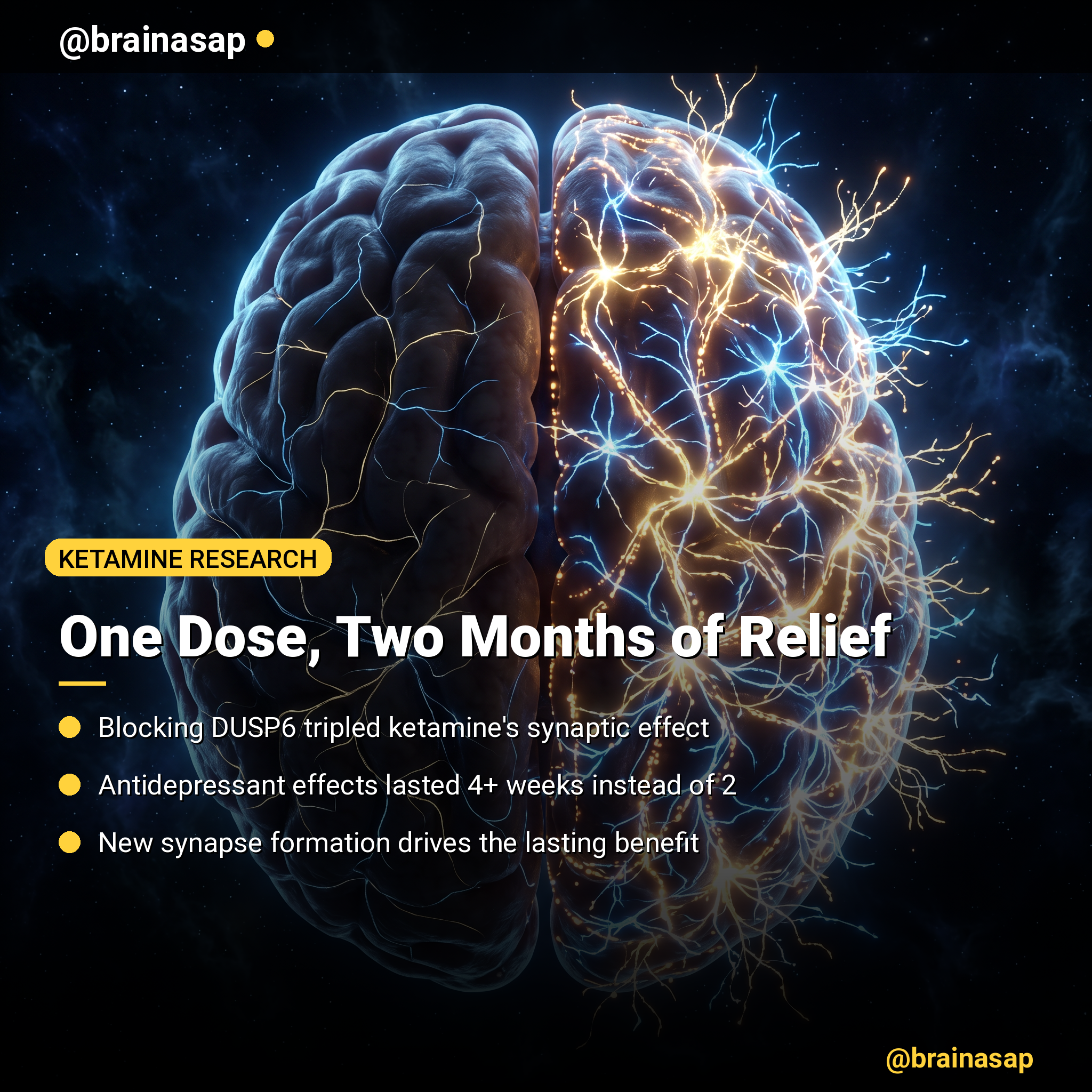
TL;DR: Blocking DUSP6 protein alongside ketamine extends antidepressant effects from 2 weeks to 4+ weeks in mice, potentially offering single-dose treatment instead of repeated infusions.
Ketamine works like almost nothing else in psychiatry. A single infusion can lift severe depression within hours, even in patients who’ve failed every other drug.
The problem? The magic doesn’t last. By week two, most patients need another dose, and repeat dosing raises concerns about addiction, dissociation, and the burden of endless clinic visits.
Now researchers have found a molecular lever that could sustain ketamine’s effects for weeks or months from a single treatment, by amplifying a cascade of signals ketamine naturally triggers in the hippocampus.
Key Findings
- 157% synaptic potentiation: Blocking the protein DUSP6 in mice co-treated with ketamine created a threefold amplification compared to ketamine alone (26.3% versus 58.7%).
- Extended behavioral effect: BCI-plus-ketamine treated mice showed reduced immobility in the forced swim test at 4 weeks post-treatment, while ketamine-alone effects vanished after 2 weeks.
- Dual mechanism—receptor + synapse: Increased surface expression of AMPA receptors (GluA1 and GluA2) at CA1 synapses and simultaneous generation of new excitatory synapses, suggesting both strengthening and proliferation of neural connections.
- TrkB dependency: Brain-derived neurotrophic factor signaling through TrkB receptors is essential; deleting TrkB from excitatory neurons abolished the behavioral benefits of DUSP6 inhibition.
- ERK persistence—25% elevation: Enhanced ERK phosphorylation persisted at 24 hours post-treatment only in the BCI-plus-ketamine group, whereas ketamine alone returned ERK to baseline by 24 hours.
- Sex-invariant effect: The antidepressant-like effects generalized across multiple behavioral tests and appeared in both male and female mice with no significant sex differences.
Source: Science (2025) | Ma et al.
The Durability Problem: Why Good Drugs Go Bad
Ketamine’s antidepressant action is almost absurdly fast—and almost absurdly fragile. It hits hard within hours by triggering a cascade that builds synaptic plasticity in the hippocampus.
But it fades. The synaptic strength returns to baseline, and so does the depression.
Patients need infusions every week or two.
Yet the mechanism gave researchers a clue: ketamine activates ERK signaling, a molecular pathway that strengthens neural connections. What if you could slow the “off switch” for that signal? That’s where DUSP6 inhibition comes in.
Tightening the Signal: DUSP6 as the Brake Pedal
Think of it simply: ERK is the accelerator, DUSP6 is the brake. DUSP6 is a phosphatase—an enzyme that turns ERK off.
DUSP6 is particularly abundant in the CA1 region of the hippocampus, where ketamine acts. Vanessa Ma and colleagues tested whether weakening DUSP6 could extend ERK signaling and ketamine’s effect.
They used BCI, an inhibitor that locks DUSP6 inactive. Mice received ketamine alone, BCI alone, both together, or vehicle.
At 24 hours, they measured synaptic potentiation. Ketamine alone produced a 58.7% synaptic potentiation, while BCI plus ketamine produced 157% synaptic potentiation—nearly triple the effect.
ERK phosphorylation remained elevated in the BCI-plus-ketamine group when it had returned to baseline in ketamine-alone mice.
Building and Rebuilding: Neurons Construct New Connections
What does 157% potentiation actually mean at the cellular level? The team used super-resolution microscopy to examine single molecules at the CA1 synapse.
The answer: both receptor insertion and new synapse building. Surface AMPA receptors—the glutamate sensors in excitatory synapses—increased in number per synapse and in absolute synapse count.
BCI-plus-ketamine treatment significantly increased the number of excitatory synapses in the CA1 region. Ketamine alone did not.
This reveals a critical mechanism: sustained potentiation requires both receptor insertion and synaptogenesis. Ketamine can briefly strengthen existing synapses, but without sustained ERK engagement, those synapses don’t proliferate and the effect wanes.
Blocking DUSP6 kept ERK active longer, enabling structural growth of the synaptic network. New synapse formation is a durable structural change—the kind of rewiring that could underpin weeks of mood improvement.
[Insert image: diagram showing ERK signaling, AMPA receptor surface expression, and synaptic potentiation in BCI + ketamine versus ketamine alone]
The Behavioral Payoff: Depression Reversed for Months
Does increased potentiation translate to antidepressant behavior? Yes. In the forced swim test, ketamine alone reduced immobility at 24 hours and 2 weeks, but the effect vanished by week 4.
BCI-plus-ketamine treated mice showed reduced immobility at both 2 and 4 weeks, consistent in both sexes.
This extended effect required TrkB signaling, the receptor for brain-derived neurotrophic factor (BDNF). When researchers deleted TrkB from excitatory neurons, the benefits disappeared.
Notably, MK801—an NMDA antagonist with ketamine’s immediate action but no lasting effect—did not benefit from DUSP6 inhibition. This specificity suggests that the ERK-TrkB-synaptogenesis axis is the therapeutic engine.
The Path to the Clinic: One Shot, Long Duration
One question remains: does potentiation at 24 hours predict behavior at 2 and 4 weeks? At 2 weeks, BCI-plus-ketamine mice no longer showed augmented potentiation—it had returned to baseline.
Yet their behavioral antidepressant effect persisted. This is crucial: the brief window of enhanced plasticity initiates a cascade that outlasts the molecular signal. A single co-treatment primes the system, with downstream changes doing the heavy lifting.
For patients, the implications are profound: a single infusion with a DUSP6 inhibitor could sustain mood improvement for weeks or months. A brief pharmacological nudge at ketamine administration could reorient the hippocampus toward recovery.
Critical Caveats
Several important caveats remain:
- No human data yet: BCI has not been tested in humans, and ERK signaling overlaps with proliferative and growth pathways, requiring careful safety evaluation.
- Behavioral test limitations: The forced swim test is a simplified proxy for human depression and may not capture the full complexity of mood disorders.
- Species differences: Mouse hippocampal circuits are not identical to human prefrontal-limbic networks, and mechanisms may not translate directly.
The Promise Ahead
The specificity of ERK signaling, persistence of behavioral effects, and clean dose-response data suggest this approach could transform ketamine therapy from repeated infusions to single-session treatment.
Full Citation:
Ma, Z. Z., Guzikowski, N. J., Kim, J. W., Kavalali, E. T., & Monteggia, L. M. (2025). Enhanced ERK activity extends ketamine antidepressant effects by augmenting synaptic plasticity. Science, 388(6747), 646–655. DOI: 10.1126/science.abb6748
Affiliations: Department of Pharmacology and Vanderbilt Brain Institute, Vanderbilt University, Nashville, TN, USA.
Funding: This research was supported by grants from the National Institutes of Health and the Vanderbilt Brain Institute.