When Depression Threatens Pregnancy: A 34% Elevated Miscarriage Risk
TL;DR: Untreated depression increases miscarriage risk by 34% across nearly 9 million women, but antidepressants reduce that risk to 24%—meaning the medication is safer than the disease during pregnancy.
For decades, obstetricians have asked the wrong question about depression in pregnancy. They worried: Is the antidepressant dangerous? New data suggests a more sobering reality—the untreated disease itself may be riskier than the medicine.
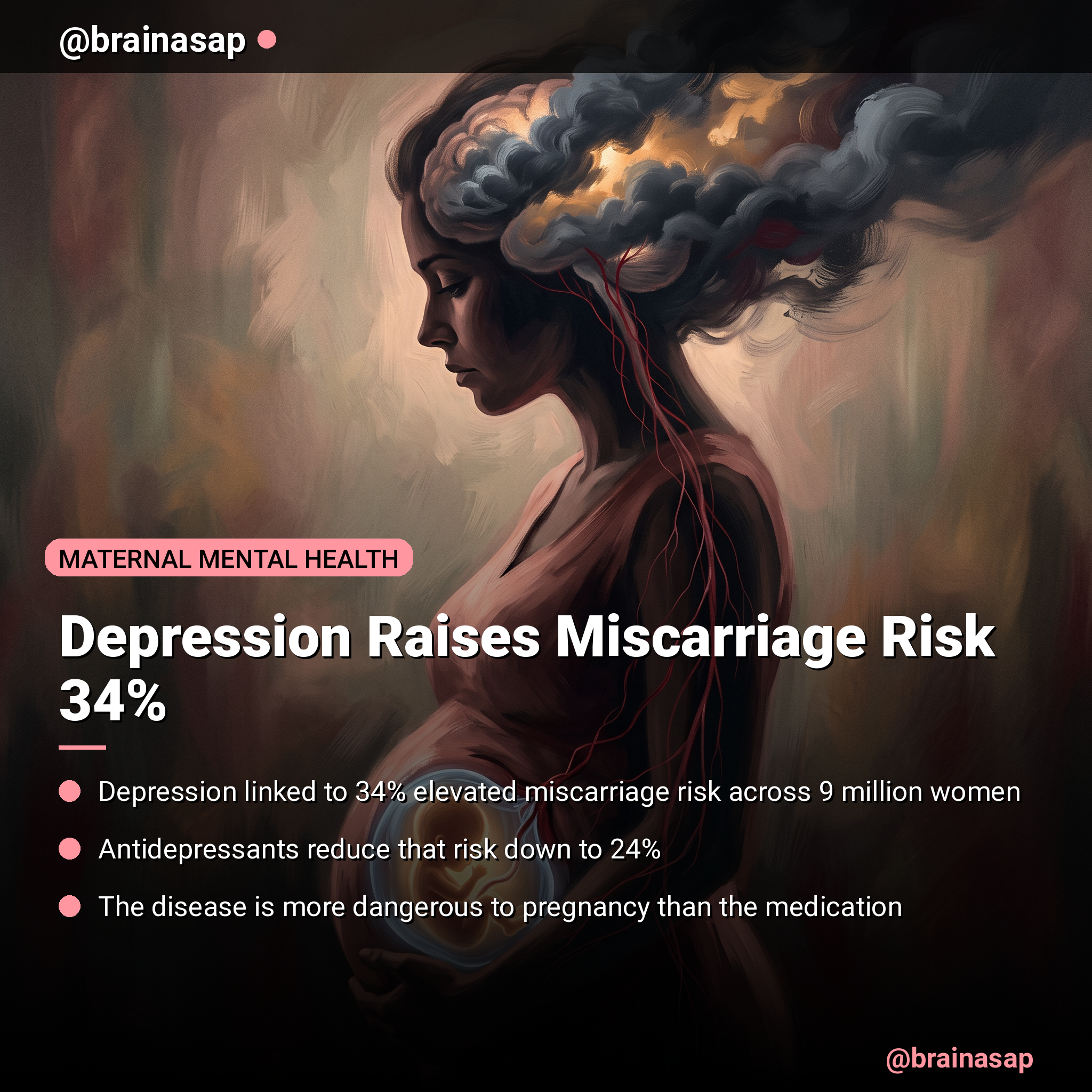
A sweeping meta-analysis of 31 studies, published in 2025, reveals that women with depression face a 34% elevated risk of spontaneous abortion. The dataset is massive: nearly 9 million women tracked across Europe, North America, Asia, and Australia.
The critical finding: antidepressants lower that risk to 24%—meaning the medication reduces baseline miscarriage risk by roughly 29%. This shifts the entire conversation about mental health and pregnancy loss. For a pregnant woman with depression, the choice between treating and untreating becomes clear.
Key Findings
- 34% elevated risk: Across 31 studies and nearly 9 million women, depression increased spontaneous abortion risk by an average of 34% (relative risk = 1.34, 95% CI [1.27, 1.41], p < 0.001)—the largest meta-analytic synthesis of this association ever conducted.
- Depression beats depressed geography: The association held in Europe, North America, Asia, and Australia, ruling out the possibility that a single region’s healthcare system or genetics account for the finding.
- Consistent across study designs: Twenty-three prospective cohort studies (the gold standard), three retrospective cohorts, and five case-control studies all reached the same conclusion, eliminating methodology as an explanation for the result.
- Antidepressants lower the risk: Women taking antidepressants showed only 24% elevated risk compared to the 34% in untreated depression—meaning medication reduces baseline risk by roughly 29%, a clinically meaningful difference.
- High heterogeneity signals multiple mechanisms: The I² value of 87% indicates substantial variation between studies, suggesting depression increases miscarriage risk through multiple biological and behavioral pathways rather than one linear cause.
- Minimal publication bias: Egger regression testing (P = 0.055) revealed a low risk of bias, meaning the literature is not skewed toward positive results; this is likely the true association.
Source: BMC Psychology (2025) | Liu et al.
The Evidence That Settles a Decade-Long Argument
For the first time, a meta-analysis has separated depression from its treatment. Previous work conflated the two, making it impossible to know whether medication or illness drove miscarriage risk. Liu and colleagues solved this by examining women in three groups: untreated depression, depression treated with medication, and several specific antidepressant classes.
The pattern was striking. Untreated depression carried a 34% elevated risk. Women on antidepressants showed only 24% elevated risk. This isn’t trivial—medication reduces baseline risk by roughly 29%. For a pregnant woman with depression, this reshapes the entire decision. The drug isn’t the danger. The disease is.
What makes this conclusion powerful is the evidence behind it. The analysis drew from 23 prospective cohort studies—the gold standard in observational research. These studies followed women before pregnancy, tracking them through conception and loss rather than reconstructing histories afterward. This prospective design eliminates memory bias plaguing retrospective work.
When 23 prospective cohorts across Europe, Asia, and North America reach the same conclusion, and case-control and retrospective studies confirm it, you’re looking at something real, not statistical noise.
The Biological Mechanisms Linking Depression to Pregnancy Loss
How does depression increase miscarriage risk? Multiple mechanisms operate simultaneously through hormonal and behavioral pathways.
Hormonal mechanisms:
- Stress hormones flood the system. Depression dysregulates the hypothalamic-pituitary-adrenal axis—the body’s stress thermostat. In healthy pregnancy, cortisol rises modestly; in depression, it spikes and stays elevated. This elevated stress hormone crosses the placenta and reaches the fetus. Sustained cortisol exposure impairs placental development and triggers inflammatory cascades that drive miscarriage.
- Inflammation tips the immune balance. Depression fans systemic inflammation, elevating cytokines throughout the body. Early pregnancy is immunologically paradoxical—the mother must accept the foreign fetus while fighting off pathogens. Depression-driven inflammation tips this balance toward rejection. The placenta becomes inflamed. Immune cells that should tolerate the fetus instead attack it.
- Pregnancy-sustaining hormones decline. Depression suppresses estradiol and thyroid hormone—both essential for pregnancy. Thyroid hormone deficiency alone is a documented miscarriage risk factor. Estradiol promotes placental blood flow and fetal growth. Without adequate levels, the pregnancy cannot sustain itself.
Behavioral mechanisms: Beyond hormones, depression breeds lifestyle changes that directly undermine pregnancy:
- Nutrition: Poor diet depletes micronutrients critical for placental development.
- Sleep: Disrupted sleep further dysregulates stress hormones and immune function.
- Substance use: Smoking and alcohol exposure directly harm the developing fetus.
- Prenatal care: Missed visits mean missed opportunities to detect and manage complications.
Together, these hormonal and behavioral pathways compound the miscarriage risk. Depression kills pregnancies through multiple channels simultaneously.
Why This Evidence Is So Strong
This meta-analysis stands out for multiple layers of rigor:
- Exceptional study quality: 21 of 31 studies scored 8/8 on the Joanna Briggs Institute quality tool—the highest possible rating. That’s 68% of the data from top-tier sources.
- Consistency across methods: Prospective cohorts, retrospective cohorts, and case-control designs all reached the same conclusion. When methods this different converge, the answer is likely true.
- Geographic breadth: Studies from Europe, Asia, North America, and Australia all showed the depression-miscarriage link. This rules out regional healthcare quirks or genetic background as explanations.
Bias and sensitivity checks:
- Minimal publication bias: Egger regression testing revealed low risk that the literature is skewed toward positive results.
- No outlier effect: Sensitivity analyses confirmed that no single study was pulling the entire result disproportionately.
- Confounding adjustment validates findings: Studies that carefully adjusted for age and socioeconomic status showed stronger associations than unadjusted studies—the reassuring pattern you’d expect if earlier work was underestimating rather than overestimating the true depression-miscarriage relationship.
The Treatment That Reduces Risk, Not the Medication That Causes It
So what matters more—the depression or the pill? The numbers are unambiguous. Untreated depression: 34% elevated miscarriage risk. Depression treated with antidepressants: 24% elevated risk. Medication reduces baseline risk by roughly 29%.
This isn’t theoretical. A 20% baseline miscarriage risk rises to 27% (untreated) versus 24% (treated). For a woman deciding whether to continue her antidepressant, that difference could mean keeping a pregnancy that otherwise would be lost.
The evidence doesn’t say antidepressants are risk-free in pregnancy—women on medication show elevated odds compared to non-depressed controls. But “elevated compared to healthy controls” differs fundamentally from “worse than untreated disease.” The latter is what clinicians and patients should fear.
For a woman with moderate to severe depression, the medicine is the better choice, even in pregnancy.
What This Means for Prenatal Care
- Screen earlier, treat faster. Depression screening rates in pregnancy remain low. The PHQ-9 takes three minutes and costs nothing. Screening should happen before pregnancy, at the first prenatal visit, and periodically after.
- Treat depression like any other pregnancy complication. Gestational diabetes is managed aggressively because it threatens fetal health. Depression should be treated with equal urgency. A 34% elevated miscarriage risk is a quantifiable threat that warrants intervention.
- Psychotherapy is real treatment, not a substitute. Cognitive behavioral therapy and interpersonal therapy have evidence supporting their effectiveness in pregnancy. But for moderate to severe depression, they work better combined with medication than alone.
- Shift the conversation from avoidance to treatment. Women often want to stop antidepressants in pregnancy out of fear. This meta-analysis rewrites that conversation: the fetus is harmed more by untreated maternal depression than by the antidepressant. Clinicians should assess severity, prior medication response, psychotherapy access, and the woman’s preferences to build an individualized treatment plan, not blanket avoidance.
Where the Data Comes From
Liu and colleagues searched three major medical databases—PubMed, Web of Science, and Embase—from inception through 2024 for studies assessing depression before pregnancy and measuring spontaneous abortion. They found 2,164 potentially relevant papers.
After removing duplicates and screening titles, abstracts, and full texts, 31 studies survived final inclusion criteria. Studies were excluded if they assessed depression only after miscarriage (risking reverse causation), used cross-sectional designs (offering no temporal sequence), or overlapped in their patient populations. The final dataset included 816,407 women with depression and 8,103,546 without.
The researchers extracted effect sizes from each study—relative risks, odds ratios, hazard ratios—and pooled them using random-effects meta-analysis, a statistical approach that acknowledges differences between studies rather than assuming all measure the same thing. Sensitivity analyses tested whether any outlier study distorted the result. Subgroup analyses examined whether the depression-miscarriage link differed by geography, study design, depression diagnosis method, or medication use.
The high heterogeneity (I² = 87%) reflects real-world differences in how researchers assess depression and define miscarriage across countries and studies—not statistical noise, but the realistic variation you’d expect when pooling decades of work.
[Insert image: forest plot showing relative risk of spontaneous abortion in depression (untreated vs treated with antidepressants)]
Full Citation: Liu J, Zhao M, Zhuan J, et al. Depression with risks for spontaneous abortion: a meta-analysis. BMC Psychology. 2025;13:1148. DOI: 10.1186/s40359-025-03484-4
Study Design: Systematic review and meta-analysis of 31 observational studies (23 prospective cohort, 3 retrospective cohort, 5 case-control)
Sample Size: 8,919,953 total women; 816,407 with depression; 8,103,546 without depression
Key Statistic: RR = 1.34 (95% CI [1.27, 1.41]), p < 0.001; I² = 87%
Quality Assessment: Joanna Briggs Institute Critical Appraisal Tool: 21 of 31 studies scored 8/8; 10 scored 6/8
Affiliation: Department of Gynaecology, Cangzhou City Hebei People’s Hospital, China