Cannabis Did Not Just Blur Word Lists. It Hit Everyday Memory Too
TL;DR: A randomized vaporized-THC trial found broad acute memory impairment, including false memories, prospective memory, source memory, and temporal order memory, with no meaningful dose split between 20 and 40 mg.
Key Findings
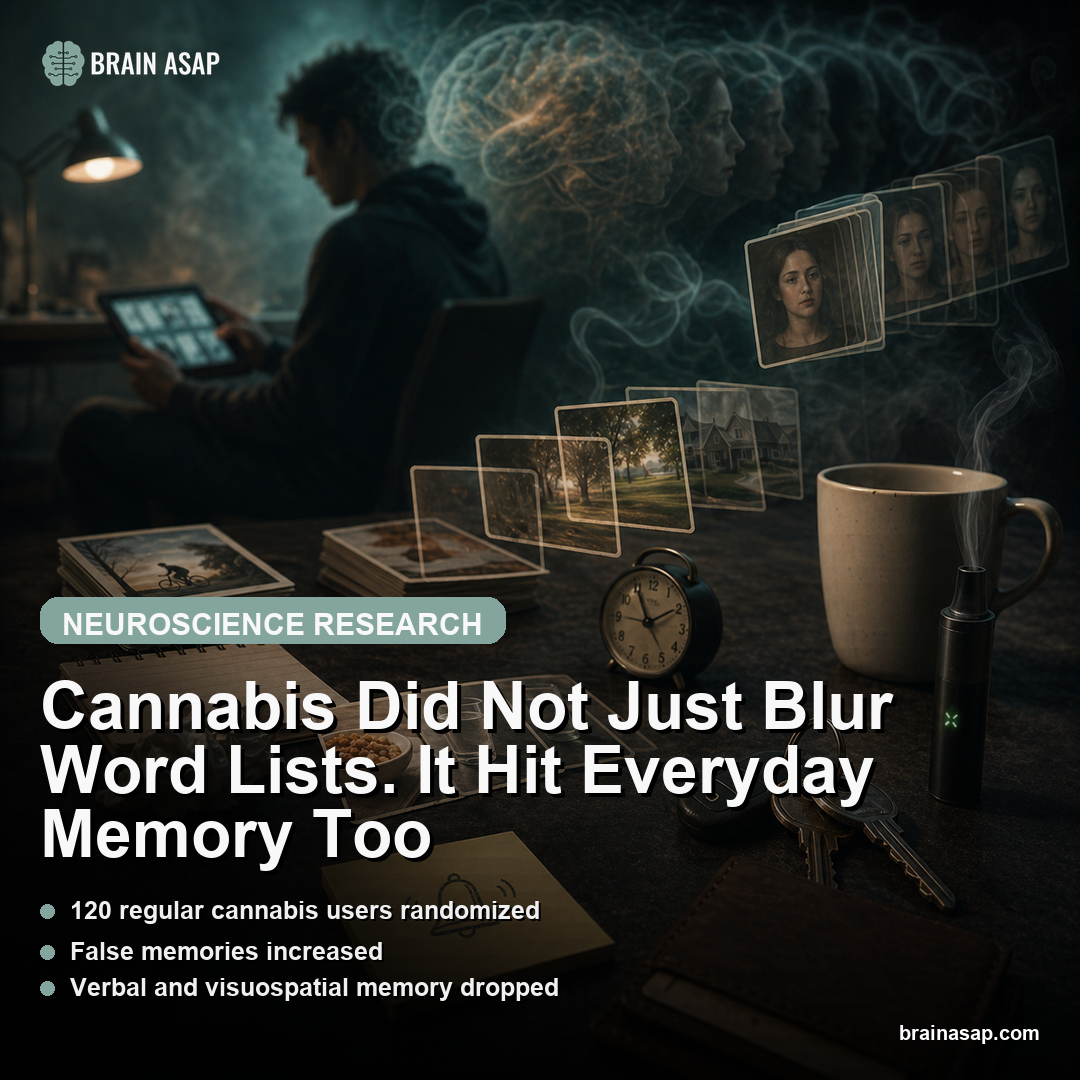
- 120 regular cannabis users randomized: Participants vaporized placebo cannabis, 20 mg THC, or 40 mg THC under double-blind conditions.
- False memories increased: THC made participants more likely to recall words that had not been presented.
- Verbal and visuospatial memory dropped: Immediate and delayed verbal memory, working memory, and immediate and delayed visuospatial memory were impaired versus placebo.
- Everyday memory domains were hit: Event-cued prospective memory, source memory, and temporal order memory were all worse after THC.
- 20 mg and 40 mg looked similar: The study did not find meaningful differences between the moderate and high THC dose groups.
Source: Journal of Psychopharmacology (2026) | Cuttler et al.
Acute cannabis intoxication is usually discussed as a short-term memory problem, but memory is not one thing. This study tested the forms of memory people actually lean on during a day: remembering what happened, where it came from, what order it happened in, and what you meant to do later.
Why False Memories Are More Than Forgetfulness
Forgetting a word is one kind of impairment. Confidently remembering a word that was never there is another. THC increased susceptibility to false memories, which means intoxication can distort the contents of memory rather than simply lowering recall volume.
The distinction is important for real life. A person who forgets an instruction knows something is missing. A person who misremembers the source or order of information may act on a memory that feels complete but is wrong.
How the Trial Mapped Memory Beyond the Usual Word List
The trial’s strongest feature is breadth. Cannabis research has often leaned on verbal memory tasks because they are efficient and well validated.
This study added several memory domains that better approximate everyday cognition:
- Prospective memory: remembering to do something later.
- Source memory: remembering where information came from.
- Temporal order memory: keeping sequences straight.
- Visuospatial memory: remembering visual locations and spatial patterns.
THC disrupted these everyday memory systems, which makes the result more ecologically serious than another word-list impairment alone.
What the Missing 20-versus-40 mg Dose Split Changes
The absence of a clear dose difference is not a free pass for the lower dose. It suggests that 20 mg was already enough to produce measurable impairment across many domains in regular users.
That finding is especially relevant as commercial cannabis products make higher THC doses easy to consume. Users may expect bigger impairments only at the higher end, but this trial suggests the impairment curve can already be steep at moderate acute exposure.
Prospective Memory Captures Everyday Cannabis-Related Forgetting
Prospective memory is the ability to remember to do something later. It is the memory system behind taking medication after dinner, sending a message when you get home, or turning off the stove after a timer. It is less glamorous than recalling a word list, but it is often more important for daily functioning.
This trial’s detection of acute cannabis effects on event-cued prospective memory therefore matters. It means intoxication can interfere with future-intention tracking, not just the storage of facts. That has practical consequences for driving plans, caregiving tasks, work responsibilities, and medication routines.
The result also helps explain why users can feel globally functional while still making specific memory errors. A person may hold a conversation and remember broad context but fail at the delayed intention which makes the day run safely.
How Source and Temporal Order Memory Change the Risk Profile
Source memory asks where information came from. Temporal order memory asks what happened first. These abilities keep conversations, instructions, and events organized.
When they degrade, people can feel confident about details while misplacing the origin or sequence of those details.
THC’s effects on these domains make acute intoxication more than a simple recall deficit. A person may remember a fact but misattribute who said it, or remember two events but invert their order. In social, academic, or workplace settings, those errors can be more consequential than forgetting outright.
This is why the study’s broad task battery is important. It captures the architecture of memory as a set of interacting systems. Cannabis did not selectively dent one fragile laboratory measure; it disrupted a suite of processes that support everyday cognition.
Why Regular Users Still Showed Acute Impairment
The participants were regular cannabis users, not naive volunteers. The reason is tolerance is often used informally to downplay acute impairment. The trial suggests that regular use did not eliminate measurable memory disruption under controlled THC exposure.
The lack of a clear 20-versus-40 mg difference also deserves careful reading. It could reflect a ceiling effect for some tasks, limited sensitivity to dose separation, or the possibility that 20 mg was already enough to impair the measured systems.
Whatever the reason, it weakens the assumption that only high-dose intoxication is important.
The safest interpretation is functional rather than moral. Acute THC exposure can disrupt memory systems needed for reliable daily action. People can use that information to plan around intoxication: avoid tasks where false recall, missed intentions, or confused sequencing would carry consequences.
What Cannabis Memory Studies Should Test After This
The next question is how long the functional window lasts. This trial captured acute intoxication, but real-world decisions often happen as users feel partly recovered. Testing memory domains across the rising, peak, and descending phases of intoxication would help people understand when prospective and source-memory risks remain meaningful.
Product type also matters. Vaporized THC is experimentally controllable, but commercial cannabis includes edibles, concentrates, mixed cannabinoid ratios, and variable terpene profiles. A dose that looks moderate on paper may produce a different time course depending on route and user tolerance.
Finally, the field needs more ecologically valid tasks. Remembering to take a mock medication, follow a multi-step cooking instruction, or report the source of a message could translate the cognitive findings into daily-life risk more clearly than any single laboratory score.
Why the Study Avoids the Usual Cannabis Debate Trap
Cannabis discussions often collapse into whether the drug is good or bad. This trial is more useful because it is narrower.
It asks what happens to specific memory systems during acute intoxication under controlled dosing, and the answer is broad but time-limited impairment.
That framing respects both realities: adults may choose to use cannabis, and intoxication can still make certain cognitive tasks unreliable.
The evidence is strongest when it is practical. Do not plan, drive, study, medicate, or make source-dependent decisions while the memory systems needed for those tasks are under THC’s influence.
For cannabis policy and personal use, that specificity is the whole point. The trial does not settle questions about chronic use, medical indications, or adult autonomy. It shows that during intoxication, memory systems needed for everyday reliability become less trustworthy, even in people who regularly use cannabis.
Why This Trial Is About Function, Not Moralizing
The study does not say cannabis users are globally cognitively impaired. It tests acute intoxication in regular users and shows that several memory systems are disrupted during that state.
The practical message is narrow but important: tasks requiring accurate recall, sequencing, source tracking, or remembering future intentions are exactly the tasks to avoid while intoxicated.
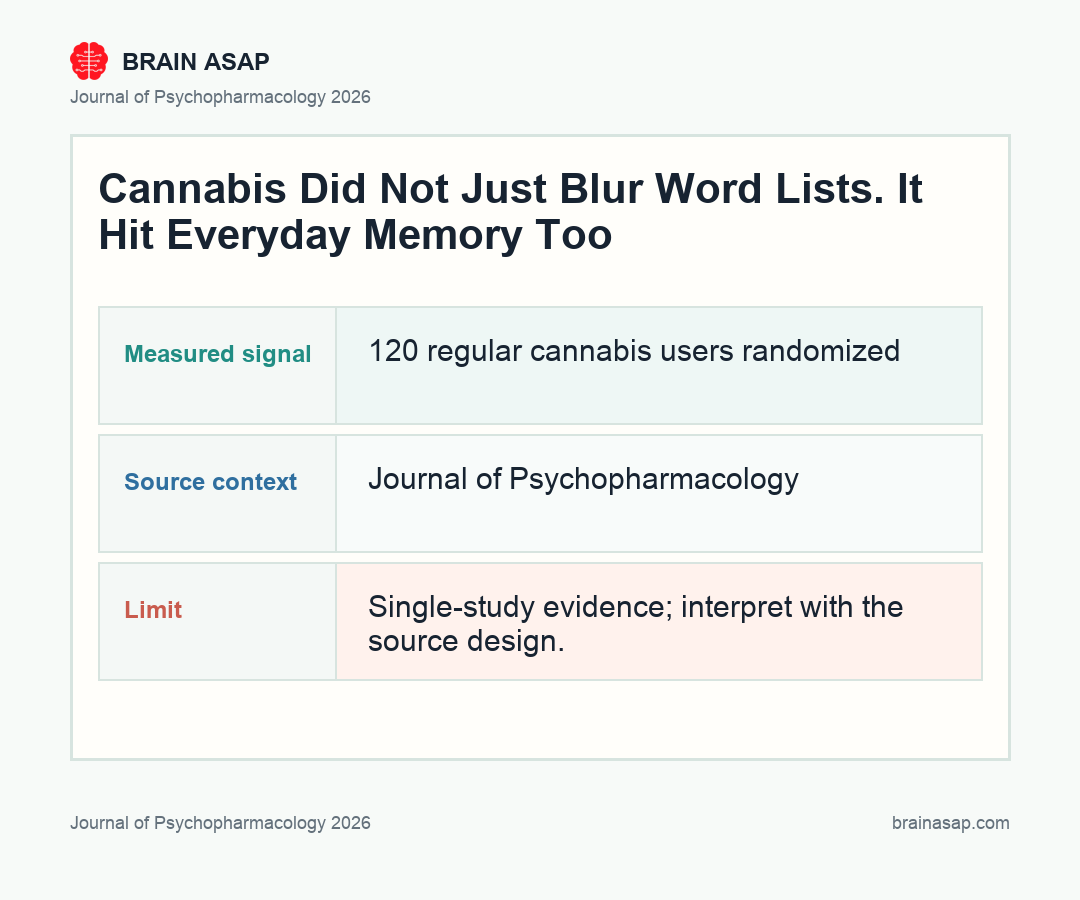
Paper: Mapping the acute effects of cannabis on multiple memory domains: A randomized, double-blind, placebo-controlled study. Journal of Psychopharmacology. 2026. DOI: 10.1177/02698811261416079
Authors: Cuttler et al.
Study Design: Randomized, double-blind, placebo-controlled vaporized cannabis experiment.
Sample Size: 120 regular cannabis users assigned to placebo, 20 mg THC, or 40 mg THC.
Key Statistic: THC impaired most tested memory domains, and 20 mg did not differ meaningfully from 40 mg.