Alpha-Synuclein Testing Could Clarify Dementia Diagnosis
TL;DR: In 398 memory-clinic patients, alpha-synuclein seed testing identified Lewy body dementia with 95% sensitivity and revealed hidden synuclein positivity in 15.8% of Alzheimer’s disease cases.
Key Findings
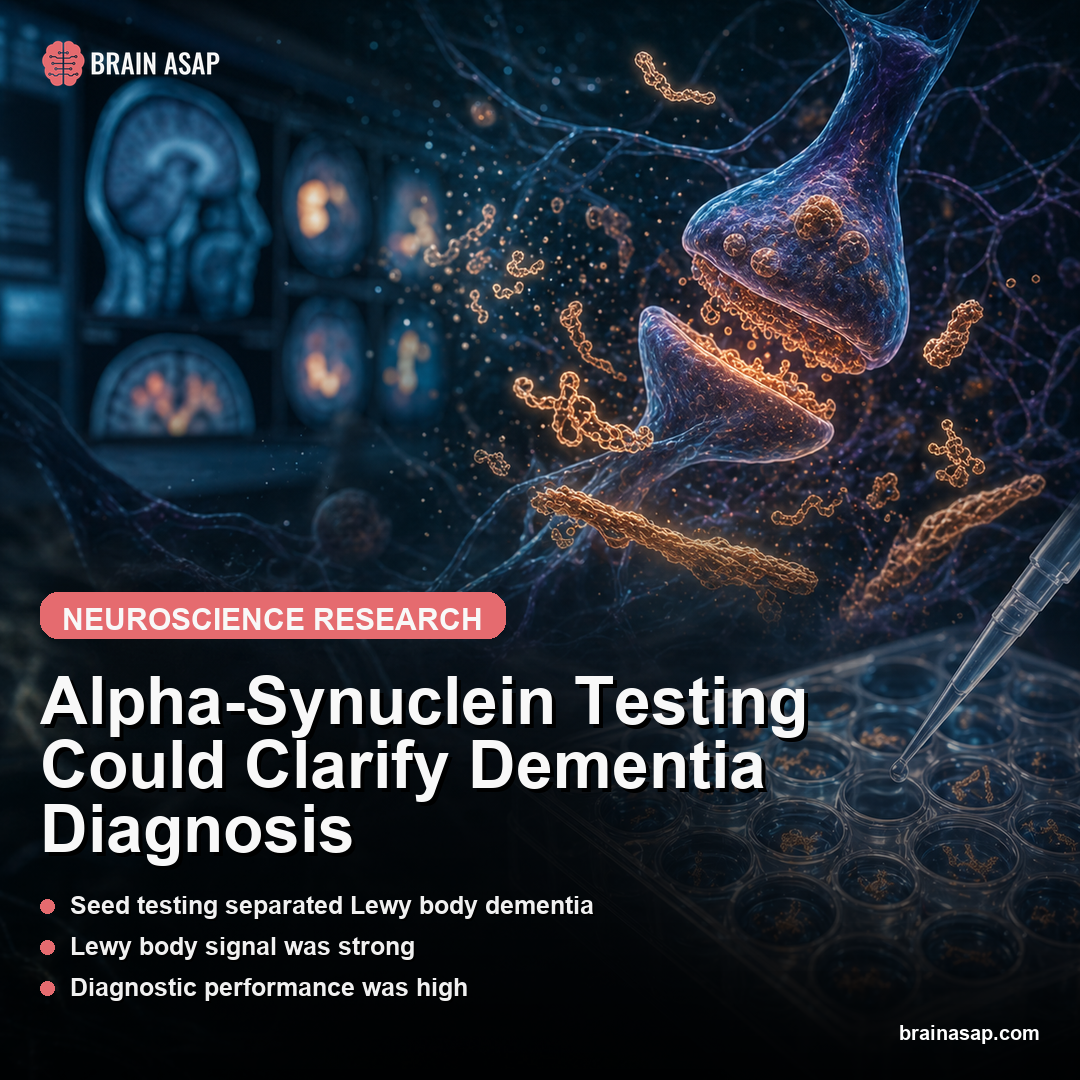
- Seed testing separated Lewy body dementia: The ALZAN cohort recruited memory-clinic patients from Montpellier, Nimes, and Perpignan between November 2022 and July 2024.
- Lewy body signal was strong: 19 of 20 patients with Lewy body dementia tested positive for alpha-synuclein seeding activity.
- Diagnostic performance was high: The assay showed 95% sensitivity and 93.5% specificity for distinguishing Lewy body dementia from patients without Lewy body dementia or Alzheimer’s disease.
- Alzheimer’s co-pathology appeared: 32 of 203 Alzheimer’s disease patients, or 15.8%, were positive for alpha-synuclein seeding activity.
- Routine biomarkers missed part of the explanation: In Alzheimer’s patients, alpha-synuclein positive and negative groups showed few blood or cerebrospinal fluid biomarker differences beyond a lower cerebrospinal fluid (CSF), the fluid surrounding the brain and spinal cord A beta 42/40 ratio.
Source: medRxiv (2026) | Jourdan et al.
Dementia diagnosis is often treated as a sorting exercise: Alzheimer’s disease over here, Lewy body dementia over there, frontotemporal dementia somewhere else. Biology is messier. Many brains carry more than one disease process at the same time.
The Protein That Does Not Stay in Its Lane
Alzheimer’s disease is defined biologically by amyloid and tau. Lewy body dementia is defined by alpha-synuclein, the misfolded protein that forms Lewy bodies and Lewy neurites. In real patients, those borders often blur.
Autopsy studies have long shown that alpha-synuclein can appear in Alzheimer’s brains, while amyloid and tau can appear in Lewy body disease. The clinical problem is that autopsy is too late to guide care. Doctors need a way to detect that biology while patients are alive.
Seed amplification assays are one answer. They test whether misfolded alpha-synuclein in cerebrospinal fluid can trigger further aggregation in a controlled lab reaction. If it can, the sample is considered positive for alpha-synuclein seeding activity.
The concept is borrowed from the biology of protein misfolding. A tiny amount of abnormal protein can act like a seed, encouraging normal protein to adopt the same abnormal shape. The assay amplifies that process enough for a lab instrument to detect it.
A Routine Memory-Clinic Test Bed
The ALZAN cohort included 398 people evaluated in routine memory clinics. All participants had CSF and blood sampling, cognitive assessment with the Mini-Mental State Examination, and clinical diagnoses confirmed independently by two senior neurologists.
The cohort was clinically mixed, which is exactly what makes the study useful. It tested the assay in the kind of diagnostic gray zone that memory clinics actually face.
- 203 patients: clinically classified as Alzheimer’s disease.
- 20 patients: clinically classified as Lewy body dementia.
- 30 patients: clinically classified as frontotemporal dementia.
- 138 patients: placed in an “other conditions” group that included mixed clinical presentations.
Alpha-synuclein status was determined using RT-QuIC, a real-time quaking-induced conversion assay. Each CSF sample was analyzed in quadruplicate, and positivity was defined by a fluorescence threshold showing seeded aggregation.
The quadruplicate design is important because the test is not a simple concentration measurement like many blood assays. It is a reaction-based readout. The researchers watched whether the sample could initiate aggregation over time, then used predefined thresholds to classify it.
The Lewy Body Signal Was Hard to Miss
The clearest result was in Lewy body dementia. Nineteen of 20 patients in that group tested positive, giving the assay 95% sensitivity in this cohort. Specificity was 93.5% for distinguishing Lewy body dementia from patients without Lewy body dementia or Alzheimer’s disease.
The negative predictive value was especially high at 99.4%. In practical terms, a negative result can be useful for making Lewy body disease less likely, at least in a similar clinical setting. Positive results still need interpretation in context because mixed pathology is common.
The assay also found alpha-synuclein positivity in 32 of 203 Alzheimer’s disease patients. That 15.8% rate is best read as possible co-pathology: Lewy-body biology appearing alongside an Alzheimer’s diagnosis, where conventional Alzheimer’s biomarkers does not necessarily capture it well.
Here, the result becomes clinically provocative. A patient can meet Alzheimer’s criteria and still carry Lewy-body biology that affects symptoms, prognosis, or treatment response. The label “Alzheimer’s disease” may be correct but incomplete.
Blood and CSF Biomarkers Did Not Fully Explain It
Across the full cohort, alpha-synuclein positive patients had lower Mini-Mental State Examination scores, lower CSF A beta 42/40 ratios, and higher plasma glial fibrillary acidic protein (GFAP), an astrocyte protein that can rise with brain injury or inflammation. But those differences partly reflected the uneven mix of diagnoses across positive and negative groups.
Within the Alzheimer’s group, the picture was narrower. Alpha-synuclein positive Alzheimer’s patients had a lower CSF A beta 42/40 ratio, suggesting greater amyloid burden, but most other CSF and blood biomarkers did not differ significantly.
That is the clinical point. Amyloid, tau, GFAP, and neurofilament light can be powerful markers, but they do not directly measure alpha-synuclein seeding. A patient can look like Alzheimer’s on standard biomarkers and still carry additional synuclein biology.
The study also found no alpha-synuclein positivity in the frontotemporal dementia group. A zero result in 30 people does not guarantee the assay will stay perfectly clean in every clinical population, but it supports the idea that the signal was not simply a nonspecific marker of neurodegeneration.
The “other” group showed a smaller positivity rate of 7.9%. That mixed category is harder to interpret because it can include different neurological conditions and subjective cognitive complaints. Still, it reinforces why the test should be read alongside clinical context rather than as a standalone verdict.
Mixed Alzheimer’s and Lewy Pathology Can Change Dementia Diagnosis
Hidden alpha-synuclein pathology can help explain why patients with the same Alzheimer’s biomarker profile sometimes progress differently or show different symptoms. Lewy body biology is linked to hallucinations, fluctuations, parkinsonism, sleep disturbance, and cognitive patterns that do not always fit a clean Alzheimer’s template.
The study did not prove that alpha-synuclein positivity independently worsened cognition in Alzheimer’s disease. The authors were careful about that limitation. The cohort lacked longitudinal follow-up, and clinical features such as hallucinations and fluctuations were not deeply analyzed.
Still, the result supports a more layered approach to dementia diagnosis. Instead of asking which single label fits best, clinicians may increasingly ask which protein processes are active in the same patient.
That shift could matter for clinical trials. If a trial enrolls people based only on amyloid or tau status, hidden alpha-synuclein co-pathology could add noise to outcomes. Identifying that subgroup can help researchers understand why some patients decline faster, respond differently, or show symptoms outside the expected pattern.
Alpha-Synuclein Seeding Adds a Missing Dementia Biology Layer
Because this is a preprint, the findings still need peer review. The result fits a broader movement in dementia research: moving from syndrome labels toward biological profiles.
Alpha-synuclein seed testing will not replace clinical judgment, amyloid testing, or tau biomarkers. It can add a missing layer. For memory clinics, that missing layer could matter most when symptoms do not fit neatly into one diagnostic box.
The practical future is probably a panel, not a single standalone test. Amyloid and tau explain one axis of disease.
Neurodegeneration markers explain another. Alpha-synuclein seeding could reveal whether Lewy-body biology is also in play.
The promise is a dementia diagnosis that reads more like a biological fingerprint: amyloid, tau, neurodegeneration, and alpha-synuclein considered together instead of forcing every patient into one clean label.
Paper: Integrating alpha-synuclein seeding activity into routine practice: insights from the multicenter ALZAN cohort. medRxiv. 2026. DOI: 10.64898/2026.04.21.26351389
Authors: Jourdan et al.
Study Design: Cohort study
Sample Size: 398 patients were tested: The ALZAN cohort recruited memory-clinic patients from Montpellier, Nimes, and Perpignan between November 2022 and July 2024.
Key Statistic: Lewy body signal was strong: 19 of 20 patients with Lewy body dementia tested positive for alpha-synuclein seeding activity.