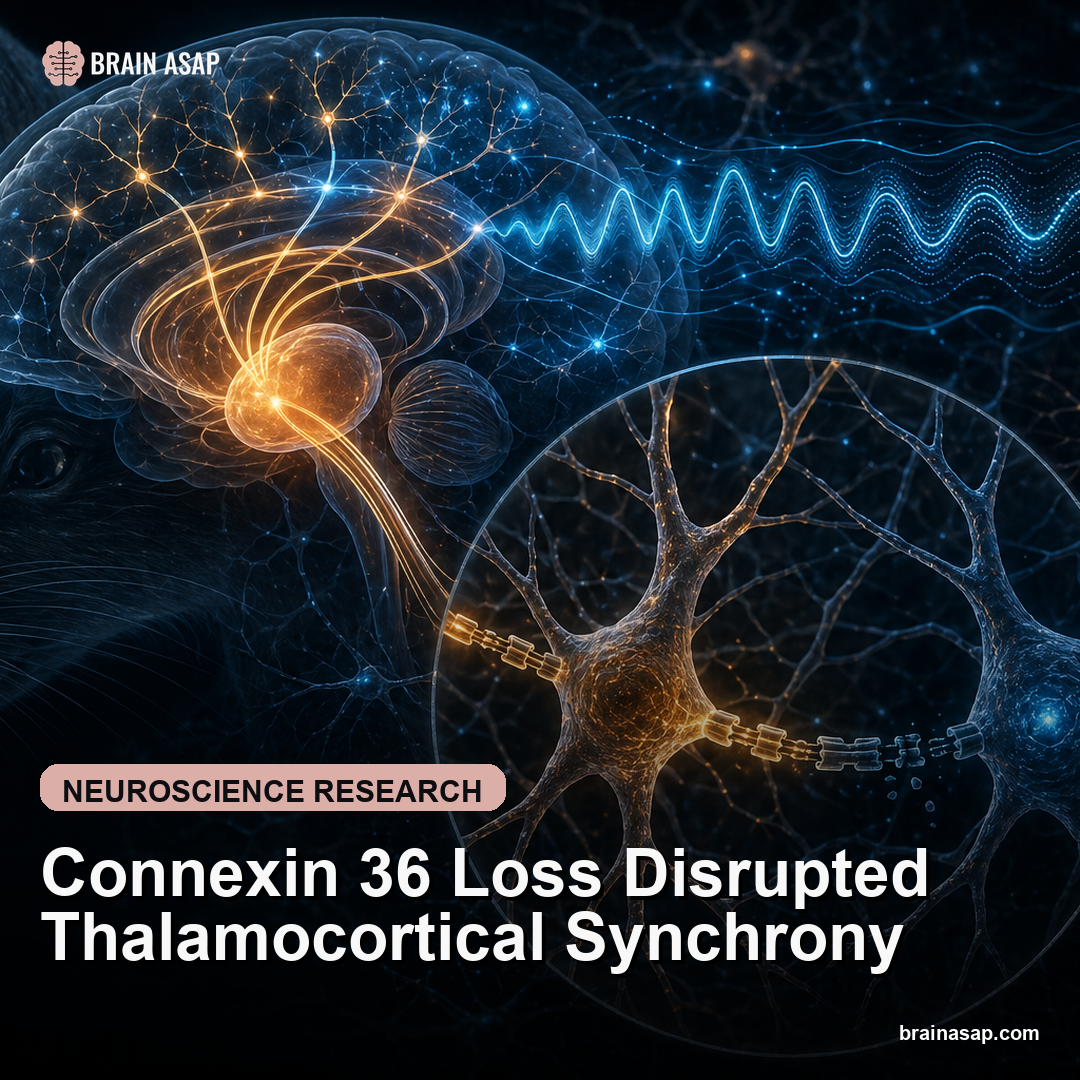
Connexin 36 Loss Disrupted Thalamocortical Synchrony
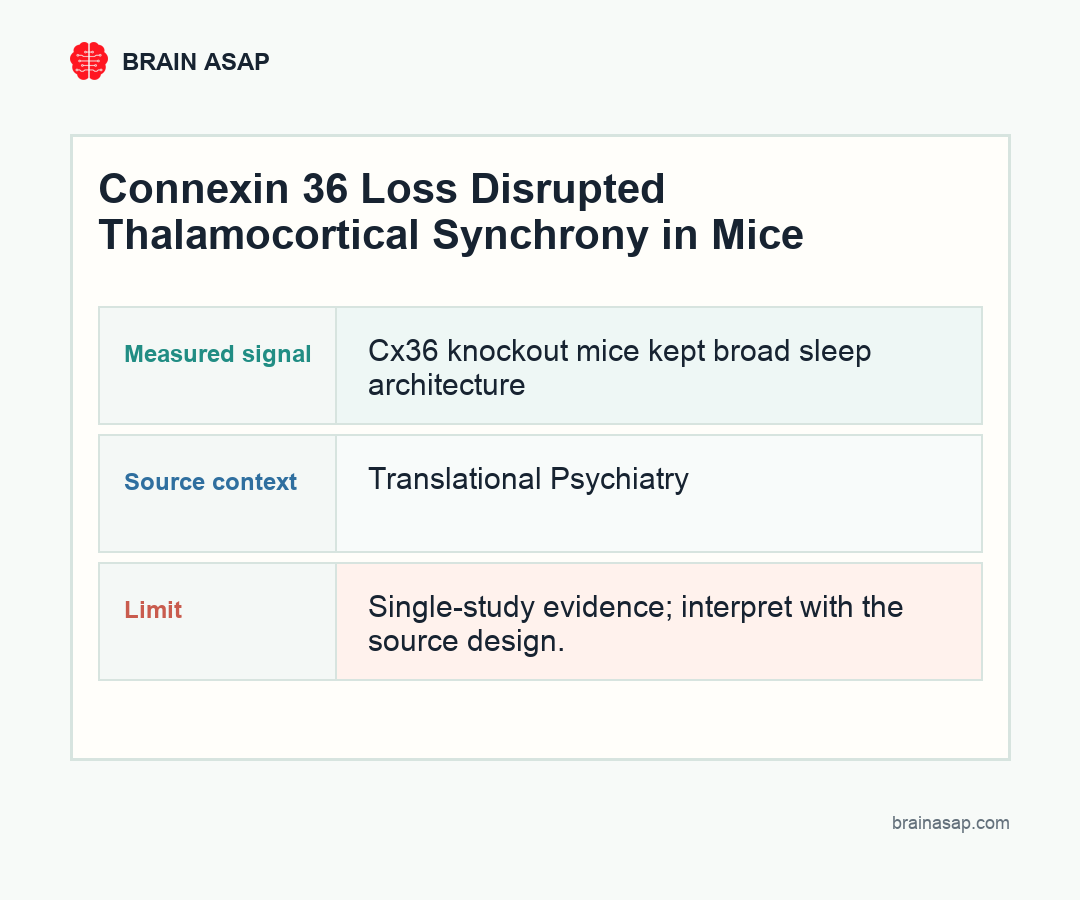
TL;DR: Deleting connexin 36 left broad sleep architecture mostly intact but disrupted fast brain electrical rhythms measured by electroencephalography (EEG), along with sensory-response markers often discussed in neuropsychiatric disease.
Key Findings
- Sleep architecture mostly held: Cx36 knockout mice did not show a broad collapse of sleep-wake organization.
- Fast rhythms weakened: Spectral analysis showed impaired gamma and beta activity, along with reduced sigma power surges before NREM-REM transitions.
- Spindles changed shape: Spindle density was preserved, but spindle amplitude and duration were reduced.
- Ketamine response blunted: Cx36 knockout mice showed reduced gamma responses to ketamine.
- Sensory biomarkers shifted: The animals had impaired 40 Hz auditory steady-state responses, reduced mismatch negativity, attenuated ERP amplitudes, and altered evoked power.
Source: Translational Psychiatry (2026) | McNally et al.
Connexin 36 is a gap-junction protein that lets neurons communicate electrically. Chemical synapses get most of the attention, but electrical synapses help inhibitory networks synchronize at high speed. This mouse study tested what happens when that timing machinery is removed from mature GABAergic circuits.
The Sleep Stage Was Less Damaged Than the Oscillation
The most informative result is the dissociation between sleep staging and network timing. Cx36 knockout mice did not simply lose normal sleep architecture. The abnormalities appeared in the rhythms riding on top of that architecture.
Gamma, beta, sigma surges, and spindle features are not cosmetic details. They are network timing signals. The finding suggests that Cx36 is less about whether the animal enters a sleep state and more about how coordinated the thalamocortical network is inside that state.
That distinction makes the study easier to interpret. The knockout did not erase sleep; it degraded the fast coordination that helps thalamic and cortical circuits communicate with millisecond precision.
Spindle Density Stayed, but Spindle Strength Changed
Sleep spindles are often treated as countable events, but this study shows why counting alone can miss the phenotype. Spindle density was preserved, while spindle amplitude and duration were reduced.
That means the network could still generate spindle-like events, but the events were weaker or shorter. For neuropsychiatric EEG biomarkers, a normal event count can hide abnormal event quality.
Ketamine Gamma and 40 Hz Responses Pointed to Translational Relevance
The ketamine result gives the study a direct pharmacology angle. Cx36 knockout mice showed blunted gamma responses to ketamine, a drug often used experimentally to probe cortical excitation-inhibition balance.
The 40 Hz auditory steady-state response and mismatch negativity findings point in the same direction. These EEG measures have a long history in schizophrenia and related research, so the study links an electrical-synapse protein to biomarkers that can be measured across species.
- Spontaneous rhythm problem: gamma, beta, sigma surges, and spindle features were altered.
- Evoked-response problem: ketamine gamma, 40 Hz auditory response, mismatch negativity, and ERP amplitudes were disrupted.
- Behavior-linked timing problem: social investigation triggered less gamma activity, tying the EEG changes to active behavior rather than only passive recordings.
Social Habituation Added a Behavioral Readout
The abnormalities were not only electrophysiological. Cx36 knockout mice also showed impaired social habituation and reduced investigation-induced gamma activity.
That pairing suggests the timing abnormality may matter during behavior, not only during passive EEG recordings. The caveat is important: mouse social investigation is not a direct equivalent of human social dysfunction.
Cx36 Looks Like a Timing Target, Not a Diagnosis
The authors suggest Cx36 may be a therapeutic target for dysfunctional network activity, but the evidence is still preclinical. The study does not show that altering Cx36 treats schizophrenia, bipolar disorder, autism, or any specific psychiatric condition.
The result shows that removing Cx36 disrupts thalamocortical synchrony in ways that resemble measurable neuropsychiatric biomarkers. It puts electrical synapses much closer to the center of psychiatric circuit research.
Electrical Synapses Are Easy to Underestimate
Psychiatric neuroscience often focuses on neurotransmitters, receptors, and chemical synapses because most psychiatric drugs act there. Neural timing also depends on electrical coupling between cells, especially in inhibitory networks that coordinate fast rhythms.
Connexin 36 is central to that electrical-synapse system. When it is missing, the network can still run, but its timing can become less precise. The EEG results fit that model: broad sleep architecture remained recognizable while rhythm quality degraded.
That is a subtle phenotype, but it may matter in disorders where perception, prediction, and cognition depend on millisecond-scale synchrony.
A Reduced Brain Response to Unexpected Sounds Made the Result Psychiatric-Relevant
Mismatch negativity is one of the more durable EEG findings in schizophrenia research. It reflects the brain’s automatic response when an expected sound pattern is violated. Reduced mismatch negativity has been linked to impaired predictive processing and functional outcomes.
The Cx36 knockout mice showed reduced mismatch negativity along with attenuated ERP amplitudes and altered evoked power. That does not turn a mouse knockout into schizophrenia. It shows that disrupting a gap-junction protein can disturb a biomarker family human psychiatry already uses.
The same logic applies to the 40 Hz auditory steady-state response. If Cx36 affects that rhythm in mice, electrical synapses should be part of the search for circuit-level causes of abnormal sensory processing.
Ketamine Gamma Blunting Adds a Pharmacology Angle
Ketamine is often used experimentally to perturb cortical excitation-inhibition balance. A blunted ketamine-induced gamma response in Cx36 knockout mice suggests that electrical synapses can help shape how the cortex responds to NMDA-receptor disruption.
The mechanism is important because ketamine models, gamma oscillations, and schizophrenia biomarkers often travel together in the literature. This study adds a missing piece: the synchronizing role of gap junctions among mature GABAergic neurons.
If future studies can modulate Cx36 function rather than delete it, researchers could test whether restoring electrical coupling improves the EEG phenotypes without broadly suppressing the network.
Mouse Sleep Architecture Limited the Cx36 Claim
The study should not be sold as a treatment result. A knockout model removes a protein across development and can produce compensations that differ from adult disease states. Human psychiatric disorders are also not caused by one missing gap-junction protein.
The value is more basic and more durable. The study identifies Cx36-containing electrical synapses as a contributor to thalamocortical synchrony. That gives psychiatric EEG biomarkers a concrete cellular mechanism to investigate instead of treating them as abstract traces on a screen.
The Finding Fits a Broader Shift Toward Network Precision
Psychiatric disorders are not only chemical imbalances and not only anatomical lesions. Many symptoms can emerge from networks that are present but mistimed. EEG phenotypes are valuable here because they expose temporal coordination.
Cx36 sits at that timing level. It helps neurons synchronize directly through electrical coupling.
Losing it therefore created a clean test of whether timing machinery matters for rhythms linked to perception and cognition. The animals still slept, heard sounds, and investigated other mice, but the timing signatures attached to those states were weaker.
The results separated state detection from signal quality. A recording can show that a brain entered sleep or responded to sound while still revealing that the underlying circuit rhythm was poorly coordinated.
In this model, the network still produced sleep and evoked responses, but the fine structure weakened. That is closer to how many psychiatric circuit problems may work: not a circuit switching off, but a circuit losing timing precision.
Paper: Loss of connexin 36 elicits abnormalities in thalamocortical network activity relevant to neuropsychiatric disorders. Translational Psychiatry. 2026. DOI: 10.1038/s41398-026-04018-1
Authors: McNally et al.
Study Design: Preclinical mouse study assessing sleep-wake regulation, spontaneous and evoked EEG activity, ketamine responses, and behavior after Cx36 deletion.
Sample Size: Cx36 knockout mice and controls; exact group counts should be checked in the full paper before publication.
Key Statistic: Cx36 loss impaired gamma/beta activity, reduced spindle amplitude and duration, blunted ketamine gamma response, disrupted 40 Hz auditory steady-state response, and reduced mismatch negativity.