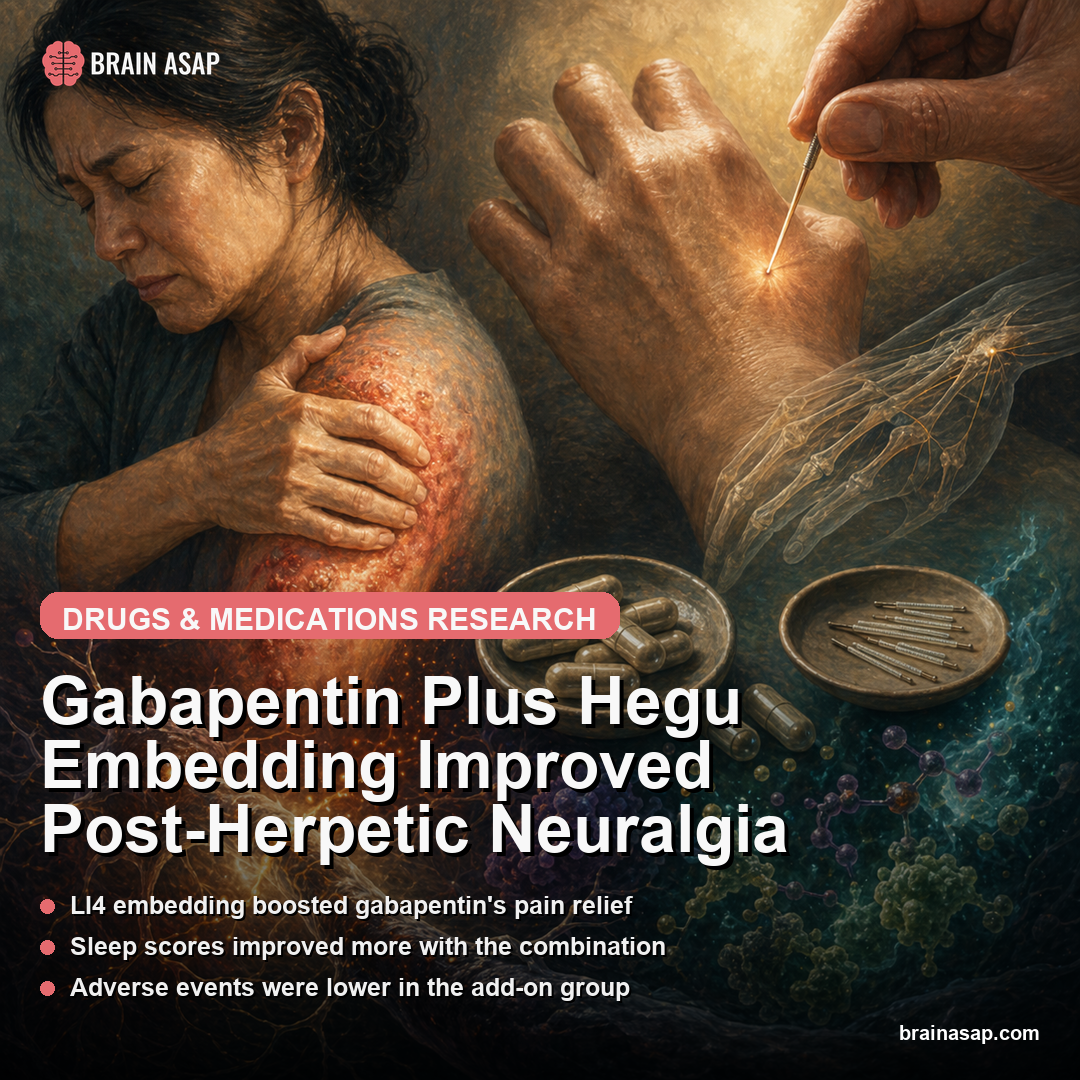
Gabapentin Plus Hegu Embedding Improved Post-Herpetic Neuralgia
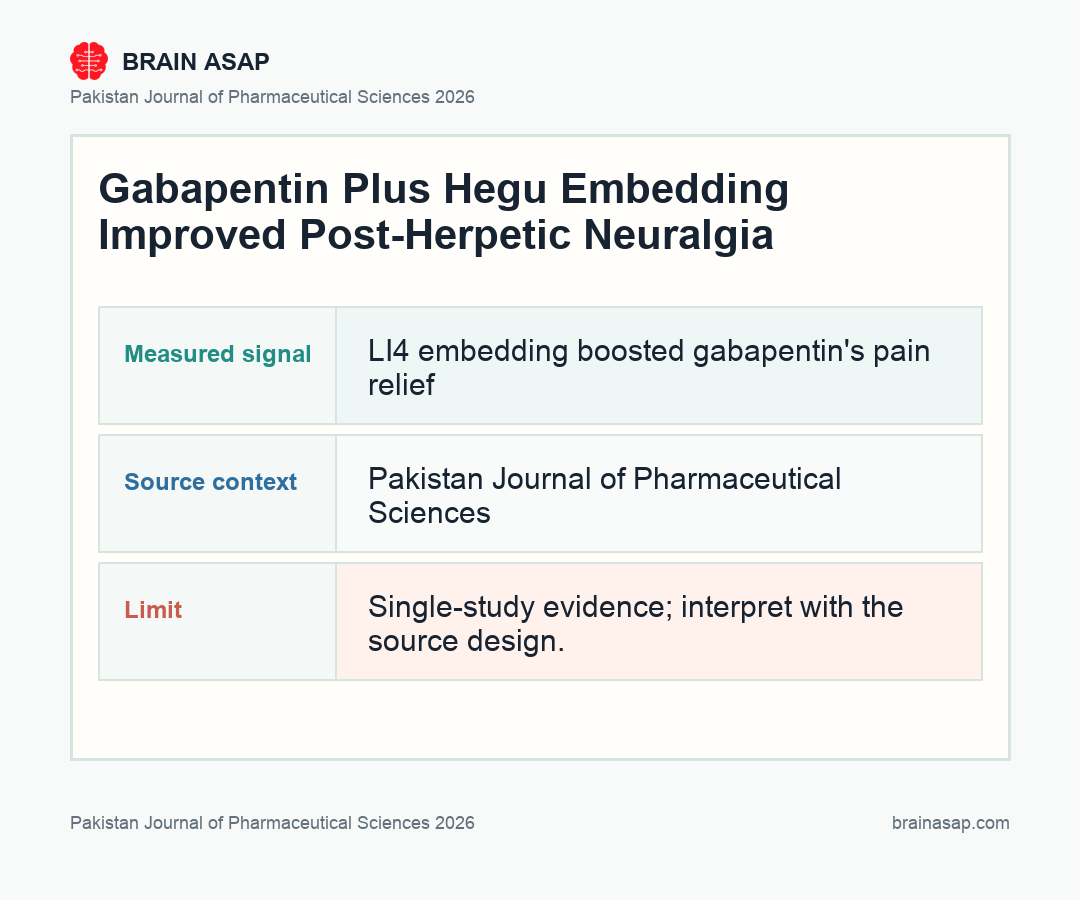
TL;DR: Adding weekly Hegu-point catgut embedding to gabapentin cut post-herpetic neuralgia pain and sleep disruption more sharply, raising response from 80.0% to 92.4%.
Key Findings
- 210 randomized PHN patients: Adults aged 40 to 70 with pain lasting at least 3 months were randomized 1:1 to gabapentin alone or gabapentin plus weekly bilateral Hegu-point catgut embedding for 4 weeks.
- VAS fell 4.34 vs 3.29 points: Pain scores dropped from 7.56 to 3.22 in the combination group versus 7.47 to 4.18 with gabapentin alone, a statistically significant separation at week 4 (p < 0.001).
- PSQI improved by 8.91 vs 6.31 points: Sleep-quality scores improved from 14.25 to 5.34 with the combination versus 13.96 to 7.65 in controls, again favoring the combined approach (p < 0.001).
- 92.38% vs 80.00% response: Overall clinical efficacy was higher when Hegu embedding was added, with 97 of 105 patients responding versus 84 of 105 on gabapentin alone (p = 0.009).
- Neuropeptides and cytokines moved together: Combination therapy drove lower substance P, IL-6, and TNF-alpha plus higher beta-endorphin than gabapentin alone after 4 weeks, consistent with a broader neuroinflammatory and analgesic shift.
- 12.38% vs 26.67% adverse events: Dizziness, somnolence, ataxia, and local-site problems were recorded in 13 of 105 combination patients versus 28 of 105 controls, suggesting the add-on did not just trade efficacy for tolerability.
Source: Pakistan Journal of Pharmaceutical Sciences (2026) | Li et al.
Post-herpetic neuralgia is one of those conditions that can hijack a life long after the shingles rash is gone. This trial asked whether a standard neuropathic-pain drug, gabapentin, works better when paired with a sustained LI4 stimulation technique that is supposed to keep pushing on pain circuits between clinic visits.
Why Gabapentin Alone Still Leaves PHN Patients Hurting and Exhausted
Post-herpetic neuralgia, or PHN, is the punishing pain syndrome that can linger for months after varicella-zoster reactivation. Patients describe burning, stabbing, electric-shock pain, often with severe allodynia. The pain itself is hard enough, but the second hit is sleep: people stop sleeping well, then become more pain-sensitive, more anxious, and harder to stabilize.
That is why this paper is more interesting than it first sounds. Gabapentin is already standard therapy for neuropathic pain because it dampens the alpha2delta calcium-channel machinery that helps drive excitatory transmitter release.
But its real-world performance is messy. Response is partial, side effects are common, and many patients still end up stuck with pain plus sedation.
The add-on tested here was Hegu-point catgut embedding, a prolonged LI4 acupoint stimulation method that leaves absorbable thread in place to keep mechanically stimulating the site for roughly a week or two. The authors frame that as a way to push not just pain perception but also inflammatory signaling and endogenous opioid release in a steadier direction than a single acupuncture session can.
What 210 Randomized PHN Patients Got Over 4 Weeks
The trial enrolled 210 adults from a single hospital in Sichuan, China, then randomized 105 to gabapentin alone and 105 to the combined regimen. Inclusion criteria were fairly practical: ages 40 to 70, definite PHN diagnosis, pain duration of at least 3 months, healed skin lesions, and baseline VAS pain of 4 or higher.
Both groups received the same routine care package, including neurotrophic medication, skin care, health education, sleep-hygiene counseling, exercise and diet advice, and emotional-support measures. The difference was the add-on procedure.
Controls received escalating oral gabapentin up to 1.8 g/day if needed. The combination arm got the same gabapentin schedule plus weekly bilateral Hegu embedding for 4 weeks using a 16-gauge embedding needle and 3-0 PGA thread.
The comparison was not drug versus no drug. It was standard PHN treatment versus standard treatment plus a sustained procedural adjunct, so the signal, if it holds up, is about whether the add-on changes the usual gabapentin tradeoff rather than whether gabapentin itself works.
How Much Extra Pain Relief the LI4 Thread Embedding Added
The clearest outcome in the paper is the pain-and-sleep separation after 4 weeks. Both groups improved, which is what you would expect in a gabapentin trial. But the combination group improved more, and by margins large enough to matter clinically rather than just statistically.
Pain on the VAS fell from 7.56 to 3.22 in the combination group, compared with 7.47 to 4.18 in the gabapentin-only group. Sleep quality moved in the same direction.
PSQI scores dropped from 14.25 to 5.34 with the combination, versus 13.96 to 7.65 in controls. That is almost a 9-point sleep improvement in the add-on arm, compared with about 6.3 points in the drug-only arm.
Those numbers line up with the response-rate split. The trial defined success as at least a 50% VAS reduction, and 92.38% of the combined-treatment patients met that threshold compared with 80.00% of controls.
The striking part is not that both groups got better. It is that the add-on seemed to move two outcomes that usually travel together in PHN: pain intensity and the sleep damage pain causes.
That is the point where the paper becomes more than a niche integrative-medicine result. If you believe PHN treatment should be judged partly by whether people can sleep again, not just by whether the pain score nudges down, the combined regimen looks meaningfully stronger.
What Happened to Substance P, IL-6, TNF-alpha, and Beta-Endorphin
The biomarker panel is where the authors try to ground the symptom change in something more mechanistic. They measured substance P, IL-6, TNF-alpha, and beta-endorphin before and after treatment.
The direction of change was consistent across both groups but steeper in the combination arm:
- Substance P fell further: levels dropped from 82.54 to 46.69 pg/mL with the combination and from 81.73 to 52.23 pg/mL in controls.
- Inflammatory cytokines decreased more: IL-6 dropped from 19.15 to 7.35 pg/mL in the combination group versus 18.92 to 12.58 pg/mL with gabapentin alone, while TNF-alpha fell to 5.83 pg/mL versus 7.02 pg/mL.
- Beta-endorphin rose more: levels increased from 32.17 to 68.34 ng/L in the combination arm compared with 33.56 to 57.26 ng/L in controls.
The authors interpret that pattern as a combined hit on pain transmission, inflammation, and endogenous analgesia. That is a fair biological pathway, at least directionally.
Gabapentin can plausibly reduce excitatory signaling and indirectly ease stress-linked inflammatory load. The embedding procedure, if it truly activates descending inhibition and neuroendocrine responses, could add a second lever by nudging opioid and cytokine systems at the same time.
None of that proves a precise pathway from LI4 thread placement to spinal or cortical pain relief. But it does make the result harder to dismiss as pure placebo noise, because the symptom improvement and the serum profile moved in the same general direction.
12.4% vs 26.7% Adverse Events Changes the Tradeoff
The most practically useful number in the paper is the tolerability split. Adverse events were recorded in 12.38% of the combination group and 26.67% of the control group. Dizziness and somnolence were both lower in the combined arm, even though that group had the extra procedure and the possibility of local-site pain or swelling.
That changes the usual objection to add-on therapies. The combined regimen performed better on efficacy and looked easier to tolerate in the short term, rather than trading pain relief for more side effects.
The authors suggest that better symptom control can have allowed lower effective gabapentin exposure, though they do not present a formal dose-comparison table. So the safest reading is narrower: the trial observed fewer common gabapentin-type side effects in the combined arm, but it did not fully prove why that happened.
How a Single-Center No-Sham Trial Needs More Than Biochemical Plausibility
Here, restraint matters. The study was randomized and assessor-blinded, but it was not patient-blinded and it did not include a sham-embedding control. That leaves a wide opening for expectancy effects, especially when two major endpoints are pain and sleep quality, both of which are subjective and highly vulnerable to context.
The follow-up was also just 4 weeks. PHN can last for months or years, so the trial showed short-term improvement rather than durable remission.
The paper also did not include broader endpoints like quality of life, functional recovery, or longer-term relapse. And because everything came from one center using one acupoint protocol, we do not know how stable the effect would be across other clinicians, hospitals, or patient populations.
The paper sits at the edge of neuroscience rather than in its center: PHN begins as peripheral nerve injury, but the outcomes included sleep disruption, neuroactive pain signaling, inflammation, and a brain-active drug. That combination makes the result more concrete than many complementary-medicine reports, even though the no-sham design leaves the subjective endpoints exposed to expectancy effects.
Paper: Pharmacodynamic basis of gabapentin combined with Hegu-point catgut embedding for post-herpetic neuralgia. Pakistan Journal of Pharmaceutical Sciences. 2026;39(6):1611-1617.. DOI: 10.36721/PJPS.2026.39.5.152.1
Authors: Li et al.
Study Design: Randomized clinical trial
Sample Size: 210 randomized PHN patients: adults aged 40 to 70 with pain lasting at least 3 months were randomized 1:1 to gabapentin alone or gabapentin plus weekly bilateral Hegu-point catgut embedding for 4 weeks.
Key Statistic: 92.38% vs 80.00% response: overall clinical efficacy was higher when Hegu embedding was added, with 97 of 105 patients responding versus 84 of 105 on gabapentin alone (p = 0.009).