How Five-Animal Play Matched Probiotics in Prediabetes
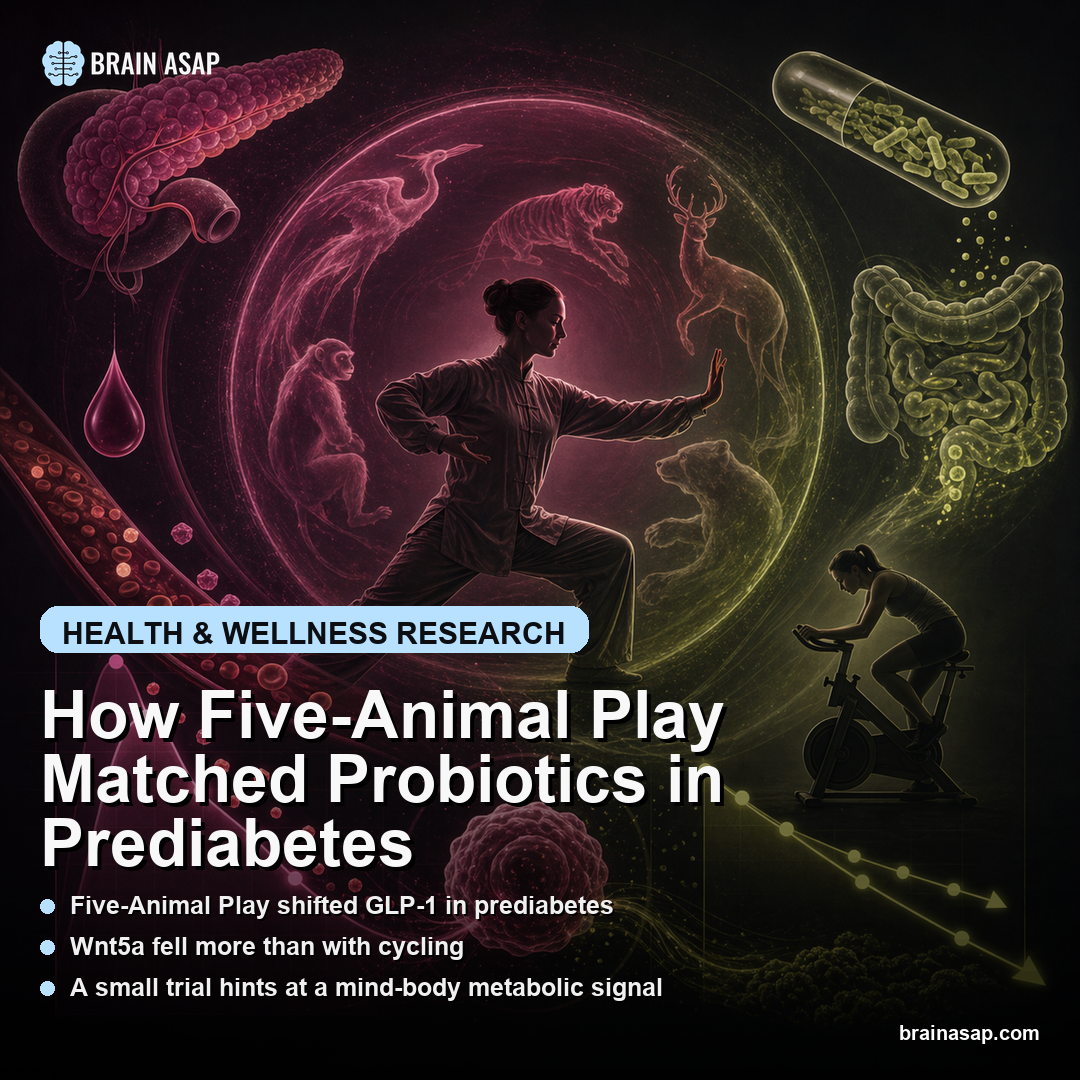
TL;DR: 4 weeks of Huatuo Five-Animal Play improved glucose control and insulin resistance about as much as bifidobacterium capsules, outperforming low-intensity cycling on several metabolic markers, including Wnt5a.
Key Findings
- Exercise shifted glucose and GLP-1: Researchers randomized 90 people with impaired glucose tolerance to bifidobacterium triple viable capsules, low-intensity cycling, or Five-Animal Play for 4 weeks.
- Four-week glucose gains in all groups: Across all three interventions, fasting blood glucose, 2-hour glucose, HbA1c, fasting insulin, and HOMA-IR all fell significantly from baseline (P < 0.05).
- Five-Animal Play beat cycling on key markers: Compared with low-intensity aerobic exercise, the movement group produced larger drops in fasting glucose, 2-hour glucose, HOMA-IR, and Wnt5a (P < 0.05).
- Comparable to bifidobacterium capsules: Post-treatment results in the Five-Animal Play group were not significantly different from the probiotic group on the main glucose-metabolism outcomes.
- Mechanism tracked with correlations: Greater rises in GLP-1 correlated with larger drops in fasting glucose (r = -0.34) and HOMA-IR (r = -0.39), while falling Wnt5a tracked with falling insulin resistance (r = 0.41).
- No liver, kidney, or safety signal: The paper reported no adverse reactions and no liver or kidney toxicity during the four-week intervention window.
Source: Pakistan Journal of Pharmaceutical Sciences (2026) | Yang et al.
Most prediabetes stories split neatly into two camps: drugs and exercise. Yang and colleagues tested a stranger comparison: a probiotic capsule, standard cycling, and a traditional Chinese movement practice in the same randomized trial. The question was whether the mind-body routine could shift modern metabolic signals like GLP-1, Wnt5a, and Sfrp5.
Why Compare a Probiotic Capsule With a Centuries-Old Movement Routine
Impaired glucose tolerance is the stage where blood sugar is already abnormal but type 2 diabetes has not yet become established. Insulin resistance is active, beta cells are under pressure, and daily behavior can still change the trajectory.
The unusual part was the comparator set. The authors compared three very different ways of trying to change metabolism: a bifidobacterium probiotic, standard low-intensity cycling, and Huatuo Five-Animal Play, a structured mind-body exercise routine built around slow coordinated movements, breathing, and repeated practice.
The biomarker panel made the trial more than a lifestyle pamphlet. The study tracked fasting glucose, GLP-1, the incretin pathway now central to obesity and diabetes drug development, plus the inflammatory-metabolic signaling pair Wnt5a and Sfrp5.
What a 90-Patient IGT Trial Changed in Just 4 Weeks
At the broadest level, all three interventions worked better than doing nothing. After 4 weeks, every group showed significant reductions in fasting blood glucose, 2-hour post-load glucose, HbA1c, fasting insulin, and HOMA-IR.
The baseline improvement also shows that the trial did not hinge on an implausibly weak control condition. Even the low-intensity cycling arm moved the core glucose markers.
The sharper question is relative performance. Here, Five-Animal Play held up surprisingly well.
Compared with the aerobic-exercise arm, it produced larger improvements in FBG, 2hFBG, and HOMA-IR. Against the probiotic arm, it was broadly comparable on the main glycemic outcomes.
A movement routine that looks, from a distance, like traditional wellness practice ended up performing more like a targeted metabolic intervention than a soft adjunct.
- Probiotic arm: tested whether bifidobacterium capsules could shift gut-linked metabolic signaling.
- Cycling arm: gave the trial a conventional low-intensity exercise comparator.
- Five-Animal Play arm: tested a coordinated movement, breathing, and practice routine against both comparators.
There is a practical reason this may matter. The exercise was intensive enough to be structured but light enough to be plausible for people who are older, deconditioned, or reluctant to begin standard gym-style exercise. Participants practiced for about 30 minutes, three times daily, 6 days per week for 4 weeks, with professional guidance and later home practice support.
Wnt5a Fell Further With Five-Animal Play Than With Cycling
The paper’s most distinctive result was the movement of the Wnt5a/Sfrp5 axis in the direction expected with lower metabolic inflammation.
Wnt5a is a pro-inflammatory non-canonical Wnt ligand that has been linked to insulin resistance and obesity-related metabolic dysfunction. Sfrp5 acts as a counter-signal, dampening that pathway. The study reported that all treatment groups increased GLP-1 and Sfrp5 while reducing or tending to reduce Wnt5a, but the Five-Animal Play group achieved a more pronounced Wnt5a decline than the cycling group.
The Wnt5a result points beyond calorie burning alone. The movement routine combines low-intensity activity with paced breathing, repeated practice, and likely autonomic effects that standard cycling at the same general intensity does not necessarily reproduce in the same way.
Over 4 weeks, Five-Animal Play was associated with a stronger shift in one inflammatory signaling marker than basic aerobic cycling, which justifies testing the movement routine as more than a generic activity control.
What the GLP-1 and Sfrp5 Correlations Say About Mechanism
The correlation analysis is where the biomarker argument becomes more than decorative. Three signals moved in directions that fit the glucose and insulin-resistance results:
- GLP-1: larger increases were associated with larger drops in fasting glucose (r = -0.34, P < 0.01) and HOMA-IR (r = -0.39, P < 0.01).
- Wnt5a: larger decreases were associated with larger reductions in insulin resistance, because Wnt5a change positively correlated with HOMA-IR change (r = 0.41, P < 0.01).
- Sfrp5: higher increases were associated with lower HOMA-IR (r = -0.36, P < 0.01) and lower fasting glucose (r = -0.28, P < 0.05).
Those correlations gave the paper a mechanistic spine. Blood sugar improved while a coherent signaling network moved in the same direction.
Most readers now hear “GLP-1” and think immediately of semaglutide or tirzepatide. This trial points to a different scale of GLP-1 biology: behavior, gut signaling, and non-drug interventions can move the same pathway, even if the size and durability of those effects will not match injectable therapeutics.
The Four-Week Trial Cannot Settle Prediabetes Care
The trial was randomized, but it was still a small, single-site study with only 30 participants per group and a short four-week duration. The design was enough to detect a short-term signal, not to settle long-term diabetes prevention.
The lipid findings are harder to interpret than the glucose and signaling-marker results. The abstract describes lipid indices moving in a favorable direction, but the glucose, insulin-resistance, GLP-1, Wnt5a, and Sfrp5 outcomes form the more coherent core of the paper.
The study was not prospectively registered, and the intervention intensity between groups was not perfectly symmetrical in the real-world sense. Five-Animal Play participants practiced multiple times per day with guidance and home follow-up, which may itself improve adherence and engagement relative to simple cycling instructions.
The main result survives those caveats. A structured mind-body exercise looked competitive with a probiotic intervention and stronger than basic low-intensity aerobic exercise on several glucose and insulin-resistance endpoints.
What a Mind-Body Exercise Result Could Mean in the GLP-1 Era
The drug comparison should be kept in proportion. A movement routine does not need to compete with injectable GLP-1 receptor agonists for severe obesity or established diabetes to have metabolic value.
The more relevant setting is earlier in the pipeline: people with rising glucose, rising insulin resistance, and enough physiologic flexibility left that a safe daily practice could still bend the curve.
The study ties a traditional movement routine to a biomarker language modern metabolic medicine already takes seriously. Follow-up would help measure durability and adherence, but the short-term result already matters. The simpler claim is enough: a consistent, structured movement routine may help glucose control, insulin resistance, and GLP-1-linked metabolic signaling in people with impaired glucose tolerance.
In plain terms: this was a 90-person trial with 30 people in each arm. Over 4 weeks, the Five-Animal Play group improved several glucose and insulin-resistance markers more than cycling and looked similar to the probiotic group on the main glucose outcomes.
Paper: Pharmacological and metabolic effects of Bifidobacterium triple viable capsules and Five-animal Play in patients with impaired glucose tolerance. Pakistan Journal of Pharmaceutical Sciences. 2026;39(5):1242-1253.. DOI: 10.36721/PJPS.2026.39.5.REG.15722.1
Authors: Yang et al.
Study Design: Randomized clinical trial
Sample Size: 90 adults, 30 per arm: Researchers randomized people with impaired glucose tolerance to bifidobacterium triple viable capsules, low-intensity cycling, or Five-Animal Play for 4 weeks.
Key Statistic: Four-week glucose gains in all groups: Across all three interventions, FBG, 2-hour glucose, HbA1c, fasting insulin, and HOMA-IR all fell significantly from baseline (P < 0.05).