Blood GFAP Started Mirroring the Brain Only After the BBB Leaked
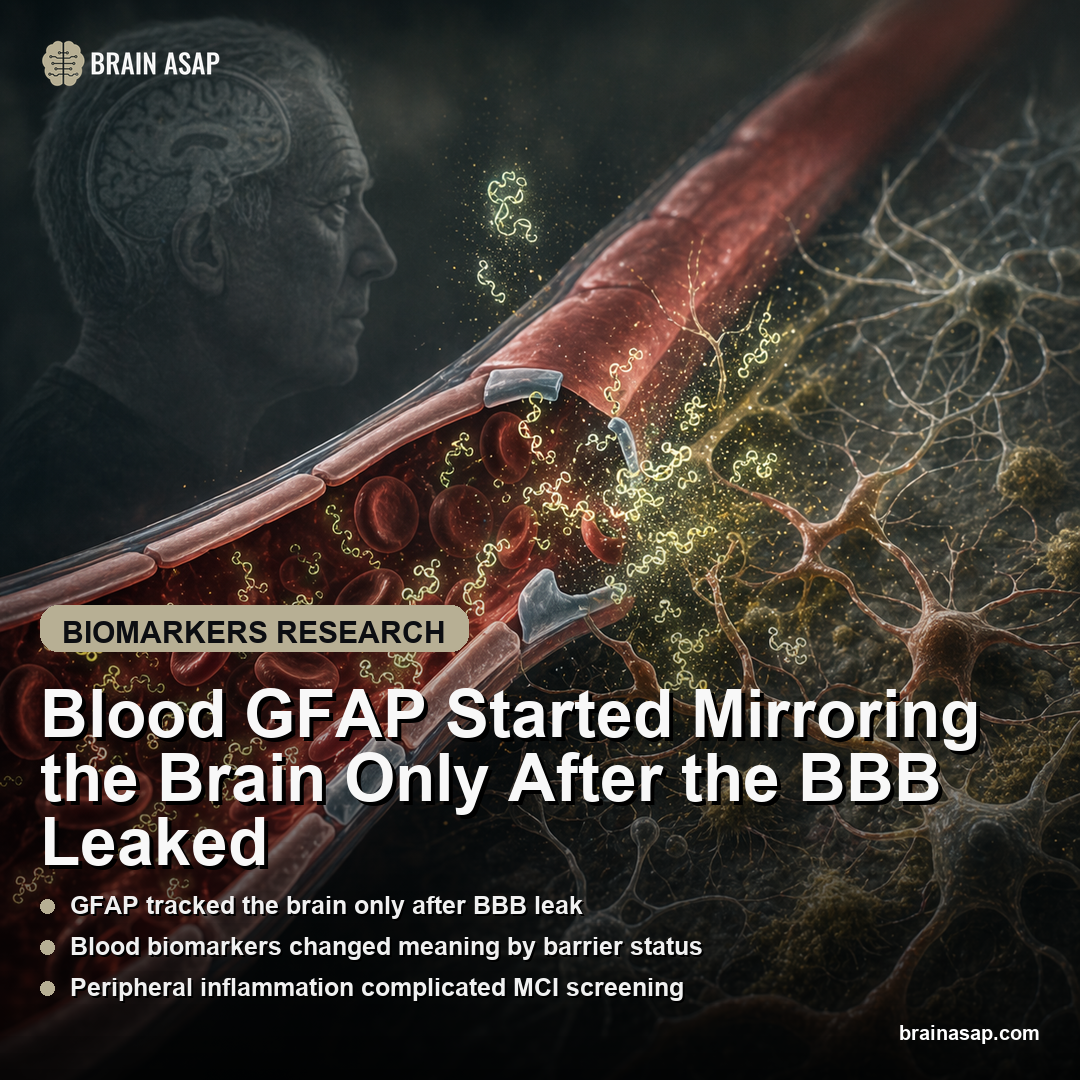
TL;DR: Blood biomarkers mostly failed to mirror the brain while the blood-brain barrier stayed intact; once the barrier leaked, glial fibrillary acidic protein (GFAP), an astrocyte injury protein, and inflammatory signals started lining up across blood and cerebrospinal fluid (CSF), the fluid surrounding the brain and spinal cord.
Key Findings
- BBB leak changed biomarker meaning: The study enrolled 37 mild cognitive impairment patients and 37 cognitively normal controls, then stratified them into intact-BBB and disrupted-BBB groups using the CSF/serum albumin ratio.
- No meaningful blood-CSF alignment with an intact barrier: In the cognitively normal intact-BBB and mild cognitive impairment (MCI) intact-BBB groups, most serum biomarkers failed to correlate with CSF measures.
- GFAP correlation jumped with BBB disruption: Serum-CSF GFAP reached r = 0.446 in cognitively normal participants with BBB disruption and strengthened to r = 0.753 in the BBB-disrupted MCI group.
- BBB leak unlocked inflammatory signal matching: In the BBB-disrupted group overall, serum-CSF correlations appeared for IL-4 (r = 0.412), IL-6 (r = 0.296), and TNF-α (r = 0.352), while the intact-BBB group showed only IL-6 at r = 0.469.
- Nf-L still refused to line up: Even with BBB disruption, neurofilament light did not show a significant serum-CSF correlation, suggesting axonal injury markers do not travel as simply as astrocytic signals do.
- GFAP looked like the most useful bridge marker: The paper’s strongest case is that GFAP may capture both astrocytic reactivity and BBB dysfunction at the prodromal edge of cognitive decline.
Source: Translational Psychiatry (2026) | Liu et al.
Blood biomarker papers in early cognitive decline often promise a simple shortcut to the brain. This one is more valuable because it explains why that shortcut keeps failing: the blood may only start telling the truth once the blood-brain barrier has become porous enough to let central pathology show through.
Why Blood Biomarkers for Early Cognitive Decline Keep Underperforming
There is a recurring fantasy in dementia biomarker research: take a blood sample, skip lumbar puncture, and read out what the brain is doing. Sometimes that works well enough for public imagination to run ahead of the data.
But the biology has always been harder. The central nervous system is not directly open to the bloodstream, and the BBB is one reason blood tests can look blurry even when real pathology is present.
This paper took that problem seriously. Instead of asking whether serum markers and CSF markers correlate in general, the authors asked whether that relationship changes once the barrier itself is impaired. That is the right question, because a blood marker is only useful if we know when it is supposed to reflect central disease in the first place.
The cohort included 74 older surgical patients, with cognition classified by Mini-Mental State Examination (MMSE), a brief cognitive screening test and barrier status defined by the CSF/serum albumin ratio. That created four comparison groups:
- Normal cognition, intact BBB: a group in which blood markers should have the hardest time reflecting CSF biology.
- MCI, intact BBB: a group with cognitive impairment but no measured barrier leak.
- Normal cognition, BBB disruption: a group that separated barrier leak from cognitive diagnosis.
- MCI, BBB disruption: the group where cognitive impairment and barrier leak overlapped.
What the 74-Participant BBB Split Revealed About Serum Versus CSF
The first result was mostly negative. In both intact-BBB groups, the correlations were basically absent.
No significant serum-CSF associations showed up for GFAP, Nf-L, IL-4, or TNF-α. Only IL-6 reached significance when the analysis collapsed people by barrier status, and even there the intact-BBB correlation was modest at r = 0.469.
That means a normal-looking blood-brain barrier changes the interpretation of any serum biomarker result. A low or noisy blood signal does not necessarily mean the brain is clean. It may simply mean the barrier is still doing its job.
The pattern changed once the barrier was compromised:
- BBB disruption without cognitive impairment: serum-CSF GFAP reached r = 0.446.
- MCI plus BBB disruption: serum-CSF GFAP climbed to r = 0.753, the strongest relationship anywhere in the paper.
That is a large shift from “blood and CSF barely talk” to “blood starts acting like a real readout of central astrocytic pathology.”
GFAP Beat Nf-L as the Blood-to-Brain Bridge
GFAP, or glial fibrillary acidic protein, is an astrocytic structural protein that rises when astrocytes react to injury or inflammation. It was a logical candidate for this kind of study because astrocytes sit directly inside the neurovascular unit and are deeply entangled with BBB behavior.
The paper leans into that interpretation. In the BBB-disrupted group overall, GFAP showed the strongest serum-CSF correlation at r = 0.652, outperforming IL-4, IL-6, and TNF-α.
The authors argue that this makes GFAP more than just a generic neurodegeneration marker. It may also be a marker of barrier dysfunction itself, or at least of the astrocytic response that accompanies it.
By contrast, Nf-L never produced a significant serum-CSF correlation, even though it is widely used as an axonal injury marker. That negative result is useful. It suggests that not every central injury signal crosses into blood in the same way, and that axonal damage markers can have more complicated kinetics, clearance routes, or compartment behavior than astrocyte-linked proteins do.
What the Cytokine Pattern Says About Peripheral Inflammation
The inflammatory cytokines tell a second part of the explanation. In the BBB-disrupted group, several immune signals showed significant serum-CSF correlations:
- IL-4: r = 0.412, the strongest cytokine alignment in the disrupted-BBB group.
- IL-6: r = 0.296 with BBB disruption, after also appearing in the intact-BBB analysis at r = 0.469.
- TNF-alpha: r = 0.352, consistent with a peripheral inflammatory signal tracking more closely with CSF when the barrier was leaky.
Those are not blockbuster correlations, but they suggest that barrier leakiness makes peripheral immune readouts more faithful to central immune activity.
Blood inflammation panels are often interpreted too casually. A cytokine level in blood may be biologically meaningful for brain disease, but the meaning is partly gated by barrier status. Without that context, the same number can be overinterpreted in one patient and underinterpreted in another.
The study also reported higher age and lower MMSE scores in the MCI groups, plus more cerebral infarction history in some subgroups. So the BBB signal here likely reflects a broader neurovascular signal, not only pure Alzheimer-type pathology. That is a limitation, but it also makes the result more clinically familiar: real older adults rarely arrive with one clean pathophysiology.
Why the Result Needs Careful Reading for Blood-Based MCI Screening
The biggest contribution of the paper is conceptual. It turns a frustrating biomarker inconsistency into a conditional rule.
Blood markers do not simply “work” or “not work” in mild cognitive impairment. They work differently depending on whether the barrier is intact.
This was still a small, cross-sectional study using MMSE rather than a more nuanced cognitive battery like Montreal Cognitive Assessment (MoCA), a brief cognitive screening test, and the authors relied on ELISA rather than ultrasensitive single-molecule platforms. So nobody should take these correlations as ready-made clinical cutoffs. But the mechanistic framing feels right: before we declare a serum biomarker good or bad, we often need to know what state the BBB is in.
The result does not promise a near-future blood test that replaces CSF. It explains why some blood tests may become more informative only after the brain’s vascular border has started to fail.
Paper: Correlation between peripheral and central inflammatory and neuronal injury markers in mild cognitive impairment patients: the role of blood-brain barrier status. Translational Psychiatry. 2026.. DOI: 10.1038/s41398-026-04050-1
Authors: Liu et al.
Study Design: Cohort study
Sample Size: 74 older adults split by cognition and BBB status: The study enrolled 37 mild cognitive impairment patients and 37 cognitively normal controls, then stratified them into intact-BBB and disrupted-BBB groups using the CSF/serum albumin ratio.
Key Statistic: No meaningful blood-CSF alignment with an intact barrier: In the cognitively normal intact-BBB and MCI intact-BBB groups, most serum biomarkers failed to correlate with CSF measures.