C9orf72 Myeloid Cells Restrained Microbial Inflammation
TL;DR: A gut-microbe signal called bacterial glycogen triggered damaging inflammation when C9orf72-deficient immune cells could not restrain it, linking an ALS/FTD gene to gut-brain immune control.
Key Findings
- Ten bacterial strains triggered C9orf72-dependent cytokine release: The inflammatory response depended on how myeloid immune cells handled microbial signals.
- Bacterial glycogen became the main suspect: Metatranscriptomics pointed to glycogen biosynthesis as a pathway separating inflammatory from less inflammatory gut bacteria.
- Parabacteroides merdae worsened inflammation in vulnerable mice: Germ-free C9orf72-deficient mice colonized with glycogen-producing bacteria showed monocytosis, blood-brain barrier breakdown, and T cell entry into the central nervous system.
- Digesting gut glycogen improved the mouse phenotype: Enzymatic breakdown of glycogen in the gut promoted survival and reduced microglial reactivity in the brain.
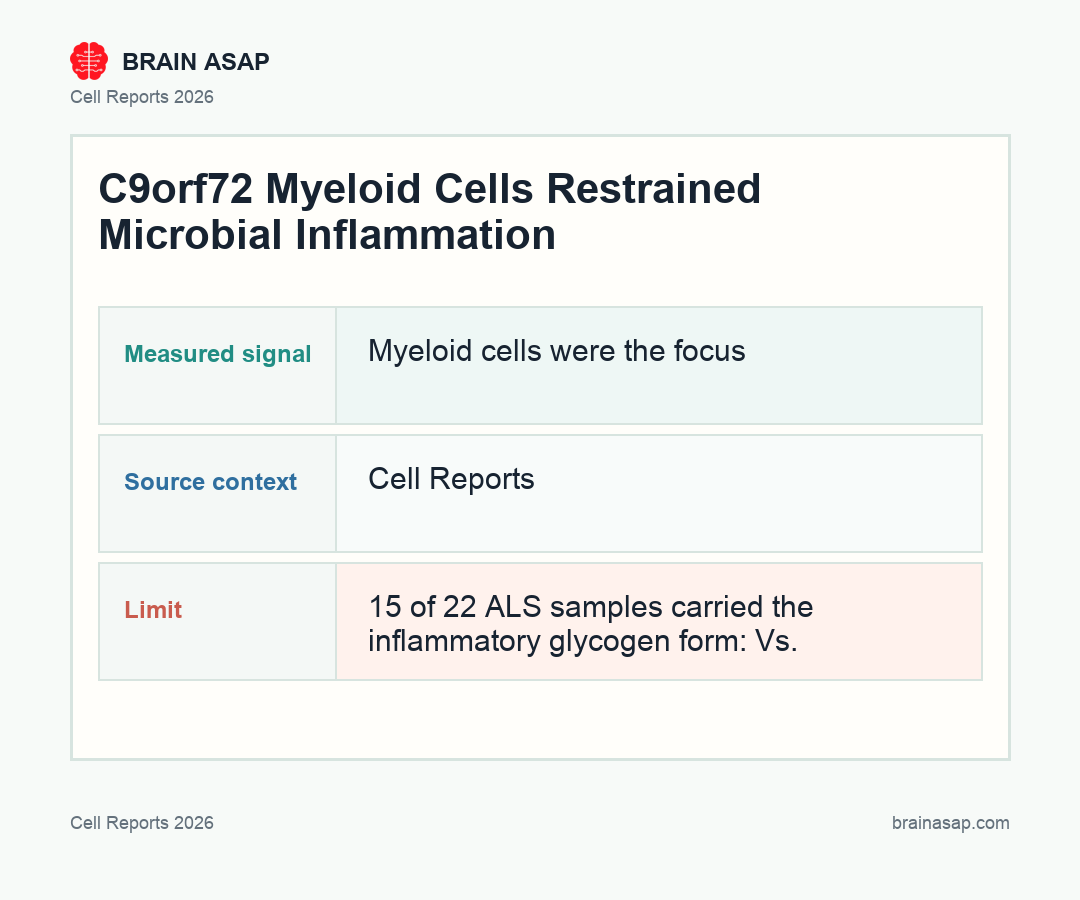
- Human fecal samples supported the biology: Inflammatory glycogen forms appeared in 15 of 22 ALS samples, 1 of 1 C9ORF72-FTD sample, and 4 of 12 healthy control samples.
Source: Cell Reports (2026) | McCourt et al.
C9orf72 is usually introduced as an ALS and frontotemporal dementia gene. This paper moves it into a less familiar setting: the gut, where bacterial carbohydrates can push immune cells toward inflammation.
The key result is specific: C9orf72-deficient myeloid cells appeared unusually sensitive to inflammatory forms of bacterial glycogen, creating a route from microbial metabolism to immune activation in the brain and body. That is a much clearer claim than saying gut bacteria somehow “cause” ALS.
C9orf72 Linked an ALS/FTD Gene to Innate Immune Control
C9ORF72 repeat expansions are a major inherited cause of amyotrophic lateral sclerosis and frontotemporal dementia. ALS destroys motor systems, while FTD affects behavior, language, and executive function, but the 2 conditions share important biology.
The gene is often discussed through neurons because neurons are what fail most visibly in these diseases. C9orf72 also functions in immune cells, especially myeloid cells, a broad family that includes macrophages, monocytes, and microglia.
Those cells decide how aggressively the body responds to microbes, debris, and tissue damage. If that threshold is set too low, normal microbial material can start to look like a threat that needs a stronger inflammatory response.
Ten Gut Bacterial Strains Exposed the Cytokine Problem
The authors screened gut bacterial strains to see which ones made C9orf72-deficient immune cells release cytokines. Cytokines are signaling proteins that immune cells use to amplify inflammation, recruit other cells, and coordinate defense.
Ten phylogenetically diverse strains promoted cytokine release in a C9orf72-dependent way. The response was therefore not limited to one narrow bacterial family.
- The microbial side: certain gut bacteria carried a molecular feature that could provoke inflammation.
- The host side: immune cells lacking normal C9orf72 restraint responded more strongly.
- The disease-relevant bridge: an ALS/FTD gene changed how microbial material was interpreted by innate immunity.
That three-part structure is the reason the paper is more than a microbiome association. The bacteria were not treated as a vague risk factor; the authors pushed toward a defined microbial product and a defined host vulnerability.
Bacterial Glycogen Became the Inflammatory Trigger
Metatranscriptomics, which measures which microbial genes are being actively expressed, pointed toward the glycogen biosynthesis pathway. Glycogen is a stored carbohydrate, best known in human biology as an energy reserve in liver and muscle, but bacteria can make their own forms of it.
Here, the inflammatory version of glycogen behaved like a microbial signal that C9orf72-deficient myeloid cells handled poorly. The immune system appeared to read this bacterial carbohydrate as a stronger inflammatory cue when the C9orf72 brake was missing.
A pathway involving a potentially modifiable microbial carbohydrate gives researchers a more concrete target than a general claim that “the microbiome is different.”
Parabacteroides merdae Pushed the Mouse Model Toward Neuroinflammation
The mouse experiments made the mechanism more concrete. The team colonized germ-free C9orf72-deficient mice with Parabacteroides merdae, a bacterial species that produced inflammatory glycogen.
Germ-free mice start without resident microbes, so colonization lets researchers ask what a selected bacterium does in a controlled host setting. In this case, the bacteria pushed the vulnerable mice toward a broader inflammatory state.
- Monocytosis increased: blood showed more monocytes, immune cells that can amplify inflammation and enter tissues.
- The blood-brain barrier weakened: a normally protective boundary between blood and brain became more permeable.
- T cells entered the central nervous system: adaptive immune cells appeared in brain and spinal-cord territory where they can contribute to inflammatory damage.
Those results connect the gut signal to the nervous system without pretending the gut alone explains neurodegeneration. The more careful interpretation is that microbial glycogen can raise inflammatory pressure in a genetically vulnerable immune system.
Digesting Glycogen in the Gut Reduced Brain Immune Reactivity
The intervention experiment is the most actionable part of the paper. When the authors enzymatically digested glycogen in the gut, C9orf72-deficient mice showed better survival and less reactive microglia in the brain.
Microglia are the brain’s resident myeloid immune cells. When they become reactive, they can help clear damage, but chronic or excessive reactivity can also contribute to neuroinflammatory injury.
The glycogen-digestion result keeps the mouse experiment mechanistic rather than merely descriptive. The microbial carbohydrate signal acted as a lever in the model: changing that gut signal changed downstream immune outcomes.
Human ALS Samples Carried More Inflammatory Glycogen Forms
The human sample survey gave the model a clinical foothold. Inflammatory forms of glycogen were detected in fecal contents from 15 of 22 people with ALS, 1 of 1 person with C9ORF72 frontotemporal dementia, and 4 of 12 healthy controls.
Those counts are not enough to define a diagnostic test. The FTD group had only one sample, and fecal microbiome signals can be shaped by diet, medication, disease stage, geography, and sampling methods.
The comparison still supports the core biology. The microbial glycogen signal was present more often in ALS samples than in healthy controls, matching the idea that this pathway can appear in human gut contents rather than only in engineered mouse experiments.
The paper is strongest when read as a gene-by-microbial-product mechanism. C9orf72 shaped how myeloid cells responded; bacterial glycogen supplied the inflammatory trigger; the mouse model connected that trigger to barrier breakdown and neuroimmune activation.
That is a serious gut-brain pathway, but it is not a reason to sell broad microbiome fixes for ALS or FTD. The human data are small, the intervention evidence is animal-model work, and ALS is far more complex than one bacterial carbohydrate.
The next research direction is mechanistic. If bacterial glycogen can be measured, modified, or reduced in specific high-risk contexts, future studies can test whether the pathway changes inflammation before it changes disease. That is a much clearer target than asking whether the microbiome as a whole is good or bad.
The result also gives ALS/FTD researchers a more disciplined way to think about immune heterogeneity. Two people can carry related genetic risk while facing different microbial exposures, different barrier states, and different immune thresholds, which can help explain why disease timing and inflammatory features vary so much across patients.
Bacterial glycogen now deserves direct testing in larger, better-characterized patient cohorts, especially alongside medication use, diet, gut symptoms, genotype, and markers of systemic inflammation.
Paper: C9orf72 in myeloid cells prevents an inflammatory response to microbial glycogen. Cell Reports. 2026. DOI: 10.1016/j.celrep.2025.116906
Authors: McCourt et al.
Study Design: Mechanistic gut-immunity study using bacterial screening, C9orf72-deficient immune models, germ-free mouse colonization, glycogen digestion, and human fecal samples.
Sample Size: Human fecal survey included 22 ALS samples, 1 C9ORF72-FTD sample, and 12 healthy control samples, alongside cell and mouse experiments.
Key Statistic: Inflammatory glycogen forms were detected in 15 of 22 ALS fecal samples versus 4 of 12 healthy control samples.
Boundary: The intervention evidence comes from model systems, and the human fecal survey is too small to support diagnosis or treatment advice.