Mediodorsal Thalamus Activity Restored Belief Updating
TL;DR: A Nature Neuroscience mouse study linked a schizophrenia-risk Grin2a mutation to weaker mediodorsal thalamus activity, impaired belief updating, and behavioral rescue when researchers reactivated the thalamus-prefrontal circuit during flexible decision-making in mice.
Key Findings
- Grin2a was the genetic entry point: The mutation affects an NMDA receptor subunit gene previously implicated in schizophrenia genetics.
- Belief updating got stuck: Mutant mice had trouble integrating new information when task conditions changed, producing abnormal belief dynamics during flexible decision-making.
- Mediodorsal thalamus activity fell: The critical circuit involved reduced activity in the mediodorsal thalamus and its pathway to the prefrontal cortex.
- Circuit reactivation rescued behavior: Reactivating the thalamus-prefrontal pathway restored more normal flexible decision-making in the mice.
- Cognition was the target: The work speaks most directly to cognitive impairment and evidence updating, not to the entire human syndrome of schizophrenia.
Source: Nature Neuroscience (2026) | Zhou et al.
Belief updating sounds abstract until it fails. The brain has to decide when new evidence is strong enough to replace yesterday’s model of reality. A mouse study from Zhou and colleagues tied that problem to a specific genetic risk factor and a specific thalamus-prefrontal circuit.
A Schizophrenia-Risk Gene Pointed to a Updating Problem
Schizophrenia is often discussed through hallucinations and delusions, but cognitive impairment can be just as disabling and much harder to treat. People can struggle to integrate new information, shift expectations, and revise decisions when the world changes.
The study centered on Grin2a, a gene that helps encode an NMDA receptor subunit. NMDA receptors help neurons use glutamate signals for learning, plasticity, and information integration, so a mutation in this system is a plausible route from genetic risk to altered cognition.
The genetic link is useful because association alone is thin. A risk gene becomes more informative when it can be connected to a circuit, a measurable computation, and a behavioral change.
Schizophrenia genetics also creates a scale problem. Hundreds of loci can contribute small pieces of risk, but patients and clinicians need mechanisms that explain cognition. Grin2a gave the researchers a tractable entry point into one such mechanism: how NMDA receptor disruption can weaken the circuit that helps new evidence overwrite an old expectation.
Flexible Choices Required New Evidence to Replace Old Assumptions
The behavioral problem was not simple failure to move, eat, or respond. The mice had difficulty updating choices when task conditions changed. In computational language, their internal belief about the task became too slow or too inaccurate when new evidence arrived.
That distinction is important for psychiatric neuroscience. A broad symptom label such as “disorganized thought” does not tell researchers which operation is failing. Belief updating is narrower: it asks whether an animal can use fresh information to revise an expectation that was useful a moment ago but has become stale.
The useful pieces of the experiment can be read as a chain:
- Genetic risk: the Grin2a mutation altered a receptor system already tied to schizophrenia biology.
- Circuit signal: activity dropped in the mediodorsal thalamus and the pathway linking it to prefrontal cortex.
- Computation: the animals showed abnormal belief dynamics when they needed to update choices.
- Rescue test: reactivating the circuit restored more flexible behavior.
That sequence is much stronger than simply observing that mutant mice behave differently. It puts the behavioral change inside a testable circuit model.
It also avoids a common weakness in psychiatric animal studies. The article does not need to claim that a mouse has schizophrenia. The relevant claim is narrower: a schizophrenia-linked mutation impaired an evidence-updating process that depends on a thalamus-prefrontal pathway.
The Mediodorsal Thalamus Was an Active Cognitive Node
The mediodorsal thalamus is a thalamic region with dense communication to prefrontal cortex. It is sometimes introduced as part of a relay system, but this paper treated it as an active participant in cognition.
That framing fits a growing view of thalamus-prefrontal loops. The prefrontal cortex can hold rules, goals, and task context, but it also needs subcortical input that helps decide when those representations should be updated. A weakened mediodorsal thalamus signal could leave the cortex leaning too heavily on yesterday’s evidence.
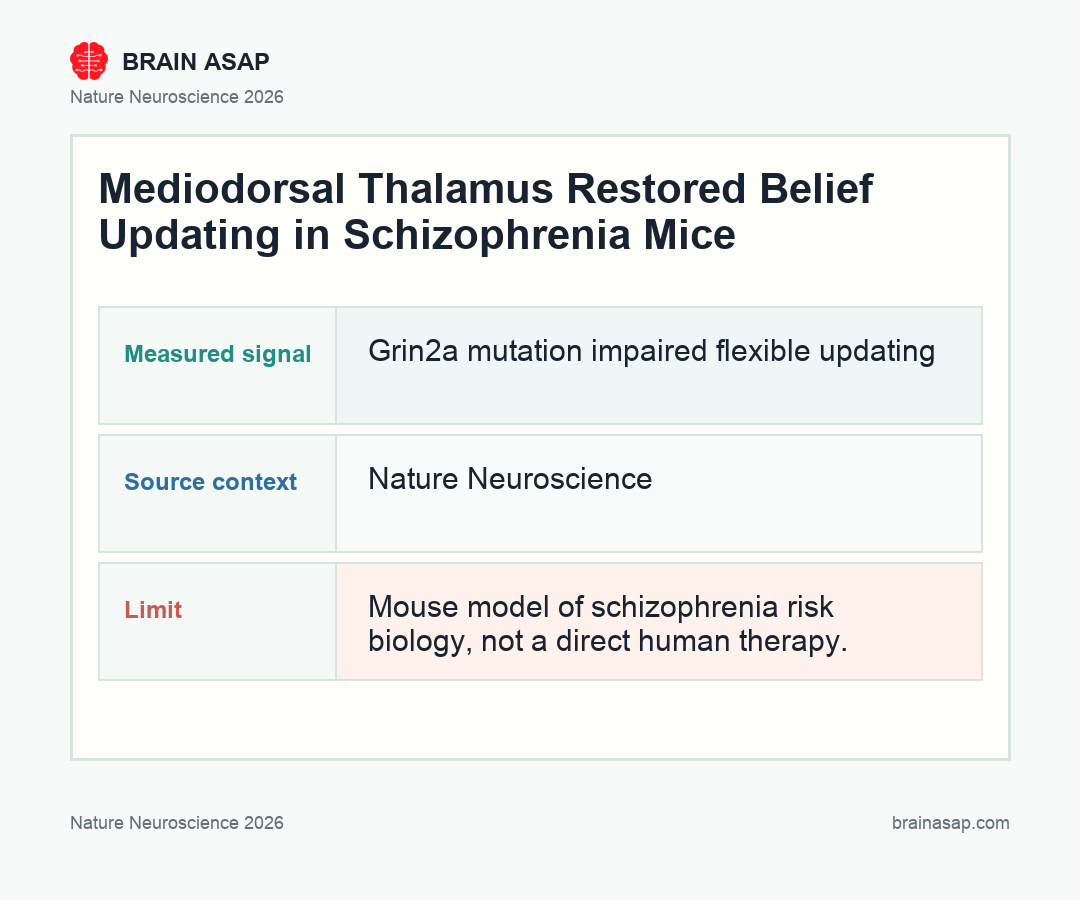
In the mutant mice, reduced mediodorsal thalamus activity tracked the abnormal belief dynamics. The circuit result gives the behavior a biological address: not “schizophrenia-like cognition” in general, but a thalamus-prefrontal pathway that appears necessary for rapid evidence integration.
That address is important because the mediodorsal thalamus is anatomically well positioned to influence how the cortex balances stability and flexibility. Too little updating can make behavior rigid; too much updating can make beliefs unstable. The study landed on the first side of that tradeoff: the mutant mice appeared slower to let new evidence change the choice policy.
Circuit Reactivation Turned Correlation Into a Stronger Test
The rescue experiment is the main reason the paper rises above a mapping study. Reduced thalamic activity could have been a bystander signal, the neural equivalent of a warning light that comes on after the real failure has happened elsewhere.
When researchers reactivated the mediodorsal thalamus-prefrontal pathway, flexible decision-making improved. That does not prove the circuit is the only route to the behavior, but it does show that restoring activity in that pathway can move the cognitive readout in the right direction.
The result also sharpens how to think about cognition in schizophrenia models. Instead of asking whether a mouse has a human psychiatric disorder, the experiment asks whether a defined genetic perturbation disrupts a defined mental operation. That is a better match for animal work because mice can model circuits and computations more directly than they can model lived human psychosis.
For treatment research, the rescue logic is useful even before anyone talks about stimulation in people. It suggests the pathway functions as a control point where activity changes can alter the behavioral computation, at least in this genetic mouse model.
The Human Translation Is Specific, Not Sweeping
The study does not show that stimulating the mediodorsal thalamus will treat schizophrenia. Human schizophrenia involves many genes, developmental timing, social context, medication exposure, and brain-wide network changes that no single mouse model can capture.
The translational value is narrower and more useful. Cognitive symptoms may arise partly when prefrontal systems cannot rapidly integrate new evidence, and mediodorsal thalamus activity may be one lever in that process. That points toward future work that measures thalamus-prefrontal updating signals in people rather than treating cognition as one undifferentiated clinical score.
It also helps explain why psychiatric genetics needs circuit experiments. A gene list can identify risk, but it cannot tell clinicians which cognitive operation is vulnerable. A circuit-level result can suggest what to measure next: updating speed, confidence weighting, prefrontal-thalamic connectivity, and whether interventions can restore the ability to revise a belief when the evidence changes.
A Circuit Model Makes the Cognitive Deficit Testable
The paper’s strongest contribution is conceptual and practical. Aberrant belief can be described as a symptom, but here it becomes a measurable update failure inside a defined thalamus-prefrontal loop.
If future human work finds analogous signatures, the field can move closer to treatments aimed at specific cognitive computations rather than the whole diagnostic label at once. The study is still preclinical, but it gives schizophrenia research a specific target: the circuit machinery that helps a brain let new evidence change its mind.
Paper: Reduced mediodorsal thalamus activity underlies aberrant belief dynamics in a genetic mouse model of schizophrenia. Nature Neuroscience. 2026. DOI: 10.1038/s41593-026-02237-9
Authors: Zhou et al.
Study Design: Preclinical genetic mouse study of flexible decision-making, thalamus-prefrontal circuit activity, and circuit rescue.
Sample Size: Grin2a-mutant and control mice.
Key Statistic: Reduced mediodorsal thalamus activity disrupted belief updating, while reactivating the circuit restored more normal behavior in mice.