TL;DR: A 2026 study in Brain found that creativity in behavioral variant frontotemporal dementia tracked a rostral prefrontal cortex gradient, meaning the functional separation between default-mode and executive-control networks predicted creative performance.
Key Findings
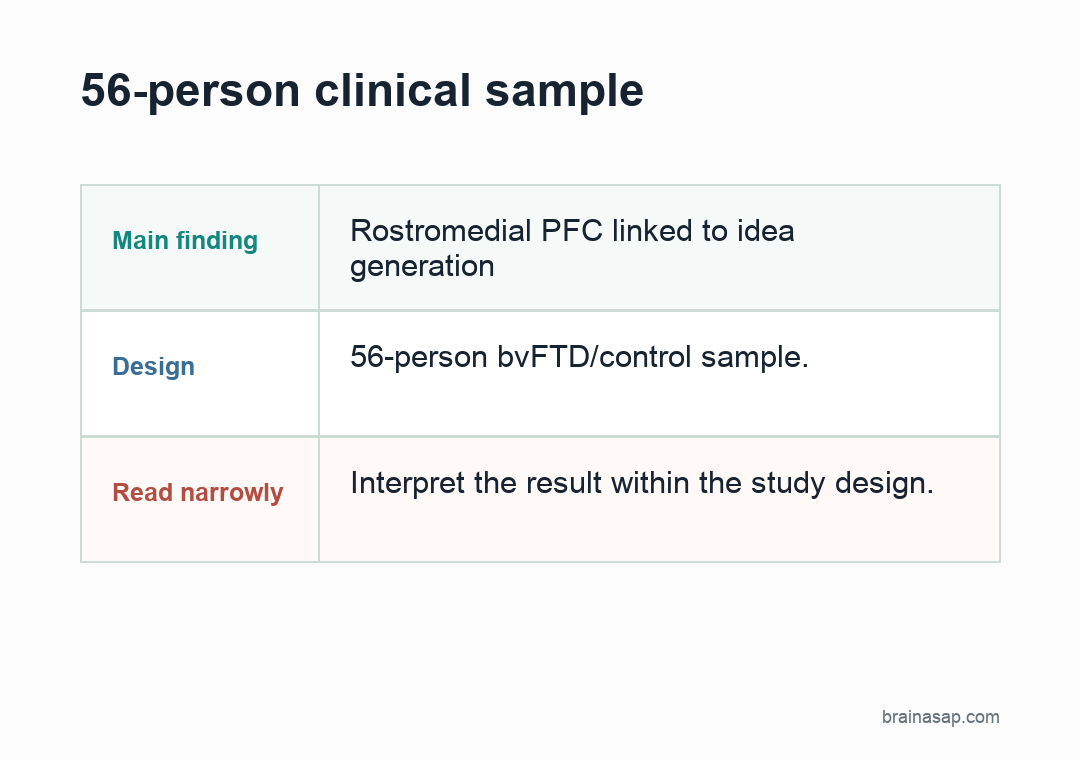
- 56-person clinical sample: researchers compared 27 patients with behavioral variant frontotemporal dementia (bvFTD) against 29 control participants from the ECOCAPTURE cohort.
- Rostromedial PFC supported idea generation: voxel-based morphometry linked the rostromedial prefrontal cortex to generating remote semantic associations.
- Rostrolateral PFC supported idea combination: a lateral prefrontal subdivision was more closely tied to combining semantic associates into workable creative responses.
- Network gradient predicted creativity: resting-state functional connectivity showed a mediolateral gradient that separated default-mode from executive-control connectivity, and a wider gradient predicted better creative abilities.
- bvFTD reduced network differentiation: patients showed a reduced gradient, consistent with weaker separation between brain systems that support spontaneous association and controlled combination.
Source: Brain (2026) | Altmayer et al.
Rostral Prefrontal Cortex Sat Between Two Creativity Networks
Creativity is not just free association. Useful creative thought usually requires two jobs: producing remote ideas and then shaping them into something relevant.
The default mode network (DMN) is often linked to spontaneous associations, autobiographical memory, and internally directed thought. The executive control network (ECN) is more involved in goal-directed control, selection, and evaluation.
Researchers focused on the rostral prefrontal cortex (PFC), the front-most part of the frontal lobe, because it sits near the boundary between these systems. The study asked whether different rostral PFC subdivisions help the brain move from raw associations to organized creative output.
Behavioral Variant Frontotemporal Dementia Made the Gradient Testable
The clinical model mattered. Behavioral variant frontotemporal dementia, or bvFTD, often affects frontal systems involved in personality, social behavior, planning, motivation, and flexible thinking.
That made bvFTD a relevant way to test whether rostral PFC structure and connectivity are needed for creative cognition. If the same region helps coordinate association and control, then damage or network disruption in bvFTD should be visible in creativity tasks.
Researchers used three kinds of measures:
- Creative abilities: tasks meant to capture the production of original and relevant ideas rather than simple memory recall.
- Remote semantic association: measures of how well participants generated distant associations between concepts.
- Combination of associations: measures of how well participants put semantic associates together into meaningful responses.
The comparison included 27 bvFTD patients and 29 control participants. The sample is small, but it is directly suited to the question because bvFTD targets the frontal and network systems under study.
Medial and Lateral PFC Divisions Had Different Creativity Roles
Whole-brain voxel-based morphometry linked the rostromedial PFC to the generation of remote semantic associations. In plain terms, this medial region was tied to producing distant ideas from stored knowledge.
The rostrolateral PFC was linked more strongly to combining semantic associates. That lateral region fits the control side of creativity: selecting, organizing, and integrating ideas rather than only producing them.
The division was not absolute. The study reported that both medial and lateral rostral PFC regions were critical for broader creative abilities, which makes sense if creativity depends on both generative and combinatory processes.
One practical way to read the finding is:
- Idea generation: the rostromedial PFC appears more involved when the task requires remote semantic associations.
- Idea combination: the rostrolateral PFC appears more involved when associations must be shaped into a coherent answer.
- Creative performance: both subdivisions matter when the person has to generate and combine ideas in the same cognitive act.
A Wider DMN-ECN Gradient Predicted Better Creative Ability
The functional-connectivity result was the clearest network finding. Resting-state data showed that rostral PFC connectivity was arranged along a mediolateral gradient.
On one side, rostromedial PFC connectivity leaned toward the default mode network. On the other side, rostrolateral PFC connectivity leaned toward the executive control network.
The important measurement was not just whether those networks touched the same region. It was the range of the gradient, meaning how differentiated those two connectivity profiles were inside the rostral PFC.
Participants with a wider functional gradient performed better on creative tasks. Patients with bvFTD showed a reduced gradient, suggesting that creativity suffered when the two systems became less clearly differentiated.
The finding avoids a simple “more connection is better” claim. Creativity seemed to depend on a workable separation between systems that generate associations and systems that organize them.
bvFTD Usually Reduces Creativity Despite Some Artistic Activity
Some clinical stories describe new or intensified artistic activity in people with frontotemporal dementia. This study does not argue that bvFTD improves creativity overall.
The source material notes that creativity is often reduced in bvFTD, even though a subset of patients may become especially active in visual art or other expressive behavior. The present result is narrower: a measurable rostral PFC gradient helped explain individual creative ability.
The main limits are straightforward:
- Small clinical cohort: 56 participants is appropriate for a specialized neuroimaging study, but it is not a population-level creativity estimate.
- Accepted-manuscript status: the DOI record available during drafting was an accepted manuscript, so final copyedited pagination may change.
- Task-bound creativity: laboratory creativity tasks capture important cognitive components, but they do not fully represent everyday art, problem-solving, or adaptation.
- Disease-specific model: bvFTD is well suited for testing frontal systems, but results may not transfer directly to healthy aging, psychiatric conditions, or other dementias.
Why the Network Separation Result Is Clinically Useful
The strongest part of the study is the way it makes creativity measurable without reducing it to a single brain spot. The rostral PFC appeared to organize a transition between spontaneous association and controlled combination.
That interpretation also fits care questions in bvFTD. If creative activity supports engagement, autonomy, or social connection for some patients, then clinicians need a clearer understanding of which cognitive systems are preserved and which are disrupted.
The result does not make creativity a treatment target by itself. It gives researchers a clearer brain-network measure to test in later studies of daily functioning, apathy, and adaptive behavior in frontotemporal dementia.
Citation: DOI: 10.1093/brain/awag032. Altmayer et al. A rostral prefrontal mediolateral gradient predicts creativity in frontotemporal dementia. Brain. 2026.
Study Design: Neuropsychological and neuroimaging study using behavioral creativity tasks, voxel-based morphometry, resting-state functional connectivity, and connectivity-gradient mapping.
Sample Size: 27 patients with behavioral variant frontotemporal dementia and 29 control participants from the ECOCAPTURE cohort.
Key Statistic: The range of the rostral PFC functional-connectivity gradient predicted creative abilities, while bvFTD was associated with a reduced gradient.
Caveat: Small specialized cohort; accepted-manuscript record; laboratory creativity measures do not capture every form of real-world creative behavior.