FTL1 Iron Protein Reversed Old Mouse Memory Loss
TL;DR: In old mice, an iron-associated hippocampal protein called FTL1 rose with cognitive decline, made young brains look older when boosted, and improved old-mouse cognition when targeted.
Key Findings
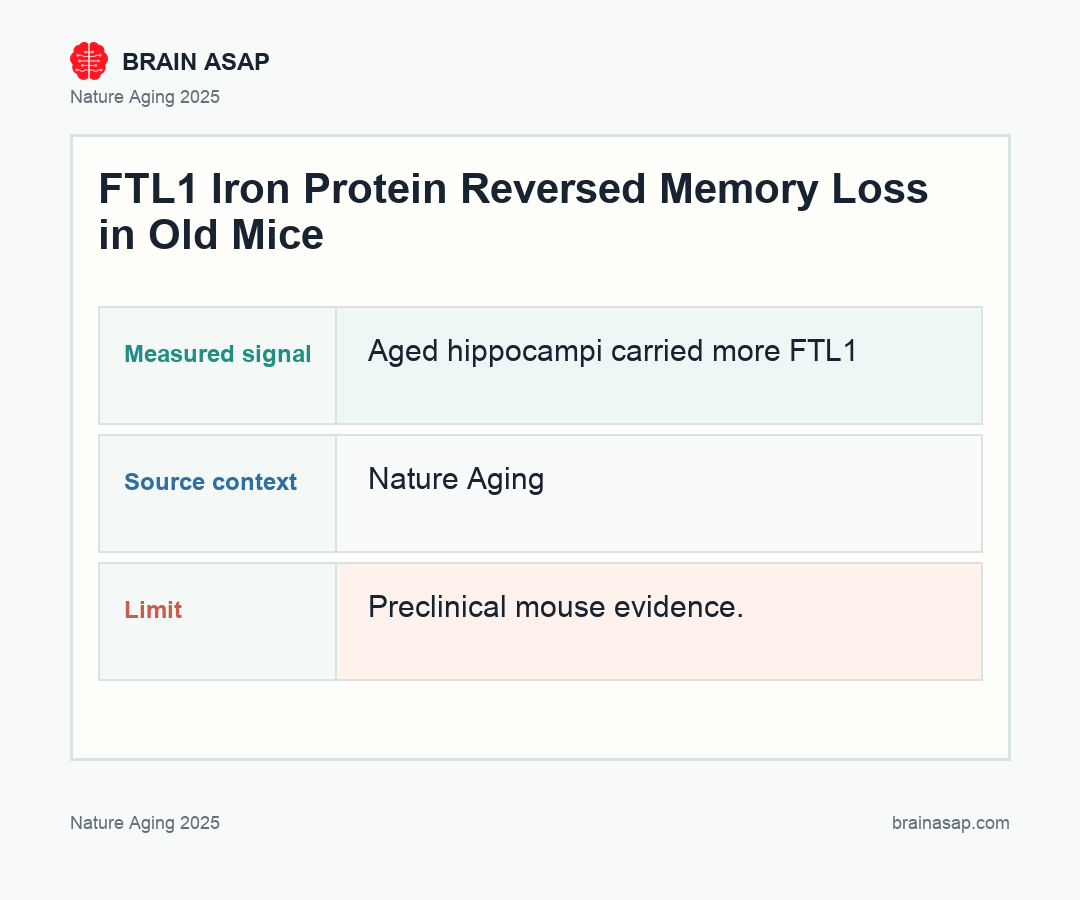
- Aged hippocampi carried more FTL1: Transcriptomic and mass-spectrometry analyses found neuronal FTL1 increased in the hippocampus of old mice, and higher levels tracked with worse cognition.
- Young mice looked older: Artificially raising neuronal FTL1 in young mice altered labile iron oxidation states and produced synaptic and cognitive features of hippocampal aging.
- Old mice improved when FTL1 fell: Targeting neuronal FTL1 in aged hippocampi improved synaptic-related molecular changes and cognitive impairments.
- ATP synthesis entered the mechanism: Single-nucleus RNA sequencing linked FTL1 to altered metabolic processes, including ATP synthesis.
- NADH softened the damage: Boosting metabolic function with NADH supplementation mitigated the pro-aging cognitive effects of neuronal FTL1.
Source: Nature Aging (2025) | Remesal et al.
FTL1 is tied to iron handling, a basic cellular housekeeping job that rarely gets the aging spotlight. This paper turns that quiet role into a sharper claim: in mouse hippocampal neurons, FTL1 looked less like background aging debris and more like a switch that could push cognition down or back up.
FTL1 Turned Iron Handling Into a Memory Problem
The hippocampus is one of the brain regions most visibly punished by aging. It helps form and retrieve memories, and its synapses are metabolically demanding. If the chemistry that supports those synapses drifts, memory can become the readout.
The authors found that ferritin light chain 1, or FTL1, rose in hippocampal neurons of aged mice. That was already interesting. The stronger result was that FTL1 levels correlated with cognitive decline, making the protein a candidate driver rather than a passive age marker.
Ferritin normally helps cells store iron safely. The problem is that iron is chemically active, and neurons are especially sensitive to shifts in iron state, oxidative chemistry, and energy production. A protein involved in iron storage can therefore become more than housekeeping when it changes inside a memory circuit.
The study began with neuronal nuclei RNA sequencing and protein analysis in young and aged mouse hippocampi. That let the team look for aging-linked molecular changes specifically in neurons, rather than averaging signals across every cell type in the tissue.
Young and Aged Hippocampi Gave the First Molecular Clue
The first comparison separated young mice from aged mice, roughly the difference between early adult and old hippocampal tissue. In the Nature Aging paper, young mice were about 3 months old and aged mice were about 18 months old, a common mouse-aging contrast.
That comparison showed FTL1 rising with age. The study also reported synapse-related gene changes, which fits the behavioral problem because memory decline is closely tied to how well hippocampal neurons maintain and remodel their connections.
- Neuronal RNA sequencing: identified age-linked gene-expression changes in hippocampal neurons.
- Mass spectrometry: helped confirm that the protein-level signal also pointed toward FTL1.
- Cognitive testing: connected higher FTL1 to worse memory performance rather than only to molecular aging.
Young Mice Became a Causality Test
Aging studies often get trapped by correlation: old tissue has many differences, and any one of them can look suspicious. The team pushed past that by increasing neuronal FTL1 in young mice.
The result moved in the wrong direction. Young mice with boosted FTL1 showed altered labile iron oxidation states, weaker synaptic features, and worse cognitive performance. Raising the protein pushed parts of the young hippocampus toward an old-age pattern.
- Iron state shifted: FTL1 changed the balance of labile iron oxidation states inside hippocampal neurons.
- Synapses weakened: molecular and structural markers of hippocampal connectivity moved in an aging-like direction.
- Memory suffered: young animals with higher neuronal FTL1 performed worse on hippocampal-dependent cognitive tasks.
Old Hippocampi Improved When FTL1 Was Targeted
The rescue experiment is the reason the paper matters. Targeting neuronal FTL1 in aged hippocampi improved synaptic-related molecular changes and cognitive impairments. In a field filled with irreversible-sounding age biology, that is a meaningful reversal signal.
The rescue leaves memory aging far from solved, but it suggests that at least one component of hippocampal decline remained biologically adjustable in old animals.
The logic is stronger because the paper pushed the protein in both directions. Raising FTL1 in young neurons made the hippocampus perform worse; lowering or targeting FTL1 in old hippocampi improved the aging phenotype. That bidirectional pattern is more convincing than a single association.
ATP Synthesis Connected Iron Handling to Memory Rescue
The RNA-sequencing data pointed toward metabolic processes, including ATP synthesis. That link is plausible because neurons cannot maintain synapses, firing patterns, and plasticity without steady energy production.
The NADH result tightened the loop. When metabolic function was boosted, the pro-aging cognitive effects of neuronal FTL1 were mitigated. The paper therefore connects iron state, mitochondrial energy, synaptic health, and memory in one chain.
NADH is a metabolic cofactor involved in cellular energy transfer. In this study, it was not used as a broad wellness supplement; it was used as a mechanistic test of whether boosting energy metabolism could soften the effects of excess neuronal FTL1.
The result needs that grounding because metabolism claims can be easy to overread. The paper is not claiming that anyone can reverse brain aging by taking an over-the-counter product. It shows that the FTL1 signal intersected with ATP-related biology strongly enough for a targeted metabolic manipulation to change the mouse phenotype.
The iron-energy link also makes biological sense. Iron is needed for mitochondrial enzymes, but poorly controlled iron chemistry can stress the same systems neurons depend on for ATP. In a high-demand region like the hippocampus, that combination can plausibly weaken plasticity before cells are visibly lost.
FTL1 Targeting Is Still a Mouse-Hippocampus Result
The work was done in mice, and the intervention was targeted to hippocampal neurons. That is a long way from a clinic, a supplement shelf, or a general anti-aging claim.
The human relevance is conceptual for now. If aging brains accumulate molecular brakes that are specific, measurable, and reversible, then cognitive aging may be less monolithic than it feels. FTL1 gives that idea a concrete target.
The next useful step is replication with clearer dosing, timing, sex balance, and longer follow-up. Researchers also need to know whether FTL1 behaves similarly in human aging tissue and whether changing it can improve memory without disrupting the iron storage functions neurons still need.
Another open question is whether FTL1 marks normal cognitive aging, neurodegenerative disease risk, or both. Iron biology changes across many brain disorders, so future work has to separate ordinary age-related hippocampal drift from disease processes such as Alzheimer’s pathology, vascular injury, or inflammation. That distinction will decide whether FTL1 becomes an aging target, a disease target, or a marker of broader neuronal stress in humans.
The careful promise is narrower than rejuvenation language suggests. Old-brain cognition may include molecular bottlenecks that can be identified and tested, rather than one irreversible slide into decline.
For aging research, that is still substantial. A target that rises in old hippocampal neurons, worsens young memory when increased, and improves old-memory performance when reduced gives the field a cleaner experimental handle than a general list of aging-associated changes.
Paper: Targeting iron-associated protein Ftl1 in the brain of old mice improves age-related cognitive impairment. Nature Aging. 2025. DOI: 10.1038/s43587-025-00940-z
Authors: Remesal et al.
Study Design: Preclinical mouse study using transcriptomics, mass spectrometry, neuronal manipulation, single-nucleus RNA sequencing, and cognitive testing.
Sample Size: Young and old mice; exact group counts should be verified in the full paper before publication.
Key Statistic: Neuronal FTL1 increased with hippocampal aging, mimicked aging when boosted in young mice, and improved old-mouse cognitive impairments when targeted.