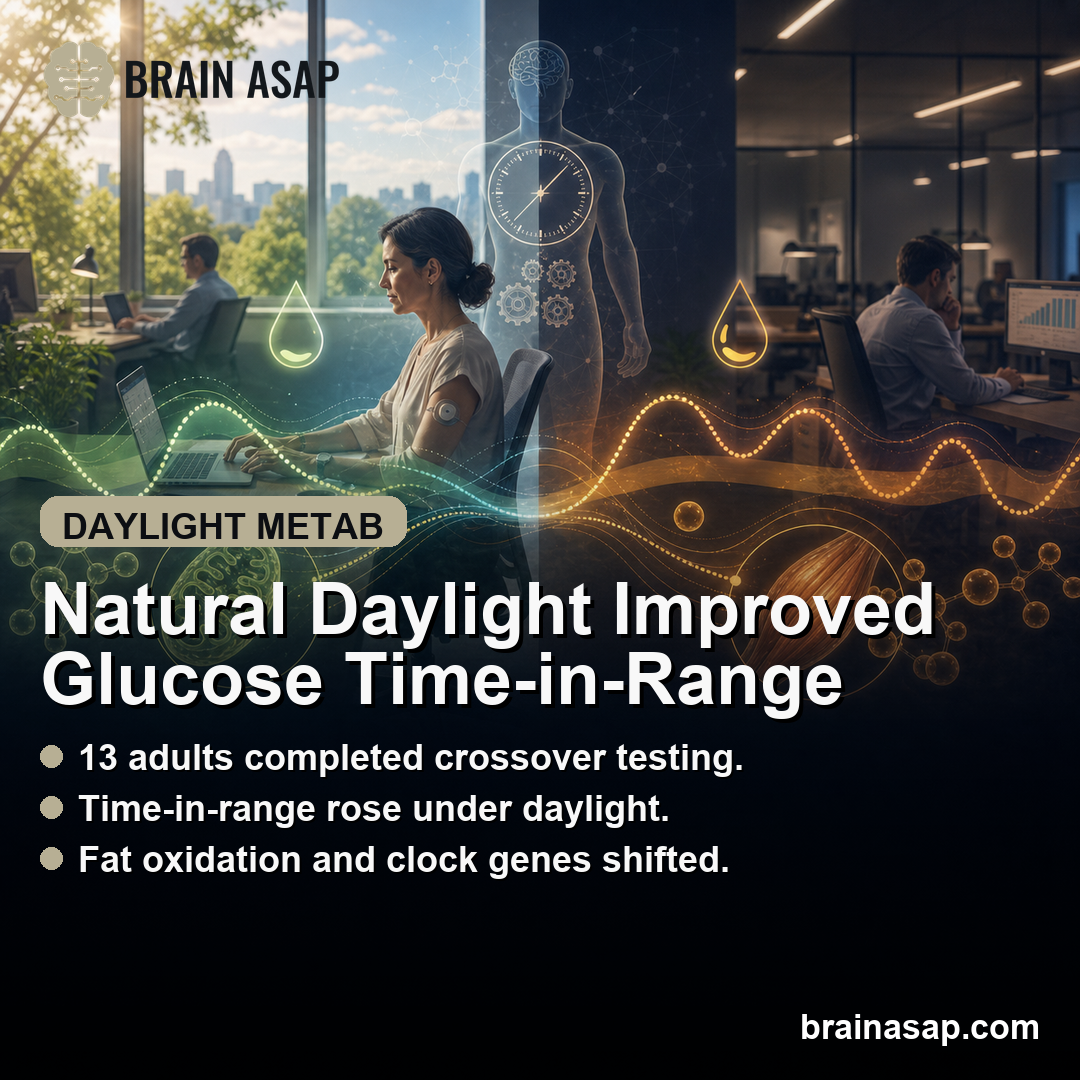
TL;DR: A 2026 randomized crossover trial in Cell Metabolism compared natural daylight against standard artificial office lighting in 13 older adults with well-controlled type 2 diabetes and found that natural-daylight days produced more time in a healthy blood-glucose range (about 51% vs 43%), smaller glucose swings, and a metabolic shift toward burning more fat and fewer carbohydrates during the day.
Key Findings
- Randomized crossover trial in 13 older adults with type 2 diabetes: Each participant completed two 4.5-day periods in a controlled research facility, one with natural daylight from a wide window and one with standard 300-lux artificial office lighting, with a four-week washout in between.
- More time in healthy glucose range under natural daylight: Continuous glucose monitors recorded participants spending about 51% of time in target range under natural light versus about 43% under artificial light, even though average overall glucose levels did not differ between conditions.
- Smaller glucose spikes and dips: Daylight produced flatter 24-hour glucose curves, with reduced excursion above and below target range — a clinically relevant pattern in type 2 diabetes management.
- Metabolic shift toward fat oxidation: Whole-body respiration measurements showed participants burning fewer carbohydrates and oxidizing more fat during daytime hours under natural light.
- Muscle-tissue circadian-clock genes were activated: Muscle samples had greater circadian-clock gene activity, and cells grown from those samples shifted their daily rhythmic patterns after natural-light exposure — molecular evidence that the lighting effect reached muscle tissue.
- Daylight ceramide trend favored health: Ceramides — a class of lipids elevated in type 2 diabetes — trended downward under natural daylight, while cholic acid and glutamic acid trended upward.
Source: Cell Metabolism (2026) | Harmsen et al.
The human metabolism runs on a 24-hour rhythm coordinated by the circadian clock, and natural light is the primary cue the clock uses to align internal timing with the outside world.
People who spend most of their working hours indoors under artificial lighting receive a much weaker time-of-day cue than the human body evolved to expect.
This crossover trial tests whether replacing artificial office light with natural daylight, while holding everything else constant, produces measurable metabolic changes in adults with type 2 diabetes.
Crossover Trial of 13 Older Adults With Well-Controlled Type 2 Diabetes
Patrick Schrauwen’s research group at the German Diabetes Center and collaborating institutions used a within-person crossover design.
The setup:
- Participants: 13 volunteers (8 women, 5 men) with well-controlled type 2 diabetes; average age 70 years.
- Two testing periods: Each lasting 4.5 days, separated by a four-week washout.
- Natural-daylight condition: Participants spent the day at a desk facing a wide window providing dynamic natural daylight.
- Artificial-light condition: Same room, but with a lightproof barrier and standard 300-lux artificial office lighting.
- Strict environmental control: Standardized meals at fixed times, identical 30-minute light-physical-activity bouts after each meal, and orange-tinted blue-light-blocking glasses if participants had to leave the room during the artificial-light condition.
The crossover design controls for individual variation, since each participant served as their own comparison. The strict environmental control isolates the lighting variable.
More Time in Healthy Glucose Range Under Natural Daylight
Continuous glucose monitors recorded blood-sugar levels around the clock under both conditions.
The headline glucose findings:
- Time in healthy range — natural daylight: About 51% of the recorded time.
- Time in healthy range — artificial light: About 43% of the recorded time.
- Average overall glucose: Did not differ between conditions.
- Glucose excursions: Smaller spikes and dips over the 24-hour cycle under natural light.
The clinically meaningful endpoint here is time-in-range, not the average. Patients with type 2 diabetes whose glucose oscillates more aggressively are at higher risk of complications, even when the long-run average looks similar.
The 8-percentage-point increase in time-in-range from natural daylight is a metabolically meaningful shift over a 4.5-day window.
Whole-Body Respiration Showed a Daytime Shift Toward Fat Oxidation
Beyond glucose, the team measured whole-body substrate metabolism using respiration chambers and breathing masks.
The technique tracks oxygen consumption and carbon dioxide production, which together let researchers calculate how many calories the body is burning and which fuel sources it is using.
Under natural daylight, participants:
- Burned fewer carbohydrates during daytime hours.
- Oxidized more fat during daytime hours.
That shift is metabolically meaningful for type 2 diabetes. People with the condition often have impaired metabolic flexibility — a reduced ability to switch between burning fat and carbohydrate as fuel availability changes.
A daytime shift toward fat oxidation under daylight conditions suggests improved metabolic flexibility under conditions closer to the body’s evolved circadian environment.
Muscle-Tissue Circadian Clock Genes Were Activated
The team also collected muscle tissue samples at the end of each condition.
The molecular findings:
- Higher circadian-gene activity: Specific genes that control the muscle-tissue circadian clock were more active under natural daylight than under artificial light.
- Lab-grown muscle cells inherited the rhythm shift: When researchers coaxed the collected cells to grow into mature muscle fibers in culture, the daily rhythmic patterns of those cells were shifted by the prior daylight exposure.
- Tracking-protein readouts confirmed the shift: Inserting a tracking protein into the cultured cells let the team observe the daily rhythm directly — and the rhythm was different after natural-light exposure.
That muscle-tissue evidence is the mechanistic anchor of the paper. Lighting affects more than mood and alertness; the same lighting difference reaches into peripheral tissue and measurably reshapes circadian-clock activity at the gene level.
Bloodstream Metabolites Shifted Too
Blood analyses tracked circulating metabolites — small molecules produced during digestion and energy use.
Three patterns stood out:
- Cholic acid: Higher under natural daylight. Cholic acid is involved in bile metabolism and fat absorption.
- Glutamic acid: Higher under natural daylight. Glutamic acid is involved in amino-acid metabolism.
- Ceramides: Trended lower under natural daylight. Ceramides are a class of lipids often elevated in type 2 diabetes and linked to insulin resistance.
The ceramide trend is the most clinically suggestive of the metabolite findings, since lower ceramides are generally associated with better metabolic health in this patient population.
Small Older-Adult Sample, Summer-Only Window, and 4.5-Day Duration Limit Generalization
- Small sample of older adults: 13 volunteers, average age 70, with well-controlled type 2 diabetes. Generalization to younger adults, less-controlled diabetes, and people without type 2 diabetes requires separate work.
- Summer-only window: The trial took place during summer months. Whether daylight effects are smaller during darker winter days, when the natural-light dose itself is lower, is not addressed.
- Short intervention: 4.5 days per condition is enough to detect circadian-clock and metabolite shifts but not enough to estimate long-term diabetes-control benefits or any sustained effect on hemoglobin A1c.
- Subjective sleep measurement: Sleep quality was assessed by questionnaire rather than objective brainwave monitoring, which limits inferences about the sleep pathway connecting daylight to metabolism.
- Mechanism partial: The trial demonstrates that daylight changes muscle clock-gene activity and substrate metabolism, but the full mechanistic chain — eye to suprachiasmatic nucleus to peripheral tissue — is inferred from prior literature rather than measured here.
Daylight access is metabolically active, not just mood-relevant: Practical implications follow from the within-person comparison:
- Daylight access is metabolically active, not just mood-relevant: Office and home environments that maximize natural-light exposure during working hours engage measurable metabolic pathways, especially in people with type 2 diabetes.
- Time-in-range may be lighting-sensitive: An 8-percentage-point shift in glucose time-in-range from a lighting change alone is large enough to factor into discussions about workplace and clinic environment design for diabetic patients.
- Artificial light at standard office levels is not metabolically equivalent to daylight: The 300-lux artificial-light condition reflects typical office practice. The trial implies that this default does not provide the circadian cue that natural daylight does.
- Longer trials are the next step: The metabolic shifts seen across 4.5 days suggest mechanism. Whether sustained daylight access produces durable benefits over weeks and months in real-world settings is the next research question.
Citation: DOI: 10.1016/j.cmet.2025.11.006. Harmsen J-F et al. Natural daylight during office hours improves glucose control and whole-body substrate metabolism. Cell Metabolism. 2026.
Study Design: Randomized crossover trial in a controlled research facility; two 4.5-day testing periods (natural daylight vs 300-lux artificial office light) separated by a four-week washout, with strictly standardized meals, activity, and blue-light blocking.
Sample Size: 13 volunteers (8 women, 5 men) with well-controlled type 2 diabetes; average age 70 years.
Key Statistic: Time in healthy glucose range about 51% under natural daylight vs about 43% under artificial light; smaller daily glucose excursions; daytime shift toward fat oxidation; activated muscle circadian-clock genes; ceramides trended lower under natural light.
Caveat: Small sample of well-controlled older adults; summer-only window; 4.5-day intervention is short for long-term diabetes-control inference; subjective sleep measurement; full eye-to-tissue mechanistic chain inferred from prior literature rather than measured directly.