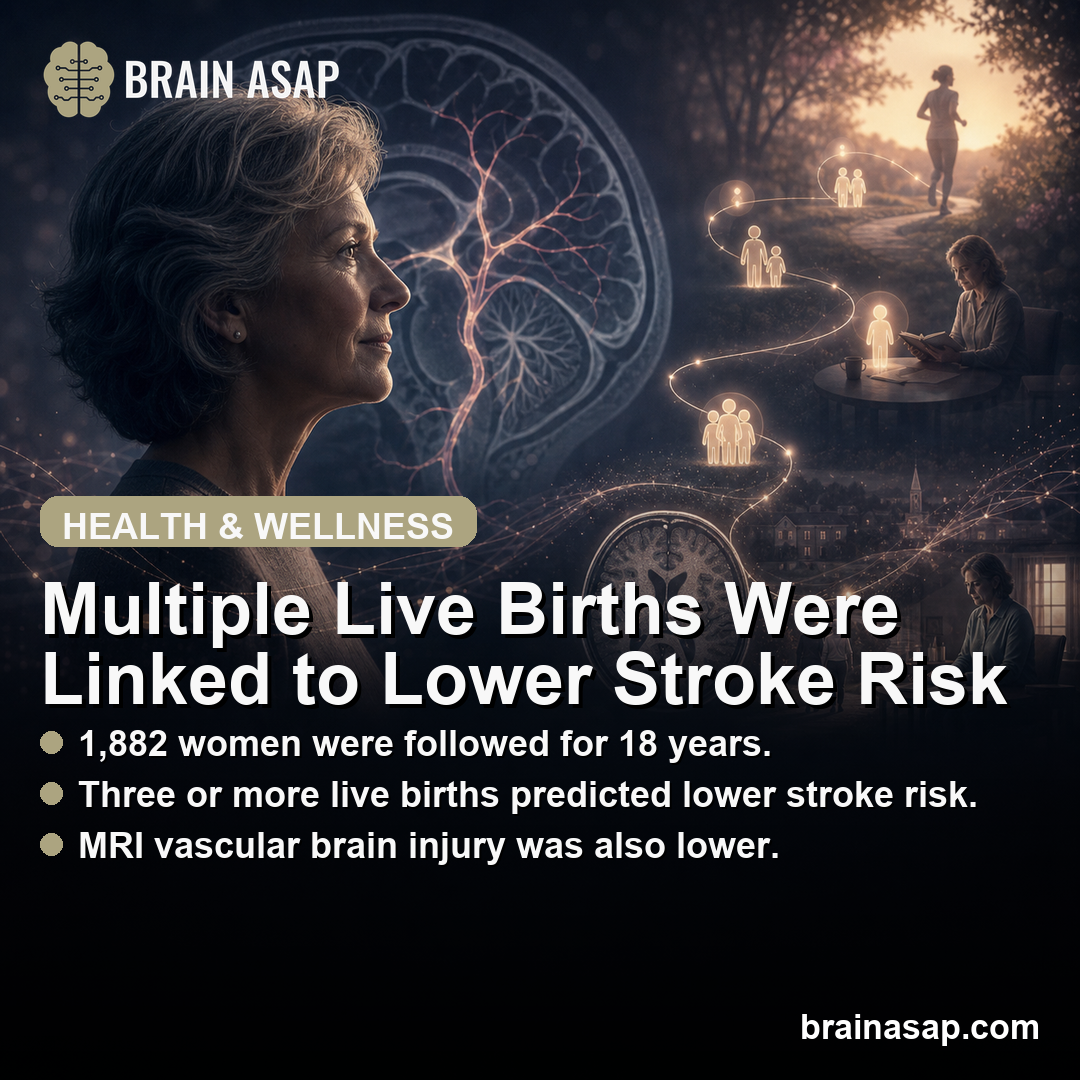
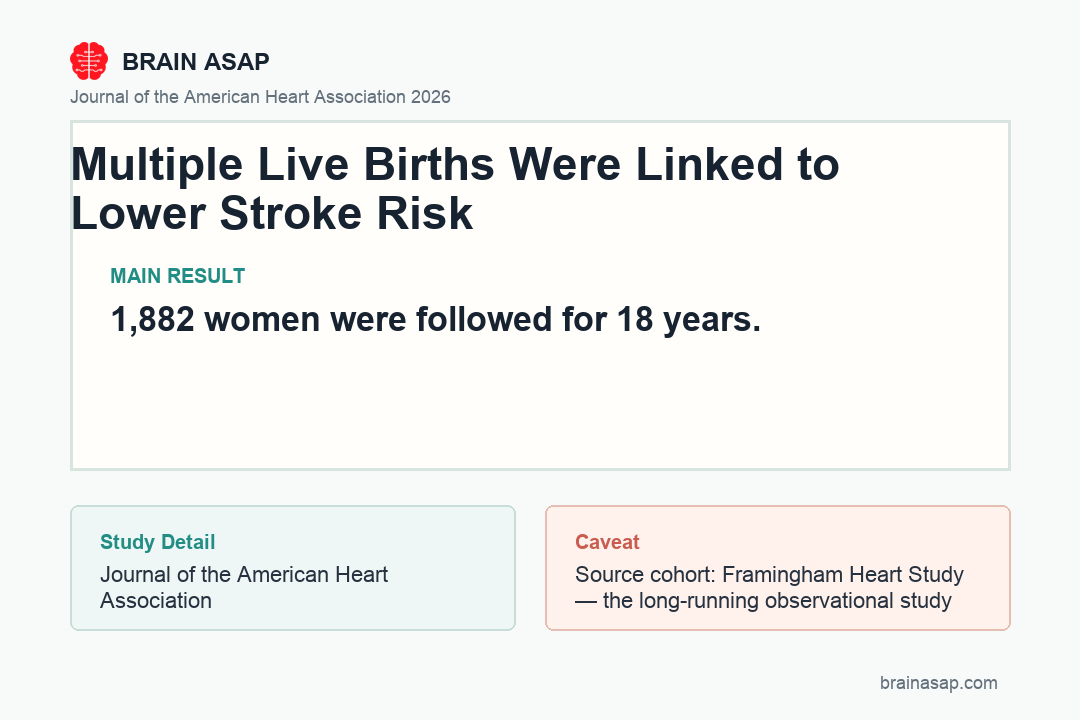
TL;DR: A 2026 study in the Journal of the American Heart Association followed 1,882 stroke-free women from the Framingham Heart Study for a median of 18 years and found that having three or more live births was associated with a reduced risk of clinical stroke and lower MRI markers of vascular brain injury — the only reproductive factor among several tested that showed a significant association.
Key Findings
- Three-plus live births linked to lower stroke risk: In 1,882 stroke-free women followed a median of 18 years, having three or more live births was associated with reduced risk of clinical stroke after adjusting for major vascular risk factors.
- Same threshold linked to lower covert brain infarct risk: Three or more live births were also associated with reduced risk of MRI-detected vascular brain injury — covert brain infarcts and white matter hyperintensities — not just clinical strokes.
- Other reproductive factors showed no significant association: Age at menopause, postmenopausal hormone replacement therapy use, and serum estradiol/estrone levels were not significantly associated with stroke or MRI markers in this analysis. Live-birth count was the only association that emerged.
- Stroke disproportionately affects women: Women account for 57% of all strokes in the United States, making female-specific risk-prediction tools clinically important — the live-birth finding is positioned as one such addition.
- Framingham Heart Study cohort: The analysis used 1,882 women stroke-free at baseline (1998-2001), mean age 61, with 126 strokes during the follow-up.
- Mechanism remains hypothesized, not measured: Researchers point to lifetime estrogen exposure and pregnancy-driven vascular adaptation as plausible explanations, but neither was directly measured here.
Source: Journal of the American Heart Association (2026) | Seshadri, McGrath et al.
Stroke is a leading cause of disability and death and disproportionately affects women, who account for 57% of all strokes in the United States.
Female-specific stroke prediction tools have lagged behind sex-neutral risk calculators, partly because reproductive history has not been consistently included as a measured input.
This Framingham Heart Study analysis tests whether several reproductive factors — live birth count, age at menopause, hormone replacement therapy, and circulating estrogen levels — predict subsequent clinical and MRI-detected stroke risk in a community cohort.
1,882 Stroke-Free Women From the Framingham Heart Study
The analysis was led by Sudha Seshadri at UT Health San Antonio’s Glenn Biggs Institute and Emer R. McGrath at the University of Galway School of Medicine.
The cohort and design:
- Source cohort: Framingham Heart Study — the long-running observational study of Framingham, Massachusetts residents that began in 1948.
- Sample: 1,882 women stroke-free at baseline (1998-2001).
- Mean baseline age: 61 years.
- Follow-up: Median 18 years.
- Outcomes: Clinical strokes (any cause), covert brain infarcts (MRI-detected vascular lesions), and white matter hyperintensity volume.
- Reproductive factors examined: Number of live births, age at menopause, postmenopausal hormone replacement therapy, serum estradiol and estrone levels.
- Statistical approach: Multivariable Cox proportional hazards models adjusted for major vascular risk factors.
Across the median 18-year follow-up, 126 women had strokes. The analysis tested which baseline reproductive factors predicted that outcome.
Three or More Live Births Stood Out as the Protective Factor
The significant association in the analysis came from one variable.
The relevant findings:
- Three or more live births → reduced clinical stroke risk: After adjusting for major vascular risk factors, women with three-plus live births had a lower stroke incidence over the follow-up window.
- Three or more live births → reduced MRI vascular injury: The same threshold was associated with lower covert brain infarcts and white matter hyperintensity volume on MRI.
- Other reproductive factors: No significant association with stroke or MRI markers.
The fact that the same live-birth threshold predicts both clinical and covert outcomes strengthens the reading. A finding that appeared only on one outcome could reflect chance; the same pattern across the clinical and imaging endpoints fits a real underlying association.
The Estrogen Hypothesis Was Tested Directly and Did Not Show Up
The conventional explanation for sex-specific cerebrovascular protection is lifetime estrogen exposure.
The Seshadri team tested several estrogen-related variables directly:
- Age at menopause: Earlier menopause means shorter lifetime estrogen exposure. No significant stroke association.
- Hormone replacement therapy use: Postmenopausal HRT extends estrogen exposure. No significant stroke association.
- Serum estradiol level: Direct biochemical measurement of circulating estrogen. No significant stroke association.
- Serum estrone level: Postmenopausal estrogen marker. No significant stroke association.
The lifetime-estrogen-exposure account, taken at face value, would have predicted that at least some of these factors would track with stroke. They didn’t. The live-birth association stood alone.
That selectivity points away from a generic estrogen-exposure mechanism and toward something more specific to the biology of pregnancy itself — vascular remodeling, immune reprogramming, lasting changes to blood pressure regulation, or other pregnancy-specific physiological adaptations not captured by estrogen levels alone.
Reproductive History May Improve Stroke-Risk Prediction
The clinical interpretation is conservative. The study does not support treating childbirth as stroke prevention or planning family size around stroke risk.
It means that live-birth count carries information that current female-specific stroke prediction tools may be missing.
Observational Design, Single Cohort, and Mechanism Limit the Conclusions
- Observational data: The protective association cannot establish that having three-plus live births reduces stroke risk through a particular mechanism. Selection effects (women who can carry multiple pregnancies are healthier to begin with) cannot be fully ruled out.
- Single-cohort generalization: Framingham is a long-running but largely white, northeastern-US cohort. Whether the live-birth pattern holds in cohorts with different demographics, healthcare access, or fertility patterns requires separate analysis.
- No mechanistic data: The study identifies a statistical association. The biological pathway connecting live-birth count to vascular brain protection is hypothesized rather than measured.
- Pregnancy complications not isolated: Live birth count alone does not capture pregnancy quality. Whether complicated pregnancies (preeclampsia, gestational diabetes, preterm delivery) confer different risks would need within-pregnancy detail this analysis does not include.
- Cross-cutting confounders: Family size correlates with socioeconomic status, partner support, and lifestyle factors that independently affect stroke risk. The covariate adjustment reduces but cannot fully eliminate this concern.
Live-Birth Count Belongs in Female-Specific Stroke Prediction Tools
The implications are specific:
- Female-specific stroke risk calculators should add live-birth count: Current tools largely ignore reproductive history. The Seshadri data support including the variable when validated externally.
- Don’t infer behavior change: The study does not support telling women to have more children for stroke prevention. The protective association is one input among many; diet, exercise, blood pressure control, and genetics matter more.
- Mechanism research is the next step: What about pregnancy itself produces lasting cerebrovascular protection? Vascular remodeling, immune reprogramming, blood pressure adaptation, and metabolic resetting are all candidate pathways worth direct investigation.
- Other reproductive factors deserve replication, not abandonment: The null findings on age at menopause, HRT, and circulating estrogens may reflect statistical power limits in this single cohort. Larger meta-analyses across multiple cohorts may yet detect smaller associations on those variables.
Citation: DOI: 10.1161/JAHA.125.044037. Seshadri S, McGrath ER et al. Number of Live Births as a Protective Factor Against Clinical and Covert Brain Infarcts: The Framingham Heart Study. Journal of the American Heart Association. 2026.
Study Design: Prospective observational cohort analysis using the Framingham Heart Study; multivariable Cox proportional hazards models for clinical stroke and MRI-derived vascular brain injury.
Sample Size: 1,882 women stroke-free at baseline (1998-2001); mean baseline age 61; median 18-year follow-up; 126 strokes across follow-up.
Key Statistic: Three or more live births associated with reduced clinical stroke risk and lower MRI markers of vascular brain injury (covert brain infarcts, white matter hyperintensity volume). No significant association for age at menopause, hormone replacement therapy, or serum estradiol/estrone levels.
Caveat: Observational design cannot establish causation; single-cohort, predominantly white northeastern-US sample limits generalization; no direct mechanistic data; pregnancy complications not separately analyzed; family size correlates with socioeconomic and lifestyle factors that independently affect stroke risk.