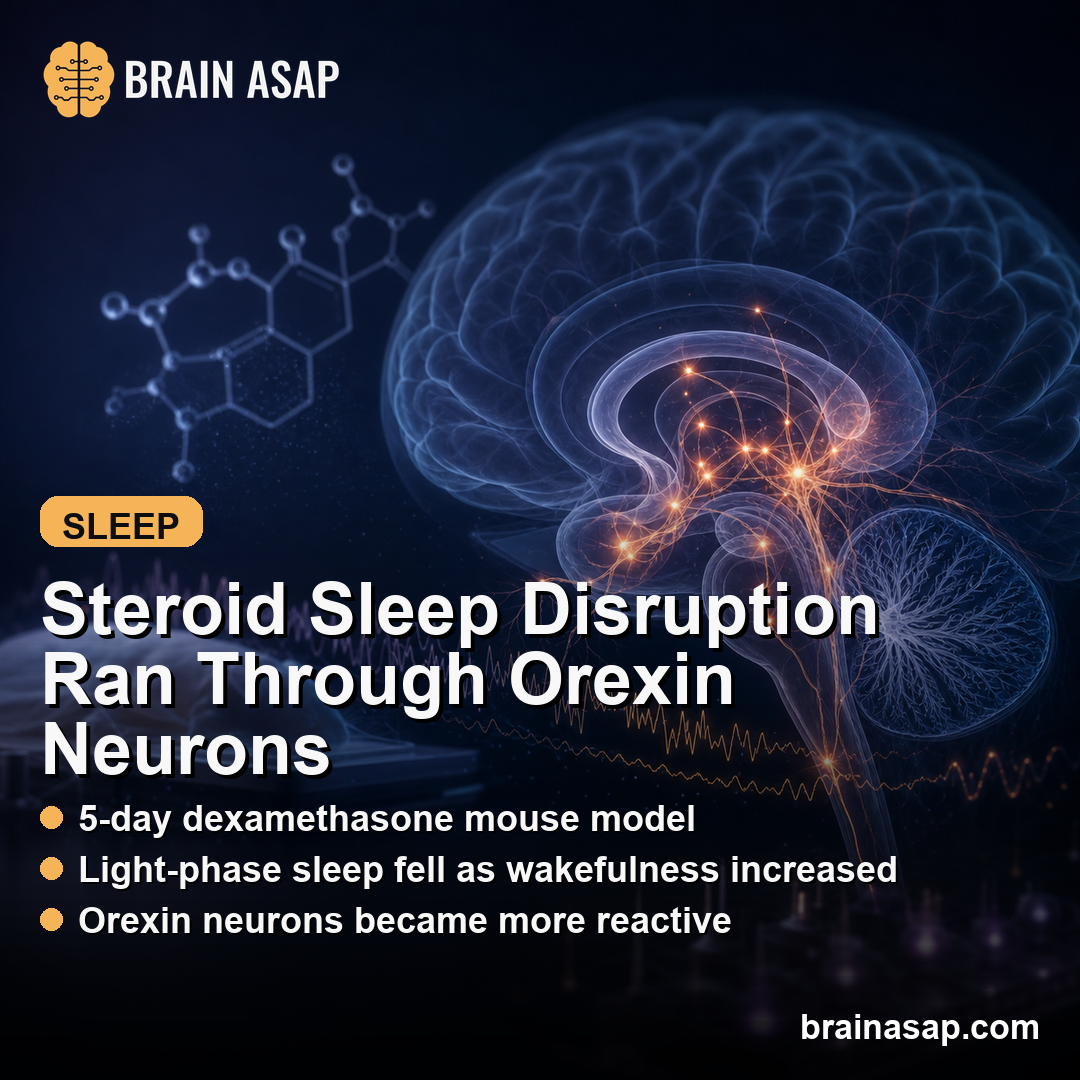
TL;DR: A 2026 mouse study in Psychopharmacology found that repeated dexamethasone, a synthetic glucocorticoid steroid, disrupted light-phase sleep and increased orexin-neuron activity, a wake-promoting hypothalamic signal, during sleep-to-wake transitions.
Key Findings
- 5-day steroid model: Male C57BL/6J mice received dexamethasone at 30 mg/kg for 5 days before 24-hour sleep recording.
- Light-phase sleep was disrupted: Dexamethasone increased wakefulness (t13 = 4.122; p = 0.0012) and reduced non-rapid eye movement sleep (NREM), the deeper non-dreaming sleep stage (t13 = 4.412; p = 0.0007).
- Orexin neurons became more reactive: Fiber photometry, an optical method for tracking cell activity, showed stronger orexin-neuron calcium signals during transitions from NREM or REM sleep to wakefulness.
- Two hypnotic strategies helped: Brotizolam, a benzodiazepine receptor agonist, and suvorexant, a dual orexin receptor antagonist, both reversed key sleep-disruption measures in the mouse model.
- Translation remains preclinical: The experiments used a high-dose mouse model, so the findings support mechanism-based testing rather than immediate clinical prescribing rules.
Source: Psychopharmacology (2026) | Endo et al.
Dexamethasone is widely used because it is a potent anti-inflammatory steroid. Sleep disturbance is also a recognized adverse effect, but the mechanism behind steroid-related insomnia is still hard to pin down in patients.
This study tested a concrete arousal-circuit hypothesis. Orexin, also called hypocretin, is a neuropeptide system in the hypothalamus that helps stabilize wakefulness.
If steroid exposure pushes orexin neurons toward excessive activation, sleep could fragment even when the body is in its normal rest phase.
Dexamethasone Increased Light-Phase Wakefulness in Mice
Researchers gave mice intraperitoneal dexamethasone injections once daily for 5 consecutive days, timed at the beginning of the dark phase. Sleep was measured with electroencephalography (EEG), which records brain electrical activity, and electromyography (EMG), which records muscle activity.
The mice still showed a normal day-night rhythm, but dexamethasone changed the balance of sleep stages. During the light phase, when mice normally sleep, treated mice spent more time awake and less time in NREM sleep.
- Wakefulness increased: Light-phase total wakefulness was higher after dexamethasone (t13 = 4.122; p = 0.0012).
- NREM sleep decreased: Light-phase NREM sleep was lower after dexamethasone (t13 = 4.412; p = 0.0007).
- Fragmentation rose: The Sleep Fragmentation Index showed a dexamethasone main effect during the light phase (F1,14 = 4.842; p = 0.0451).
- REM sleep was less affected: Rapid eye movement sleep (REM), a sleep stage linked with dreaming and muscle atonia, did not show the same total-duration change.
The researchers also checked whether the sleep changes were simply signs of severe sickness behavior. Body weight and food intake stayed comparable at the sleep-study dose, while blood-cell changes confirmed that dexamethasone was pharmacologically active.
Fiber Photometry Showed Orexin Hyperactivation During Awakening
To test the orexin mechanism, researchers used Orexin-tTA mice engineered for targeted recording from orexin neurons. They expressed GCaMP6, a calcium-sensitive fluorescent reporter, in hypothalamic orexin cells and recorded fluorescence while EEG/EMG tracked sleep state.
The key measurement was not average orexin activity across the whole day. Researchers aligned activity to specific state transitions, especially the moments when mice moved from sleep into wakefulness.
During NREM-to-wake transitions, orexin calcium signals rose in both groups, but the dexamethasone group showed a larger surge. The wakefulness-phase Z-score increase was significantly higher in treated mice (F1,9 = 6.941; p = 0.0272; post hoc p = 0.0048).
A similar pattern appeared after REM-to-wake transitions, with a dexamethasone-related increase that approached significance in the two-way analysis (F1,9 = 5.150; p = 0.0520).
The follow-up wakefulness comparison reached significance (p = 0.0129).
Importantly, orexin activity did not show the same abnormal surge when mice transitioned from wakefulness into NREM sleep. That direction-specific pattern fits a model of exaggerated wake initiation rather than a general inability to enter sleep.
Brotizolam and Suvorexant Both Reversed Sleep Disruption
The pharmacology experiments compared 2 treatment ideas after the dexamethasone sleep phenotype was established. Brotizolam broadly promotes sleep through benzodiazepine receptor signaling.
Suvorexant targets the orexin system more directly by blocking orexin receptors.
- Brotizolam: In dexamethasone-pretreated mice, brotizolam decreased wakefulness and increased NREM sleep during the light phase, with post hoc p = 0.0076 for both comparisons against Dex-Sal.
- Suvorexant: In dexamethasone-pretreated mice, suvorexant decreased wakefulness (p = 0.0402) and restored NREM sleep (p = 0.0107) versus vehicle.
- REM difference: Brotizolam did not significantly alter REM sleep, while suvorexant increased REM sleep duration in both saline- and dexamethasone-pretreated mice.
The two-drug result does not prove suvorexant is clinically superior. It does show that blocking orexin signaling can reverse the mouse phenotype in a way that matches the orexin-recording data.
The Mouse Model Points to Steroid-Linked Hyperarousal
The study supports a specific mechanism: repeated steroid exposure made orexin neurons overreact during sleep-to-wake transitions. That could increase the chance that a brief arousal becomes a sustained wake episode.
The model also captured a split between rest-phase and active-phase effects. During the light phase, dexamethasone increased wakefulness and sleep fragmentation.
During the dark phase, treated mice showed lower wakefulness and higher NREM sleep, which the researchers interpreted as a possible compensatory pattern after disrupted rest-phase sleep.
Clinically, the finding is most useful as a mechanistic lead. Steroid-induced insomnia in people occurs in a more complicated setting, with illness, hospital routines, inflammation, other drugs, mood symptoms, and pain all influencing sleep.
High-Dose Male-Mouse Data Limit Clinical Translation
The main caveat is dose and species. The dexamethasone dose was intentionally high to produce a robust sleep-disruption model and isolate arousal circuitry. Rodent steroid metabolism also differs from human steroid exposure.
- Male-mouse emphasis: The C57BL/6 sleep experiments used male mice, although Orexin-tTA photometry included both sexes.
- Correlation, not causal silencing: Fiber photometry tracked orexin activity but did not directly inhibit orexin neurons during the steroid-induced sleep disruption.
- Other arousal systems: Steroids affect many brain systems, including serotonergic and noradrenergic pathways, so orexin is unlikely to be the only contributor.
- Acute rescue only: Brotizolam and suvorexant were tested on a single recording day after chronic dexamethasone exposure, not as long-term co-treatment.
For now, the study gives researchers a plausible neural circuit for steroid-linked sleep disturbance and a reason to test orexin-targeted strategies more carefully in clinical settings.
Citation: DOI: 10.1007/s00213-026-07057-0. Endo et al. Dexamethasone induces sleep disruption in male mice and is associated with hyperactivation of orexin neurons. Psychopharmacology. 2026.
Study Design: Preclinical mouse sleep-architecture study using EEG/EMG, orexin-neuron fiber photometry, and acute hypnotic reversal tests.
Sample/Model: Male C57BL/6J mice for sleep recordings; Orexin-tTA mice for orexin-neuron calcium recording; sleep architecture figure reports n = 6-9 per group.
Key Statistic: Dexamethasone increased light-phase wakefulness (t13 = 4.122; p = 0.0012), decreased NREM sleep (t13 = 4.412; p = 0.0007), and increased orexin-neuron activation during NREM-to-wake transitions (post hoc p = 0.0048).
Caveat: The study used a high-dose preclinical mouse model, and the pharmacology tests were acute rather than long-term clinical treatment trials.