TL;DR: A 2026 cohort study in BJPsych Open found that childhood attention-deficit/hyperactivity disorder (ADHD) and autism spectrum disorder (ASD) difficulties predicted poorer young-adult outcomes, but rare copy number variants (CNVs), which are deleted or duplicated DNA segments, did not clearly sharpen that prognosis.
Key Findings
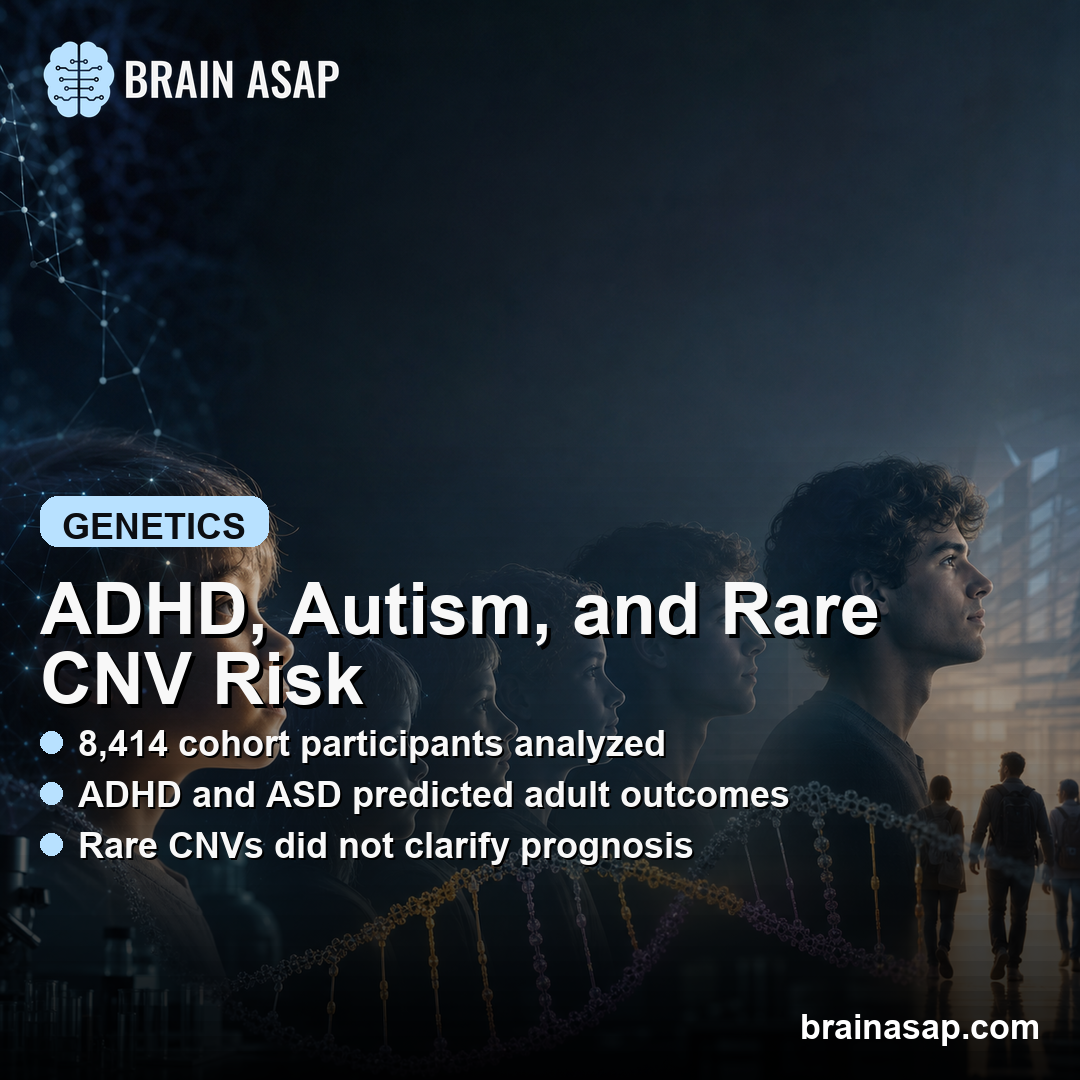
- 8,414 young people had CNV data: Researchers analyzed genetic and developmental data from the Avon Longitudinal Study of Parents and Children.
- 2.3% carried a neurodevelopmental CNV: The study identified 194 carriers of a known neurodevelopmental copy number variant.
- 8.7% carried any large rare CNV: A broader rare-CNV definition captured 734 participants, giving the study a second genetic-risk test.
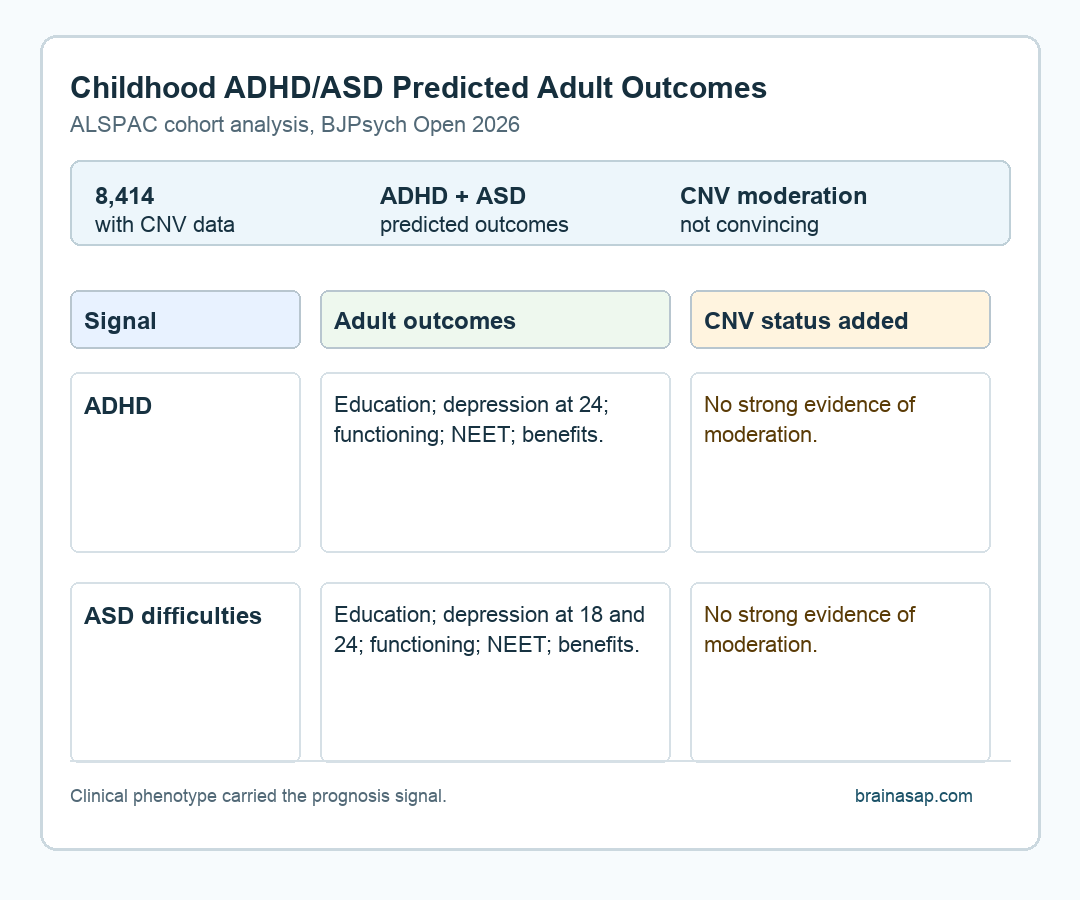
- ADHD predicted several adult outcomes: Childhood ADHD was associated with GCSE non-attainment, depression at age 24, functioning difficulty, NEET status, and state-benefit receipt at age 25.
- ASD predicted all tested outcomes: Childhood ASD difficulties were associated with GCSE non-attainment, depression at ages 18 and 24, functioning difficulty, NEET status, and state-benefit receipt.
- CNV moderation was not convincing: The study did not find strong evidence that neurodevelopmental or large rare CNVs changed the ADHD/ASD-to-outcome associations.
Source: BJPsych Open (2026) | Dennison et al.
Copy number variants are rare genetic changes where stretches of DNA are deleted or duplicated. Because some CNVs are enriched in ADHD, ASD, and intellectual disability, one practical question is whether CNV testing can help clinicians estimate which children are most likely to struggle later.
Researchers tested that question in a long-running UK birth cohort. ADHD and ASD difficulties mattered for later education, mental health, and functioning, but CNV carrier status did not clearly separate higher-risk from lower-risk children inside those groups.
ALSPAC Linked Childhood ADHD and ASD to Adult Functioning
The study used the Avon Longitudinal Study of Parents and Children (ALSPAC), a population-based cohort that followed children born in the early 1990s into adulthood. After quality control, 8,414 people had usable CNV data.
Researchers defined childhood ADHD from ICD-10 ADHD assessments at ages 7, 10, 13, or 15. ASD difficulties came from the Social Communication Disorders Checklist, using the validated threshold at ages 7, 10, 13, or 16.
- Educational outcome: GCSE non-attainment was measured by whether participants reported failing to receive at least one A* to C grade.
- Mental-health outcomes: Depression was assessed at ages 18 and 24 using Clinical Interview Schedule-Revised criteria.
- Adult-function outcomes: Researchers tested self-rated functional impact, not being in education, employment, or training (NEET), and state-benefit receipt at age 25.
The design went beyond short-term symptom tracking. It asked whether childhood neurodevelopmental difficulties still tracked meaningful adult outcomes years later.
ADHD and ASD Predicted Different Parts of Young-Adult Risk
Childhood ADHD was associated with several later problems. The strongest categorical associations included GCSE non-attainment and NEET status at age 25, with odds ratios of 4.97 and 5.70, respectively.
ADHD also predicted depression at age 24, self-rated functioning difficulty, and receiving state benefits at age 25. In the table, ADHD was not listed as associated with depression at age 18 in the same categorical model.
ASD difficulties showed a broader pattern across the outcomes tested. Childhood ASD was associated with GCSE non-attainment, depression at both young-adult time points, functional impact, NEET status, and state-benefit receipt.
- ASD and GCSE non-attainment: The odds ratio was 3.06, with a 95% confidence interval from 1.90 to 4.92.
- ASD and NEET status: The odds ratio was 4.18, with a 95% confidence interval from 2.80 to 6.22.
- ASD and state-benefit receipt: The odds ratio was 1.90, with a 95% confidence interval from 1.30 to 2.77.
The same general pattern appeared when researchers used continuous ADHD and ASD trait scores rather than categorical definitions. The pattern did not depend on one threshold choice.
Rare CNVs Did Not Clearly Improve Prognosis
The genetic analysis tested two CNV definitions. Neurodevelopmental CNVs were rare variants previously linked to neurodevelopmental conditions.
Large rare CNVs were a broader category meant to catch other uncommon deletions or duplications.
Among the 8,414 participants with usable data, 194 people carried a neurodevelopmental CNV and 734 people carried any large rare CNV. Those numbers were large enough for exploration, but still small once split across ADHD, ASD, CNV carrier status, and multiple adult outcomes.
The core moderation test asked whether the ADHD-outcome or ASD-outcome association changed when a child also carried a CNV. In practical terms: did CNV status tell clinicians that a child with ADHD or ASD difficulties had a different adult-risk trajectory?
- ADHD moderation: Neurodevelopmental CNVs did not moderate ADHD associations with depression at age 18 or functional impact; several other interactions could not be estimated because sample sizes were too low.
- ASD moderation: Neurodevelopmental CNVs did not moderate the ASD associations with GCSE non-attainment or state-benefit receipt; other outcomes again had too little data for stable estimates.
- Large rare CNVs: Sensitivity analyses using the broader CNV definition did not show evidence of moderation for ADHD or ASD outcomes.
The Negative CNV Finding Still Has a Clinical Use
A null moderation result is not the same as saying CNVs are irrelevant to neurodevelopment. CNVs can still contribute to the origins of ADHD, ASD, intellectual disability, and other developmental differences.
The narrower point is about prognosis. In this cohort, CNV carrier status did not provide strong evidence for sorting children with ADHD or ASD difficulties into meaningfully different young-adult outcome pathways.
Genetic testing is sometimes discussed as if it will automatically make psychiatric prediction sharper. This result supports a more restrained reading: a rare genetic risk marker may help explain etiology without necessarily improving individual outcome forecasts.
Wide Confidence Intervals Keep the Door Open
The researchers were careful about the main limitation. CNVs are rare, and the number of children who had ADHD or ASD difficulties, carried a CNV, and had each young-adult outcome could become small quickly.
That is why several interactions could not be estimated and why the confidence intervals around moderation were wide.
The study rules out a strong, obvious moderation signal in this population cohort, but it does not prove that CNVs never matter for prognosis in larger or more clinically selected samples.
A practical interpretation is that childhood ADHD and ASD signals should stay central in risk planning. CNV status may belong in the developmental and etiological record, but this study did not support using CNV carrier status by itself as a reliable adult-outcome stratifier.
Citation: DOI: 10.1192/bjo.2026.11018. Dennison et al. Childhood ADHD and autism spectrum disorder difficulties: exploring the impact of copy number variants on young adult outcomes. BJPsych Open. 2026;12:e108
Study Design: UK population-based cohort analysis using ALSPAC childhood ADHD/ASD measures, CNV data, and young-adult outcomes.
Sample Size: 8,414 participants with CNV data after quality control.
Key Statistic: 194 participants carried a neurodevelopmental CNV, and 734 carried any large rare CNV; neither CNV definition showed strong evidence of moderating ADHD/ASD outcome associations.
Caveat: CNV moderation tests were limited by rare carrier status and low sample sizes for several interaction estimates.