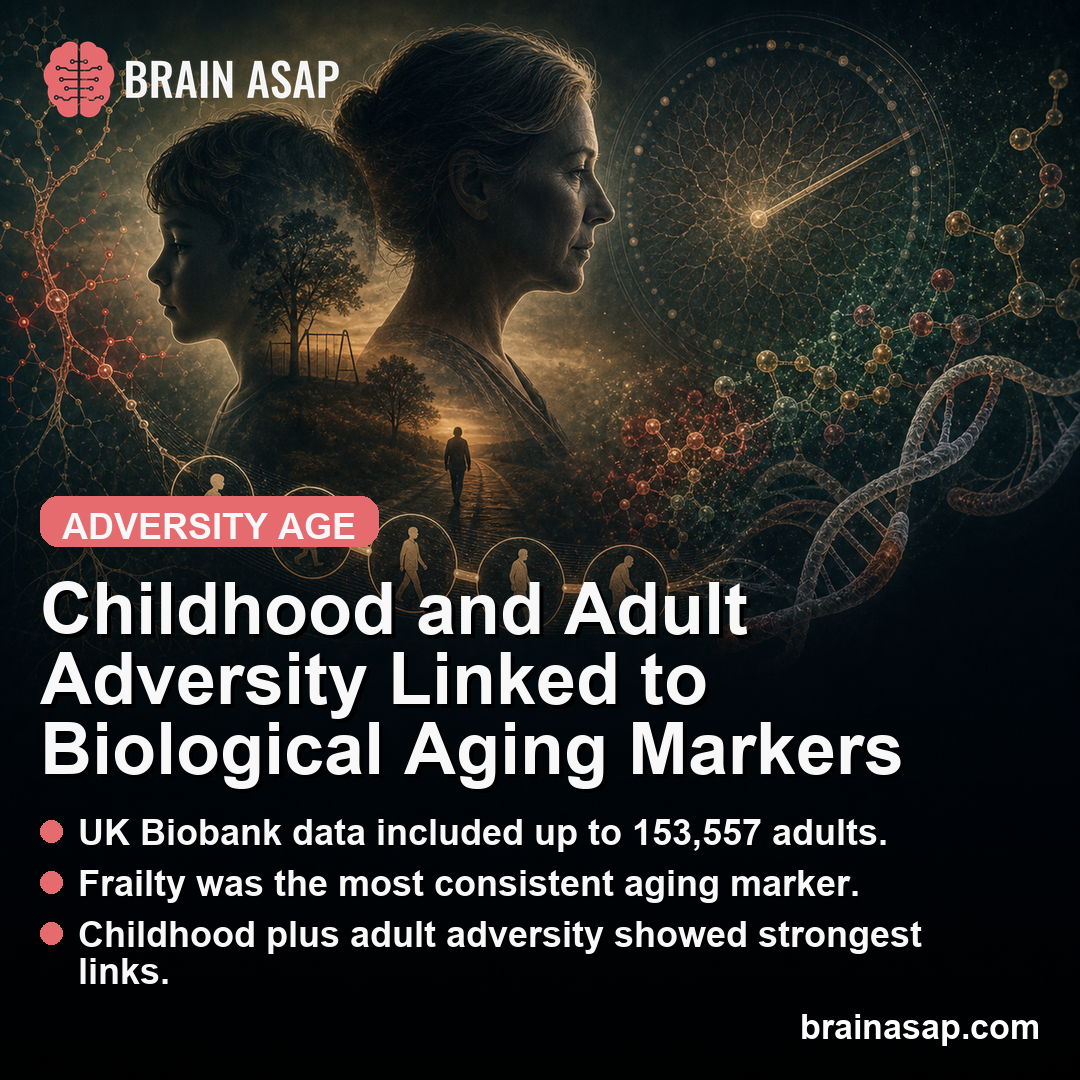
TL;DR: A 2026 BMC Medicine study of UK Biobank adults linked adversity in both childhood and adulthood to higher frailty, older metabolomic age profiles, lower grip strength, and some telomere differences, with the clearest associations in people reporting multiple adverse events.
Key Findings
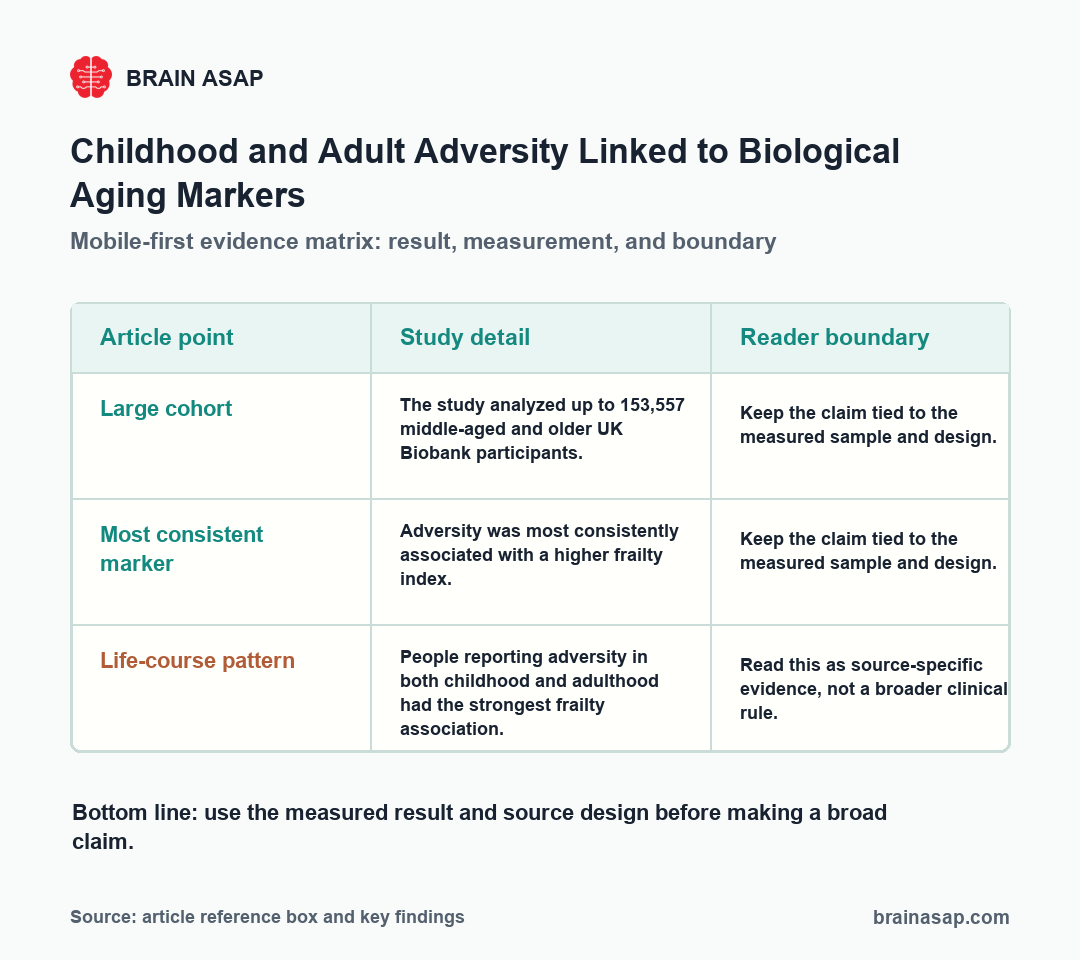
- Large cohort: The study analyzed up to 153,557 middle-aged and older UK Biobank participants.
- Most consistent marker: Adversity was most consistently associated with a higher frailty index.
- Life-course pattern: People reporting adversity in both childhood and adulthood had the strongest frailty association.
- Metabolomic aging: Only the group with both childhood and adult adversity had metabolite-predicted age exceeding chronological age in the combined timing analysis.
- Caution: The study was observational and cannot prove that adversity directly accelerated biological aging in each person.
Source: BMC Medicine (2026) | Aas et al.
Adverse events are already linked to later health risk, but many studies stop at disease diagnoses or mental health outcomes. Researchers asked a broader biological question: do people who report adversity show measurable differences across aging-related markers?
The study did not rely on one aging score. It compared adversity with metabolomic age, a metabolomic mortality profile, a clinical frailty index, telomere length, and grip strength.
Using several markers helps because biological aging is not one thing. A blood-metabolite clock, accumulated health deficits, chromosome-end length, and physical strength can move differently.
The clearest association was not a molecular clock. It was frailty. Across childhood adversity, adulthood adversity, and combined exposure timing, higher frailty index values were the most consistent finding.
UK Biobank Linked Life-Course Adversity to Several Aging Markers
The analysis used UK Biobank data from middle-aged and older adults. Depending on the marker and exposure, the sample reached up to 153,557 people.
Adversity came from questionnaires covering five types of childhood adverse events and five types of adult adverse events.
The outcomes were intentionally broad:
- MileAge delta: estimated whether metabolite-predicted age was older or younger than chronological age.
- Metabolomic mortality profile: summarized metabolite patterns linked to mortality risk.
- Frailty index: counted accumulated health deficits.
- Telomere length and grip strength: measured chromosome-end length and physical function.
Models adjusted for age, sex, education, income, ethnicity, and neighborhood deprivation. Those covariates do not remove every confounding problem, but they help separate adversity from several obvious demographic and socioeconomic differences.
The paper also looked at severity by counting how many types of adverse events a participant reported. That approach cannot measure every detail of stress exposure, but it can test whether multiple adverse event types are associated with worse aging-marker profiles than a single reported type.
Because the markers came from different biological and clinical domains, the study could also show where the adversity association was strongest.
A result that appears only in one molecular clock would be easier to overinterpret. A pattern that includes frailty, grip strength, and metabolomic measures gives a broader but still observational picture.
Frailty Index Had the Most Consistent Association With Adverse Events
Among 153,557 participants with childhood adversity data, 63,066 reported at least one childhood adverse event. Childhood adversity was associated with higher frailty index values and, in the full model, with modest differences in metabolomic age and telomere length.
Adult adversity was common as well.
Among 150,848 participants, 80,895 reported at least one adult adverse event.
Adult adversity was associated with higher frailty and lower grip strength, while metabolomic age and telomere findings were less consistent.
The dose pattern was clearest for frailty. People reporting multiple types of adverse events tended to have higher frailty scores than people reporting none or fewer events.
That was true for childhood exposure and adult exposure, and it became most apparent when the analysis considered adversity across both life periods.
Frailty is a composite measure, so it can absorb many downstream effects of health burden.
That is a strength and a limitation.
It can capture real accumulated vulnerability, but it does not identify one biological mechanism by itself.
Childhood and Adult Adversity Together Marked Older Biological Profiles
The timing analysis separated people into no adversity, childhood-only adversity, adulthood-only adversity, and both childhood and adulthood adversity. The group reporting both time periods stood out most clearly.
About 27.1% of participants in that combined analysis reported adversity in both childhood and adulthood. This group had the highest frailty association, with a standardized estimate around 0.434 in the fully adjusted model.
The childhood-only and adulthood-only groups also had higher frailty scores than people reporting no adversity. The both-period group was clearly larger in the combined timing model, consistent with cumulative burden across the life course.
Metabolomic measures added another layer. MileAge delta asks whether a person’s metabolite profile resembles that of someone older or younger than their chronological age, and the both-period adversity group was the clearest category for metabolite-predicted age exceeding chronological age.
Metabolomic age showed a narrower pattern: childhood-only and adulthood-only adversity were not the clearest combined-timing categories for metabolite-predicted age exceeding chronological age. The both-period group was the one that showed that association after adjustment.
Grip strength also fit the life-course pattern. Adult adversity, with or without childhood adversity, was associated with lower grip strength.
A clinical explanation is that grip strength reflects current physical function and may be more sensitive to adult health, stress, and disease burden.
Abuse Was More Consistently Linked Than Neglect
The study also separated types of childhood adversity. Abuse-related measures were more consistently associated with aging markers than neglect-related measures.
Neglect can still be harmful. The narrower point is that the markers available in this dataset showed a stronger and more consistent pattern for abuse.
Interpretation has to stay measured. These were retrospective questionnaire reports, and adversity categories do not capture intensity, duration, age of onset, relationship to the person causing harm, or later recovery conditions with perfect precision.
Still, grouping all adverse events together can hide differences.
A participant who reports emotional abuse, physical abuse, or multiple exposures may not have the same risk profile as someone with one lower-intensity event.
The paper supports separating timing, type, and accumulation when studying stress-related aging.
UK Biobank Design Limits Causal Claims About Aging
The study is large and biologically detailed, but the causal claim remains limited. UK Biobank is not a perfectly representative population sample, and healthier volunteer bias can affect the size and direction of associations.
Several limits are especially important:
- Observational design: The data cannot prove that adversity caused each aging-marker difference.
- Timing uncertainty: Some adult adverse events may have occurred after some health changes began.
- Retrospective reporting: Childhood adversity was recalled later in life, which can introduce reporting bias.
- Marker limits: Telomere length was measured with qPCR, and biological age measures do not capture every aging process.
The restrained conclusion: cumulative adversity was associated with worse aging-related profiles across several domains, especially frailty. The study supports biological aging as one possible pathway between life-course stress and later health, but it does not reduce that pathway to a single biomarker or prove inevitability.
That distinction is important for prevention. The findings support closer attention to long-term health after repeated adversity, while leaving room for recovery, treatment, social support, and physical health interventions to change later risk.
The main point is not that adversity leaves a permanent biological stamp. The study shows group-level associations in middle and older adulthood.
It also shows where future studies can test whether reducing stress burden, improving physical function, and treating trauma-related symptoms change aging-marker trajectories over time.
Citation: DOI: 10.1186/s12916-026-04815-x. Aas M, Hoppen TH, Morina N, Zhang S, Li B, Mlakar V, Mutz J. Adverse events in both childhood and adulthood are associated with molecular, clinical and functional markers of ageing. BMC Medicine. 2026;24:252.
Study Design: Observational UK Biobank analysis of childhood and adulthood adverse events and multiple biological aging markers.
Sample Size: Up to 153,557 middle-aged and older adults, depending on exposure and aging-marker availability.
Key Statistic: Participants reporting both childhood and adult adversity had the strongest frailty-index association in the combined timing analysis.
Caveat: Observational UK Biobank data cannot prove adversity caused the aging-marker differences.