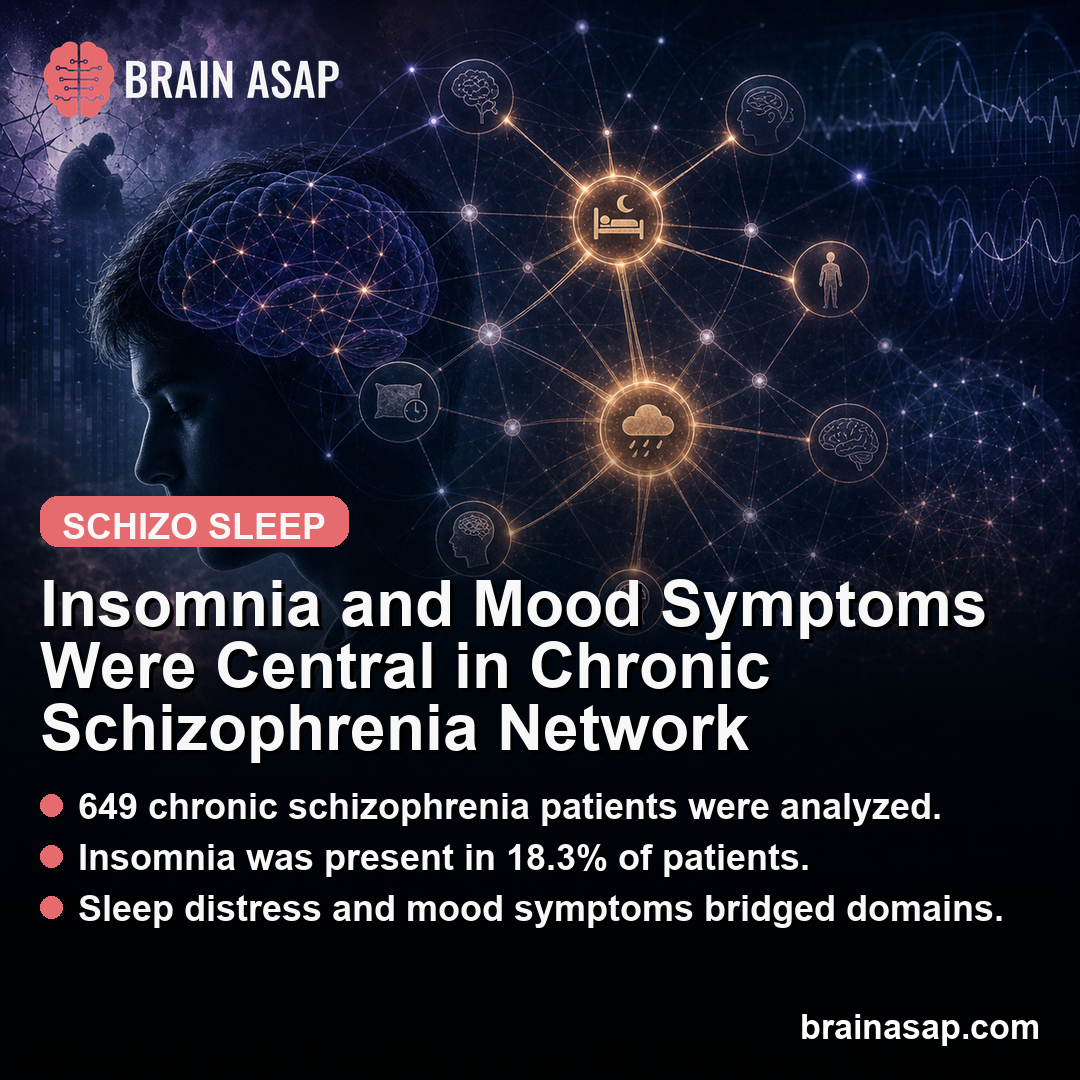
TL;DR: A 2026 network analysis study in European Archives of Psychiatry and Clinical Neuroscience found that insomnia was present in 18.3% and childhood trauma in 49.5% of patients, while daytime dysfunction and sleep-related distress were central nodes, while mood symptoms and difficulty falling asleep bridged domains.
Key Findings
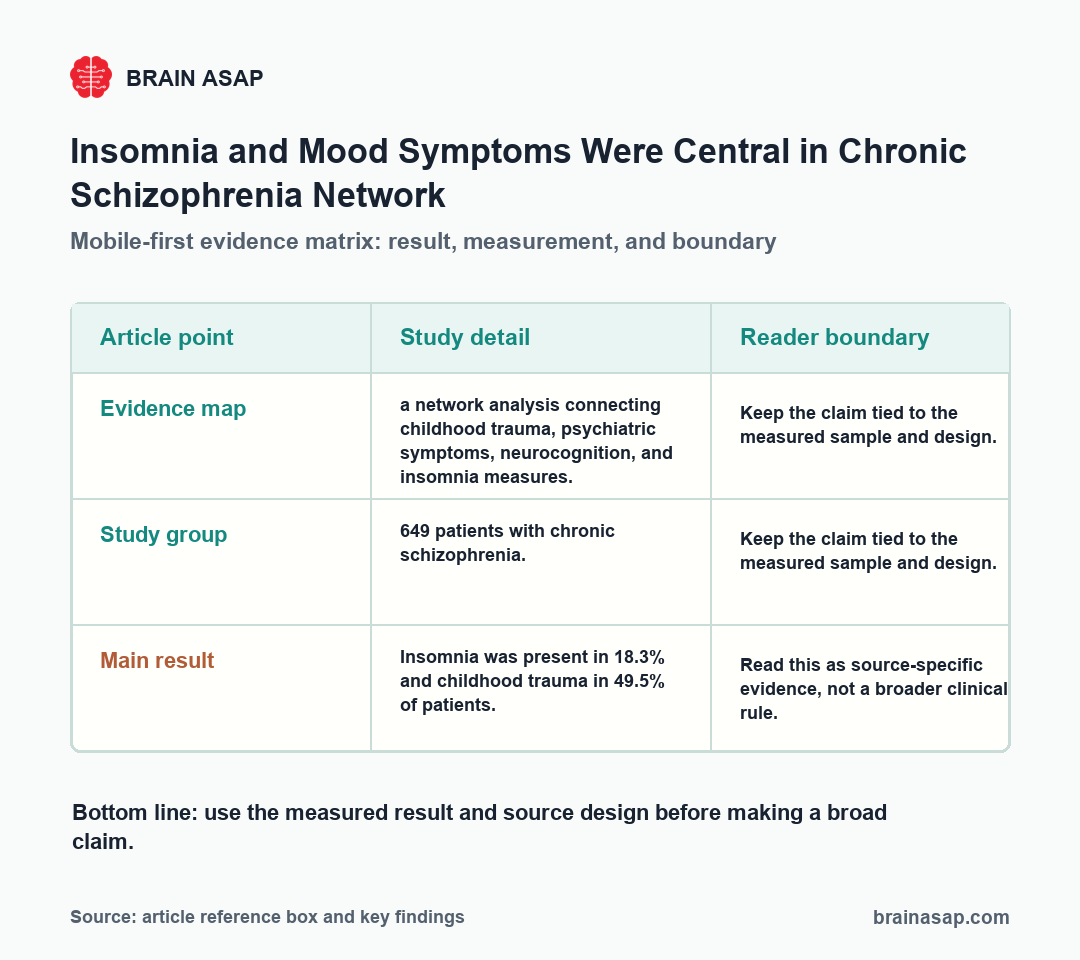
- Evidence map: a network analysis connecting childhood trauma, psychiatric symptoms, neurocognition, and insomnia measures.
- Study group: 649 patients with chronic schizophrenia.
- Main result: Insomnia was present in 18.3% and childhood trauma in 49.5% of patients.
- Second result: Daytime dysfunction and sleep-related distress were central nodes, while mood symptoms and difficulty falling asleep bridged domains.
- Caution: Network centrality is not proof that treating one node will cause broad improvement.
Source: European Archives of Psychiatry and Clinical Neuroscience (2026) | Chen et al.
Childhood trauma, sleep problems, mood symptoms, cognition, and psychotic symptoms often overlap in schizophrenia. Network analysis tries to map how those symptom domains connect.
This 2026 European Archives of Psychiatry and Clinical Neuroscience study examined 649 people with chronic schizophrenia using trauma, symptom, cognition, and insomnia scales. The analysis highlighted sleep and mood links rather than treating insomnia as a side complaint.
The useful finding is a symptom-network result: insomnia was present in 18.3% and childhood trauma in 49.5% of patients. The analysis points to sleep and trauma as connected clinical domains in chronic schizophrenia.
Chronic Schizophrenia Network Included Trauma, Sleep, Symptoms, and Cognition
Design: a network analysis connecting childhood trauma, psychiatric symptoms, neurocognition, and insomnia measures. Study group: 649 patients with chronic schizophrenia.
The network included trauma history, sleep symptoms, psychiatric symptoms, and cognition. The reason is chronic schizophrenia care often treats those domains separately.
- Trauma: Childhood Trauma Questionnaire measured early adversity.
- Symptoms: PANSS factors captured psychiatric symptom domains.
- Cognition: RBANS measured neurocognitive performance.
- Sleep: Insomnia Severity Index measured sleep problems.
Insomnia and Childhood Trauma Were Common
The prevalence numbers are a concrete starting point: 18.3% insomnia and 49.5% childhood trauma. Those are not rare side issues in the sampled chronic schizophrenia group.
The bridge-node result is the more mechanistic clue. Daytime dysfunction, sleep-related distress, mood symptoms, and difficulty falling asleep helped connect domains across the network.
The node names matter because each one points to a different clinical task. Daytime dysfunction is about how sleep problems show up during waking life; sleep-related distress is about the emotional burden attached to poor sleep; difficulty falling asleep captures the front end of the insomnia pattern.
- Daytime dysfunction: fatigue, poor concentration, and reduced daily functioning can make sleep problems visible in routine care.
- Sleep-related distress: distress may connect insomnia with mood symptoms rather than leaving sleep as an isolated complaint.
- Difficulty falling asleep: sleep-onset problems can sit near arousal, worry, trauma history, and mood symptoms.
- Clinical use: the network supports asking about sleep and trauma together instead of treating insomnia as background noise.
The result also keeps the claim proportional.
A network can identify tightly connected symptoms, but it cannot tell clinicians which symptom started the chain.
Intervention trials would be needed to show whether improving insomnia changes mood, cognition, or psychotic symptoms in this population.
Sleep Dysfunction and Mood Symptoms Bridged Clinical Domains
Network analysis can show which symptoms sit near each other statistically. It cannot prove that changing one node will automatically improve the whole network.
The restrained interpretation is that sleep dysfunction and trauma history deserve routine attention in chronic schizophrenia assessment. It is not proof of one master treatment target.
Mood symptoms acting as bridges also keeps the interpretation from turning sleep into the only issue. The network suggests overlapping clinical burdens rather than one isolated cause.
A second practical point is measurement sequence. If sleep distress and daytime dysfunction sit near mood symptoms, clinicians need enough detail to know whether insomnia is current, chronic, trauma-linked, medication-related, or driven by psychosis relapse.
Those distinctions change what follow-up should look like. A patient whose main sleep problem is difficulty falling asleep may need a different plan than someone whose main problem is daytime dysfunction after fragmented sleep.
- Current insomnia: ask about sleep onset, sleep maintenance, distress, and daytime impairment.
- Trauma history: document whether nightmares, hyperarousal, or safety concerns are affecting sleep.
- Mood bridge: track whether mood symptoms rise when sleep worsens.
Network Analysis Cannot Prove Treatment Targets
Main limitation: network centrality is not proof that treating one node will cause broad improvement.
- Cross-sectional: The network cannot prove direction of effect.
- Central nodes: High centrality does not guarantee treatment impact.
- Single context: The sample came from Chinese patients with chronic schizophrenia.
- Limited source detail: Some full article details were not available in the public summary text.
The main limit is causal direction. A central node in a network may be clinically important, but intervention studies are needed before it becomes a treatment target.
The numbers also give the study a baseline for future treatment research. If insomnia is present in 18.3% of patients and childhood trauma in 49.5%, a sleep or trauma intervention trial would not be chasing a rare subgroup.
The next useful test would measure sleep, trauma symptoms, mood symptoms, cognition, and psychosis before and after an intervention, then ask whether the network structure actually changes.
Schizophrenia Assessment Should Include Sleep and Trauma
A practical read is that sleep, trauma, and mood symptoms should not be treated as background details in chronic schizophrenia.
- Best use: Use the network to identify domains that may deserve more routine assessment.
- Do not overread: Do not assume network centrality proves that treating insomnia alone will improve cognition or psychosis.
- Next question: Test whether targeted sleep or trauma-informed interventions change broader symptom patterns.
The clinical question is direct: are sleep, trauma, mood, and cognition being measured together, or are connected domains being missed?
Citation: DOI: 10.1007/s00406-026-02242-w. Chen et al. Interrelationships of childhood trauma, psychiatric symptoms, neurocognition, and insomnia in chronic schizophrenia. European Archives of Psychiatry and Clinical Neuroscience. 2026.
Study Design: A network analysis connecting childhood trauma, psychiatric symptoms, neurocognition, and insomnia measures.
Sample Size: 649 patients with chronic schizophrenia.
Key Statistic: Insomnia was present in 18.3% and childhood trauma in 49.5% of patients.
Caveat: Network centrality does not prove that treating one symptom node will improve the broader network.