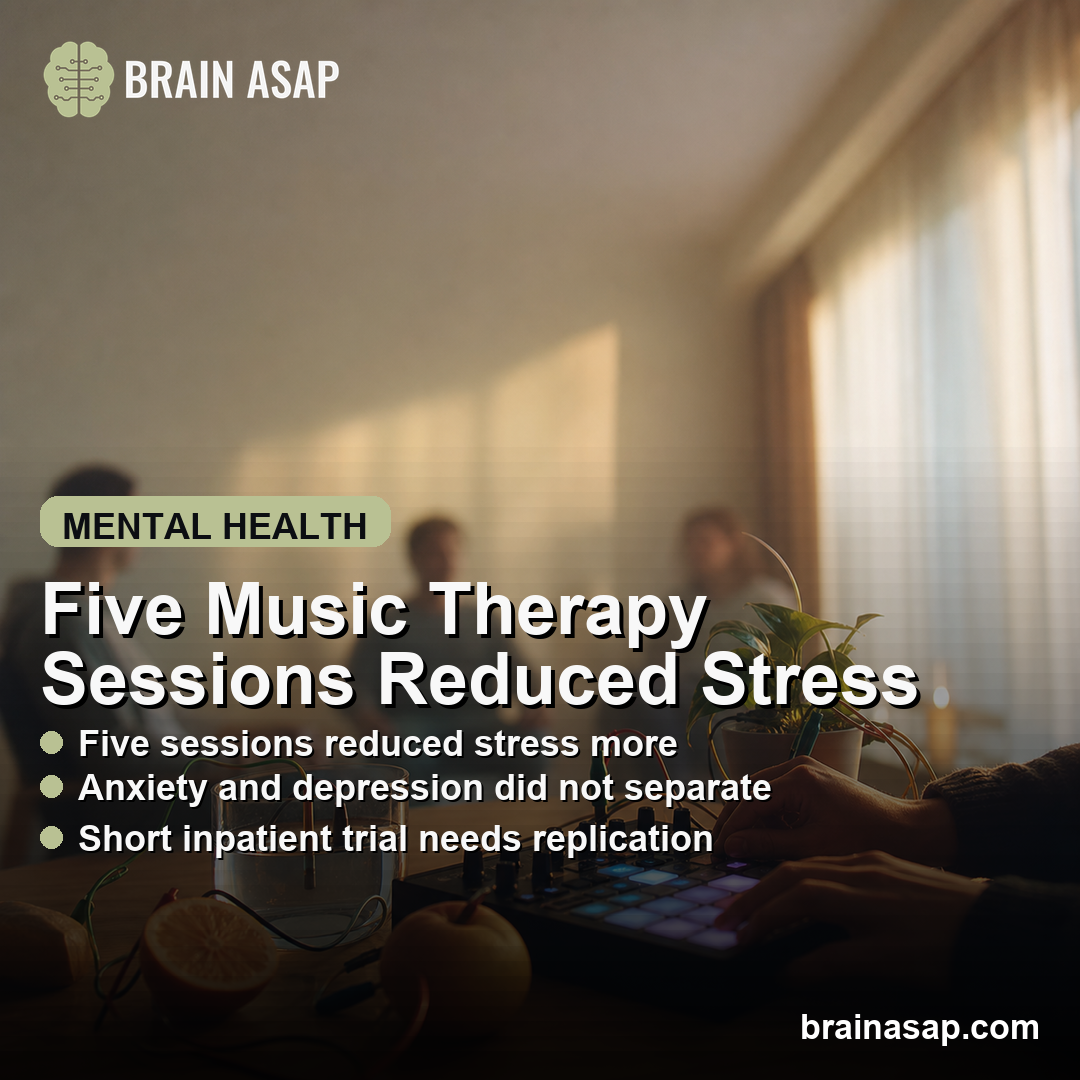
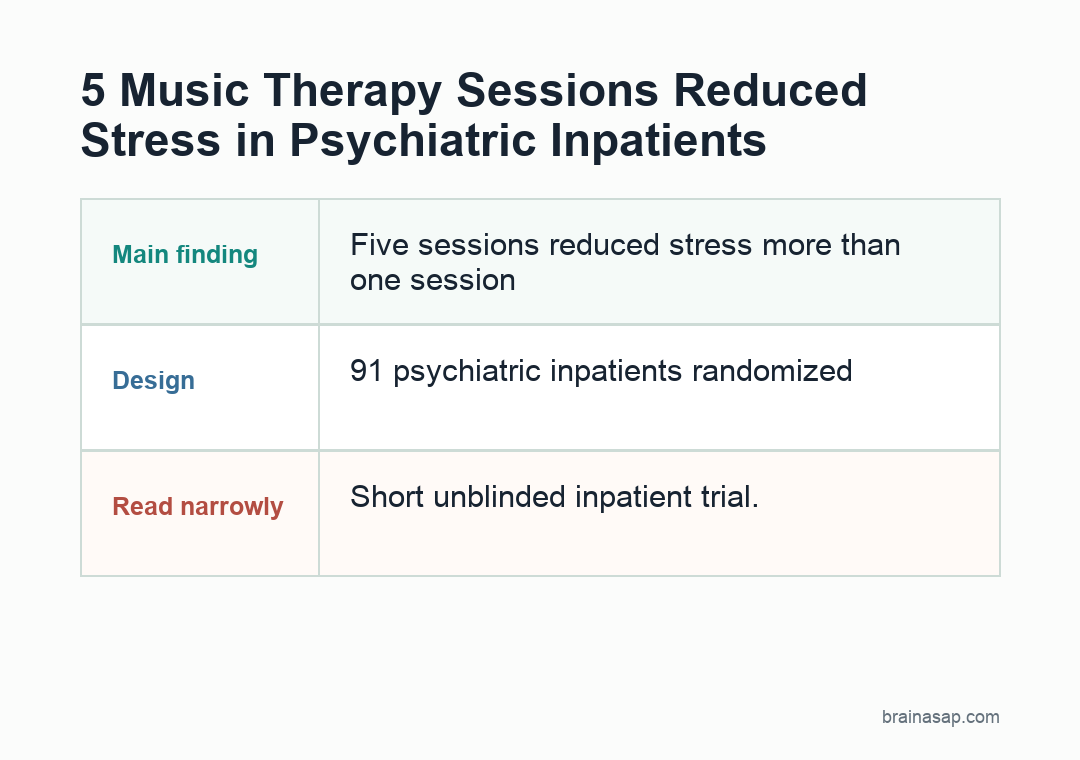
TL;DR: A 2026 randomized trial in PLOS One found that 5 MIDI-assisted group music therapy sessions during psychiatric hospitalization reduced Depression Anxiety Stress Scale-21 (DASS-21) stress scores more than 1 session, while anxiety, depression, life satisfaction, and immediate emotional-response measures did not clearly differ by session frequency.
Key Findings
- Stress fell further: DASS-21 stress showed a significant group-by-time interaction, with greater stress-score reduction after 5 sessions than after 1 session (p = 0.023).
- Anxiety did not separate: DASS-21 anxiety improved over time, but the between-group interaction was not significant (p = 0.339).
- Depression did not separate: DASS-21 depression also improved over time, but 5 sessions did not outperform 1 session on the between-group test (p = 0.270).
- Life satisfaction stayed similar: Satisfaction With Life Scale (SWLS) change did not differ significantly between high-frequency and low-frequency groups.
- Brief inpatient sample: Researchers randomized 91 adult psychiatric inpatients in Bogota; 74 completed the post-intervention assessment used in the per-protocol analysis.
Source: PLOS One (2026) | Esteban-Cárdenas et al.
5 Music Therapy Sessions Were Tested Against 1 Session
The trial tested MIDI-assisted group music therapy during short psychiatric hospitalization. MIDI is a digital music format that lets controllers, computers, and instruments trigger sound in a structured way.
In this intervention, participants used a Playtron MIDI controller connected to conductive objects such as fruit, water, and plants. Sessions also included a welcome song, breathing and muscle-relaxation work, group synchronization, creative play, and a closing song.
- High-frequency group: Participants were assigned to 5 30-minute sessions, delivered once per day for 5 consecutive days.
- Low-frequency group: Participants were assigned to 1 30-minute session during the same inpatient week.
- Shared background care: Both groups were psychiatric inpatients receiving usual clinical treatment, including medication management.
The design narrows the interpretation. The study was not a music-therapy-versus-no-therapy trial. It asked whether a short, higher-frequency dose produced a stronger short-term effect than a single inpatient session.
DASS-21 Stress Improved More After 5 Sessions
The main result came from the Depression Anxiety Stress Scale-21 (DASS-21), a 21-item questionnaire with separate depression, anxiety, and stress subscales. The stress subscale was the only DASS-21 domain where session frequency clearly separated the groups.
Among 74 completers, stress scores decreased in both arms. The high-frequency group moved from 12.5 +/- 6.77 at baseline to 6.49 +/- 5.55 after the intervention week. The low-frequency group moved from 11.6 +/- 6.69 to 7.03 +/- 5.81.
The mixed-effects model found a significant group-by-time interaction for stress, with p = 0.023. In practical terms, 5 sessions were linked to a larger short-term stress reduction than 1 session during the same inpatient window.
Anxiety, Depression, and Life Satisfaction Did Not Clearly Differ
The stress finding should not be stretched into a broad mental-health claim. DASS-21 anxiety decreased over time in the high-frequency group, but the between-group interaction was not significant.
The interaction estimate was small, and the reported p value was 0.339.
DASS-21 depression followed the same pattern: both groups improved, but the difference between 1 session and 5 sessions did not reach statistical significance. The depression interaction p value was 0.270.
- Stress: 5 sessions produced the clearest frequency-specific benefit.
- Anxiety: Scores improved, but 5 sessions did not significantly outperform 1 session.
- Depression: Scores improved, but the between-group test was not significant.
- Life satisfaction: SWLS change did not show a session-frequency advantage.
- Immediate response items: Selected CISMA items for feeling, relaxation, and cheerfulness did not show significant between-group differences.
This narrower pattern is clinically important. The evidence supports a possible short-term stress effect, not a claim that more sessions broadly improved depression, anxiety, life satisfaction, or the whole inpatient experience.
The Inpatient Setting Makes the Dose Question Practical
Short psychiatric admissions make intervention timing more than a logistics detail. Researchers noted that inpatient stays may last only about 10 to 12 days, so weekly outpatient-style music therapy schedules may not fit the clinical window.
A 5-session format can be delivered within one inpatient week. The tested dose is realistic for a unit trying to add a structured, non-drug stress intervention without waiting for a long outpatient course.
The intervention also had plausible stress-specific ingredients: breathing, progressive muscle relaxation, group rhythm, sensory novelty, role-play, and shared creative activity.
Those elements may affect arousal and emotional regulation quickly. Depression and anxiety scales may need longer treatment, more targeted care, or a no-treatment control to separate from usual inpatient improvement.
The Small Trial Makes the Stress Finding Exploratory
The study’s strongest limitation is size. Researchers randomized 91 inpatients, but the primary per-protocol endpoint included 37 participants per group. Seventeen randomized patients did not contribute to the final post-intervention analysis.
Several design issues also narrow the interpretation:
- No no-treatment control: Both groups received music therapy and standard inpatient psychiatric care, so ordinary hospitalization effects could explain part of the improvement.
- No blinding: Participants and therapists knew whether the assigned dose was 1 session or 5 sessions.
- Retrospective registration: The trial was registered after completion, limiting public verification of prespecified outcomes before data collection.
- Short follow-up: The study measured change during hospitalization, not whether stress reduction lasted after discharge.
- Medication uncertainty: Medication types and doses were not systematically recorded or compared across groups.
The DASS-21 subscales are related, but separate tests still raise the possibility of a false-positive result. Researchers explicitly noted that a strict Bonferroni correction would not leave the stress interaction statistically significant.
The supported claim is specific: 5 MIDI-assisted music therapy sessions may be a useful short-term stress-reduction dose in similar inpatient settings, but larger prospectively registered trials need objective clinical outcomes and post-discharge follow-up.
Citation: DOI: 10.1371/journal.pone.0317950. Esteban-Cárdenas et al. High-frequency vs. low-frequency MIDI-assisted group music therapy in psychiatric inpatients: A randomized controlled trial. PLOS One. 2026;21(4):e0317950.
Study Design: Parallel-group randomized controlled trial during adult psychiatric hospitalization.
Sample Size: 91 randomized psychiatric inpatients; 74 completed the post-intervention assessment.
Key Statistic: DASS-21 stress showed a significant group-by-time interaction favoring 5 sessions over 1 session (p = 0.023).
Caveat: The small, unblinded, retrospectively registered trial had short follow-up, no no-treatment control, and incomplete medication detail.