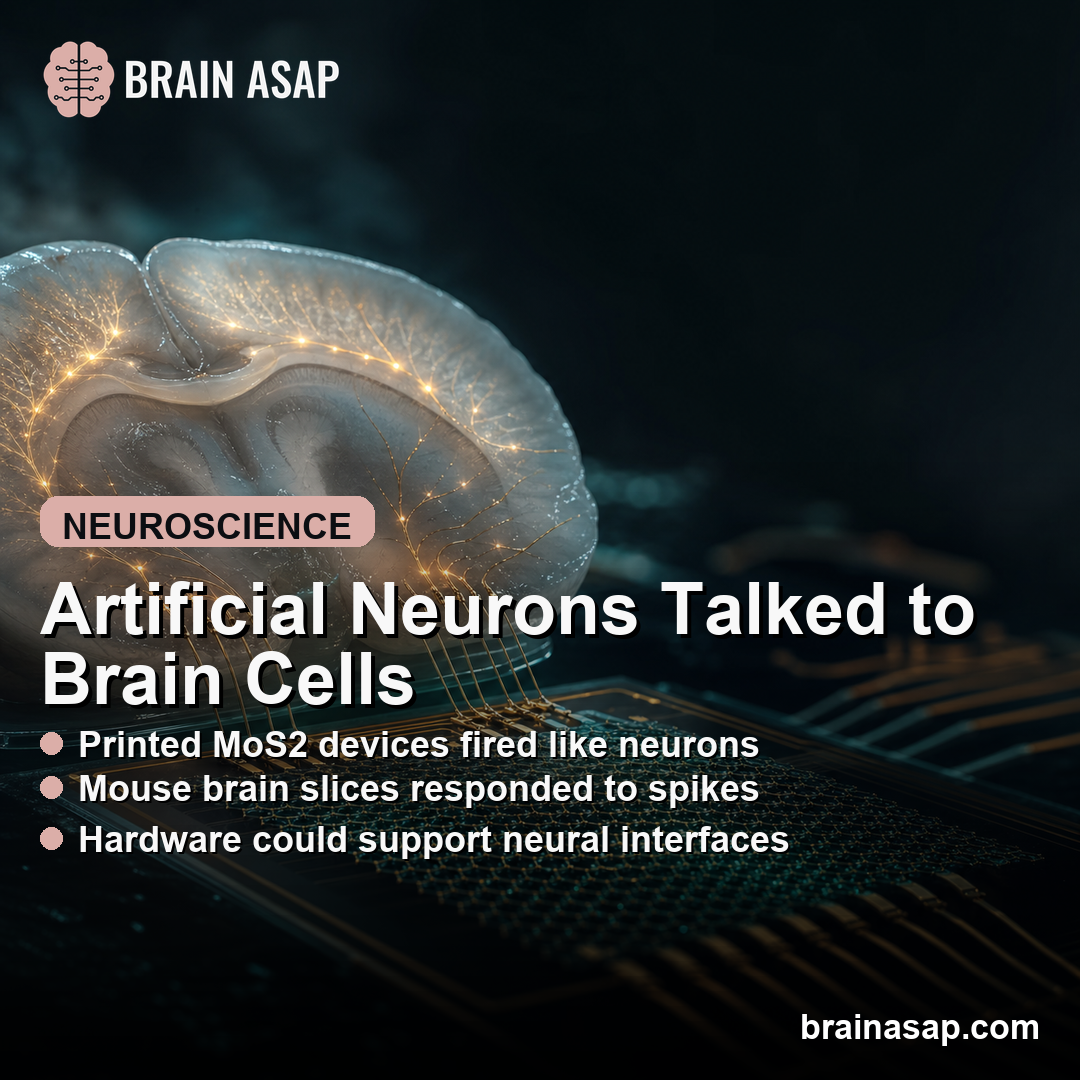
TL;DR: A 2026 study in Nature Nanotechnology reported that printed MoS2 memristive nanosheet networks, electronic devices that can produce neuron-like spikes, triggered responses in living mouse brain slices.
Key Findings
- Artificial spiking neurons: Researchers built printed MoS2 memristive nanosheet networks that generated electrical activity resembling neural spikes.
- Living-tissue response: In mouse brain-slice experiments, the artificial neurons successfully triggered responses in real neurons.
- Bioelectronic interface: The test showed functional compatibility between a synthetic neural device and living neural tissue.
- Computing angle: The same hardware concept could support lower-power brain-inspired computing, a major issue for data-heavy AI systems.
- Clinical distance: The work is an early device-and-tissue demonstration, not a tested implant for restoring hearing, vision, or movement.
Source context: The public summary came from a ScienceDaily discovery item, while the citation and article are based on the underlying DOI record and journal paper.
Artificial neurons are usually discussed as a computing idea. This study gives the phrase a more literal test: printed electronic devices were asked to communicate with living neural tissue.
The devices were built from molybdenum disulfide (MoS2) nanosheet networks. MoS2 is a layered semiconductor material.
A memristive device is an electronic component whose resistance changes depending on past electrical activity. That memory-like behavior is why memristors are often used as hardware models for synapses or neurons.
The central claim was not just that the device produced a neural-looking waveform. Researchers reported that the printed network produced spiking-neuron behavior and then drove responses in real neurons from mouse brain slices.
MoS2 Memristive Networks Produced Neuron-Like Spikes
Neurons communicate partly through rapid electrical events. An artificial-neuron device therefore needs more than a steady on/off current.
It needs to produce spike-like activity that can be timed, repeated, and read by another system.
The study used printed MoS2 memristive nanosheet networks to create artificial spiking neurons with multiple orders of complexity.
In practical terms, the device was designed to show different levels of dynamic electrical behavior rather than a single fixed output.
The nervous system is not a simple wire. Neural signals depend on timing, thresholds, recovery, and the way prior activity changes the next response.
A device meant to interface with neurons has to work in that time-dependent language.
- Material platform: MoS2 nanosheets provided the semiconductor network used in the printed device.
- Memory behavior: Memristive switching let previous activity shape later electrical output.
- Neuron-like output: The device generated spike patterns rather than only a static current signal.
The study sits between neuroscience, nanotechnology, and computing hardware. It is not a behavioral neuroscience paper about memory or movement.
The question is whether electronic materials can speak a closer electrical dialect to living neurons.
Mouse Brain Slices Responded to the Artificial Neurons
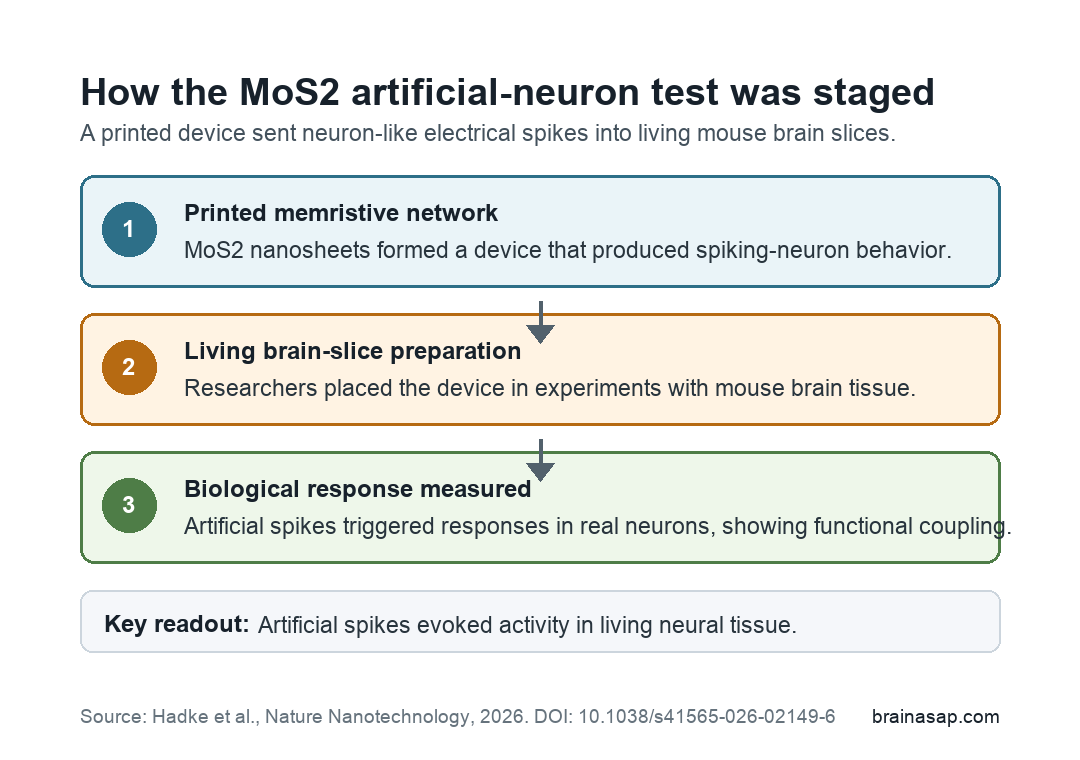
The strongest reader-facing result is the brain-slice test. In experiments using living mouse brain slices, the artificial neurons successfully triggered responses in real neurons.
That tissue response is a higher bar than showing a device trace on an oscilloscope.
Brain-slice experiments preserve living neural tissue outside the animal so researchers can measure how cells respond under controlled conditions.
The setup does not recreate a whole brain, but it keeps enough biological tissue architecture to test whether a stimulus can influence real neurons.
For a bioelectronic interface, this distinction is important. A device can look neuron-like in isolation and still fail to interact with tissue.
Here, the reported tissue response suggests the electrical output crossed from device behavior into biological neural activity.
- Device alone: The printed network needed to generate controllable spiking behavior.
- Tissue interface: The device output then had to reach living neurons without destroying the biological preparation.
- Measured response: The reported result was a real neural response in the mouse brain slice.
The device is not ready for human implantation. The narrower point is that synthetic spiking hardware can be made compatible enough with living neural tissue to produce a measurable response.
Brain-Inspired Hardware Targets the Energy Cost of AI
The paper also belongs to the larger push for low-power computing. Modern AI systems rely on enormous data movement and digital computation. That approach works, but it consumes large amounts of energy.
The motivation is straightforward: the brain is vastly more energy efficient than a conventional digital computer.
The study’s hardware is one attempt to borrow from that biological strategy.
Memristive hardware is attractive because it can combine memory and computation in the same physical substrate. Conventional computers usually move data between memory and processing units.
Neural tissue does not work that way; each connection changes with activity.
The device is not a complete artificial brain. The relevant computing point is that spiking hardware may handle some information-processing tasks in a more brain-like and energy-efficient way.
- AI computing: Brain-inspired chips may reduce the energy burden of data-heavy model training or inference.
- Neuroprosthetics: More biologically compatible electrical outputs could matter for future hearing, vision, or movement devices.
- Brain-machine interfaces: Hardware that can interact with living neurons may offer a better bridge between electronics and tissue.
Those applications remain future-facing. The study is best read as an enabling materials-and-interface result, not as proof that any specific medical device now works.
The Main Limit Is Translation From Slice to System
The main limitation is scale. A mouse brain-slice response is a controlled proof of compatibility, not a whole nervous-system demonstration.
A living animal, an implanted device, and a human clinical application each add separate challenges.
Those challenges include long-term stability, immune response, heat, signal specificity, electrode placement, device packaging, and whether artificial signals can produce functional benefit rather than just measurable activation.
Still, the finding narrows the technical question. Instead of asking only whether artificial neurons can mimic neural spikes on a bench, researchers can now ask how precisely those spikes can be shaped, targeted, and sustained in biological tissue.
Practical takeaway: the study shows early functional coupling between printed artificial-neuron hardware and living brain tissue. The next tests need to show whether that coupling can become stable and selective in more realistic neural systems.
Citation: DOI: 10.1038/s41565-026-02149-6. Hadke et al. Printed MoS2 memristive nanosheet networks for spiking neurons with multi-order complexity. Nature Nanotechnology. 2026.
Study Design: Materials-device and living-tissue experiment using printed MoS2 memristive nanosheet networks and mouse brain-slice testing.
Sample/Model: Printed artificial-neuron devices tested with living mouse brain slices.
Key Statistic: Artificial-neuron stimulation successfully triggered responses in real neurons.
Caveat: Brain-slice compatibility is an early experimental step and does not establish long-term implant performance or clinical benefit.