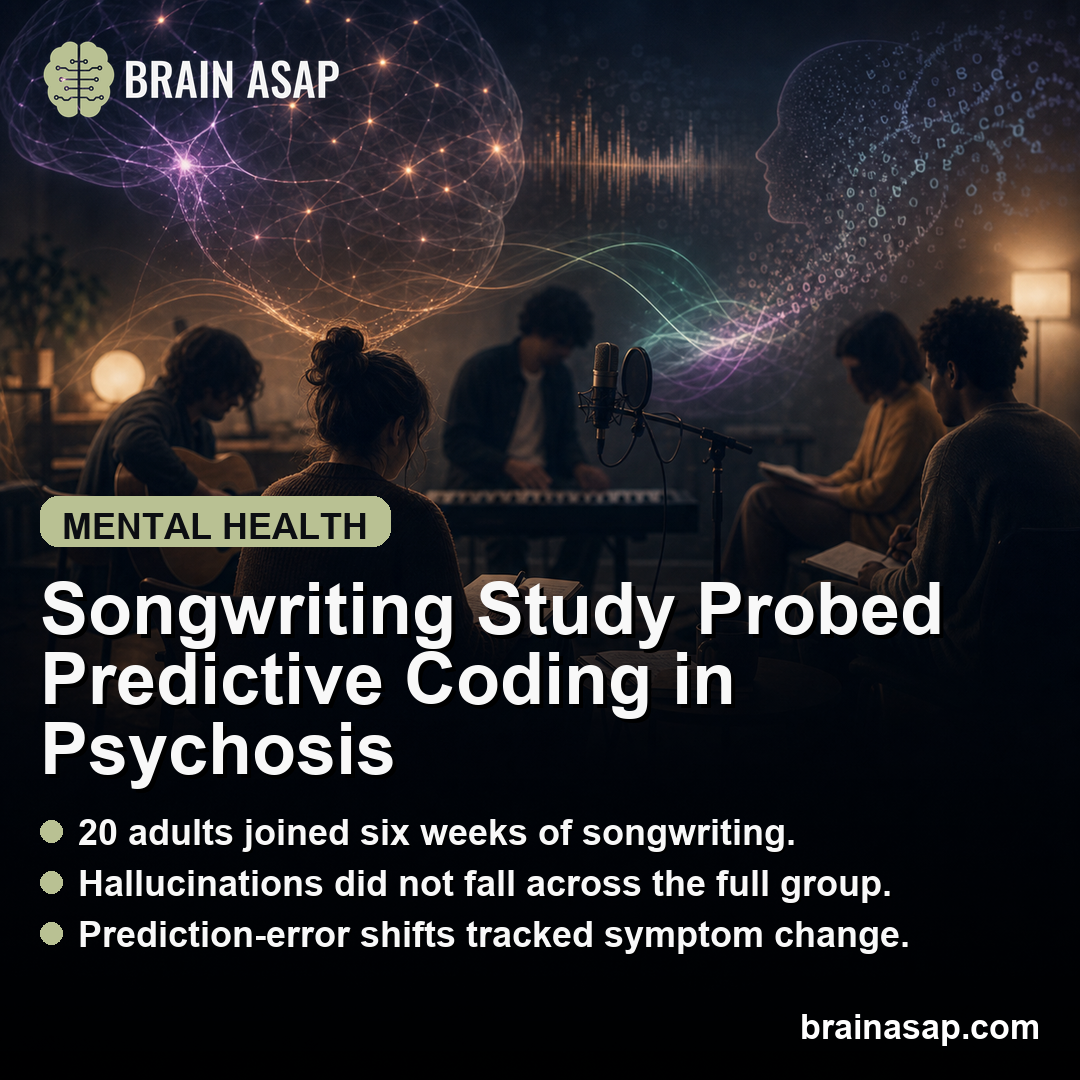
TL;DR: A 2026 longitudinal pilot study in Psychosis from Yale recruited 20 adults with schizophrenia or distressing auditory hallucinations into 6 weeks of group songwriting and found reduced paranoia in less-severely affected participants plus a shift from self-focused first-person pronouns toward plural pronouns.
Key Findings
- Group songwriting recruited adults with psychosis symptoms: 20 participants aged 18-65 were recruited in Connecticut after either clinical referral or self-registration; all reported distressing auditory hallucinations at least once per week or carried a schizophrenia diagnosis.
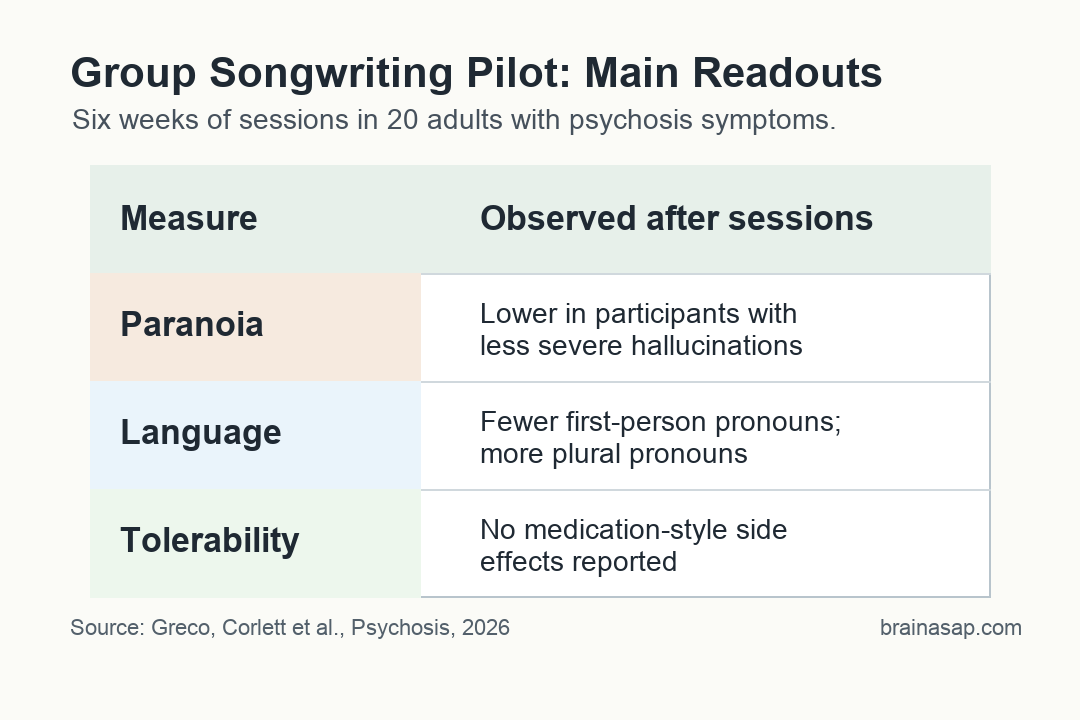
- Reduced paranoia in participants with less severe hallucinations: The intervention did not reduce hallucinations across the full sample, but participants whose hallucinations were less severe reported less paranoia after the sessions.
- Linguistic shift away from first-person isolation pronouns: Post-session interviews showed reduced first-person pronoun use (“I”, “me”, “mine”) and increased plural pronoun use (“we”, “us”, “ours”) — a known marker of reduced social isolation in psychiatric populations.
- Predictive-coding mechanism is the conceptual hook: The Corlett lab’s framework treats music as a structured prediction-and-resolution exercise; brains that struggle to separate internal predictions from external reality may benefit from rhythmic prediction practice that delivers safe, immediate confirmation.
- Pilot longitudinal design with pre-post questionnaires: Participants attended 4 group sessions over 6 weeks, then completed the same symptom measures plus a post-session interview.
Source: Psychosis (2026) | Greco, Corlett et al.
Predictive coding is the neuroscience framework that treats the brain as a system constantly generating predictions about incoming sensory signals based on past experience.
One leading account of psychosis describes hallucinations and delusions as predictive coding gone wrong — predictions become so strong that the brain generates sensory experience without external input, or interprets ordinary input as confirming false beliefs.
This Yale pilot study tests whether structured music-making, which exercises prediction in an unusually direct way, can produce measurable benefits for adults living with psychosis.
Music as a Prediction-and-Resolution Exercise
The conceptual framework comes from predictive-coding work at Yale: music gives the brain a rapid, low-stakes way to make predictions and update them when the next sound arrives.
The argument is simple:
- Music is built on prediction: Listeners and players continuously anticipate the next note, beat, or chord based on the established pattern.
- Predictions resolve immediately: The next note arrives within fractions of a second, confirming or violating the prediction.
- Safe expectation violation: Music, like a roller coaster, lets the brain experience prediction errors without any real-world danger.
- Practice for a struggling system: A brain whose predictive machinery has gone awry may benefit from repeatedly exercising prediction-and-confirmation in this safe rhythmic context.
That makes group songwriting a plausible training task for prediction-and-resolution: participants can anticipate, hear, adjust, and repeat the loop without the stakes of a real-world threat.
20 Adults With Schizophrenia or Auditory Hallucinations Over 6 Weeks
The team partnered with Adam Christoferson, a music facilitator and founder of Musical Intervention, an organization that has used music-making for rehabilitation in New Haven for years.
The pilot design:
- Recruitment: 20 adults aged 18-65, either clinician-referred or self-registered.
- Inclusion: Schizophrenia diagnosis or distressing auditory hallucinations at least once per week.
- Baseline assessment: Psychometric questionnaires plus an in-person interview.
- Intervention: Four weekly two-hour group sessions in groups of five, guided by a professional musician, with recording equipment provided (microphone, guitar, keyboard, drums) and participants encouraged to write their own lyrics.
- Final assessment: Same questionnaire battery plus a post-session interview.
The recording-equipment-plus-musician format turns the prediction-and-resolution idea into a concrete task: participants continuously generate, hear, and adjust musical predictions in real time.
Paranoia Dropped in Less-Severely-Affected Participants
The pre-post psychometric comparison did not show a uniform reduction in hallucinations across the full sample.
The pattern that did emerge:
- Hallucination severity stratification: Participants with less severe hallucinations at baseline reported less paranoia after the six-week intervention.
- Severe-hallucination subgroup: Participants with more severe hallucinations did not show the same paranoia reduction.
- Implication: The benefit may be most accessible to people whose predictive machinery is dysregulated but not yet entrenched in severe sensory generation.
The severity-graded result fits the predictive-coding theory. People whose prediction errors have become large but still tractable are likely to benefit most from prediction-and-resolution training; people whose predictions have entirely overridden external sensory input often need a different intervention layer first.
The Pronoun Shift Is the Most Quantitative Signal
Earlier research has shown that people with severe psychosis use first-person pronouns (“I”, “me”, “mine”) more often than plural pronouns (“we”, “us”, “ours”) — a linguistic pattern that tracks social isolation and distress.
The post-session interviews showed a measurable pattern shift:
- Reduced first-person pronoun use after the 6 weeks.
- Increased plural pronoun use.
- Implication: A measurable, linguistically anchored signal of less social isolation following participation in the group music-making sessions.
The pronoun analysis is methodologically appealing because it does not depend only on participant self-report of paranoia or hallucination. It gives the study an automatic transcript-based measure that can be followed from the first interview to the final interview.
Group Songwriting Had No Medication-Style Side Effects
Antipsychotic medications are the standard pharmacological intervention for schizophrenia and persistent hallucinations.
The medications produce known side effects:
- Concentration difficulty.
- Lack of motivation.
- Lethargy.
- Weight gain and metabolic effects with many agents.
The music-making intervention produced none of those, and the qualitative observation from the team is that participants kept asking to come back — a level of voluntary return that is rare in psychiatric interventions of this severity.
The broader point is that music therapy can be studied with clinical research tools instead of treated only as informal adjunct programming. The pilot is not enough to compare it against medication, but it does show that a structured music intervention can produce measurable behavioral and language signals worth testing in a larger trial.
Pilot sample size, single site, and mechanism imaging still limit the claim.
- 20-participant pilot: The sample is small enough that the results need replication in a larger, controlled trial before broader clinical adoption is reasonable.
- No randomized control arm: All participants received the music intervention. A control group receiving a non-musical group activity is needed to isolate the music-specific effect from generic group-attention effects.
- Single-site sample: Recruitment was Connecticut-based and integrated with one specific musical-intervention organization. Generalization to other regions and music-facilitation models is untested.
- Brain-circuit mechanism is hypothesized, not measured: The team plans to investigate brain circuitry changes associated with the intervention but has not yet imaged the predicted predictive-coding-related changes directly.
- Severity-graded effect needs refinement: The benefit was concentrated in less-severely-affected participants. Whether the intervention has a meaningful role for participants with more severe hallucinations needs separate testing.
Music Therapy Belongs in Serious Clinical Research, Not Just Adjunct Programming
The actionable framing follows from the pilot’s design principles:
- Proper clinical trials of music therapy are feasible: The Yale work demonstrates that pre-post psychometric measurement, longitudinal assessment, and quantitative linguistic analysis can be applied to music-based interventions in psychosis populations.
- Severity-stratified inclusion may be the right design: Future trials should pre-specify hallucination severity as a moderator, since the benefit may differ across severity levels.
- Pronoun analysis is a scalable outcome: Automatic linguistic analysis of interview transcripts is cheap, robust, and tied to validated psychiatric markers — a useful outcome for larger trials.
- Predictive-coding theory needs imaging support: Brain-imaging studies that map circuit changes during and after music-making interventions would let the field test the theoretical mechanism Corlett’s lab is using directly.
Citation: DOI: 10.1080/17522439.2026.2634654. Greco D, Corlett P, Christoferson A et al. Song-making in a group (SING): a longitudinal study for people experiencing psychosis. Psychosis. 2026.
Study Design: Six-week longitudinal pilot study with pre-post psychometric questionnaires and structured interviews; four weekly two-hour group songwriting sessions guided by a professional musician.
Sample Size: 20 adults aged 18-65 with schizophrenia or distressing auditory hallucinations at least once per week.
Key Statistic: Reduced paranoia in participants with less severe hallucinations after the intervention; measurable shift away from first-person and toward plural pronouns in post-session interviews; no antipsychotic-style side effects, and participants asked to continue attending.
Caveat: Small pilot sample (N=20); no randomized control arm; single-site Connecticut recruitment; brain-circuit mechanism is theorized via predictive coding but not directly imaged; benefit was concentrated in less-severely-affected participants and may not generalize to severe presentations.