TL;DR: A 2026 study in The Journal of Sex Research found that teenage daughters’ own humor during sexuality conversations was linked to more open mother-daughter communication and higher sexual well-being, while mothers’ humor was linked to less openness from daughters.
Key Findings
- 98 mother-daughter pairs: Researchers analyzed confidential survey data from Israeli mothers and teenage daughters ages 14 to 18.
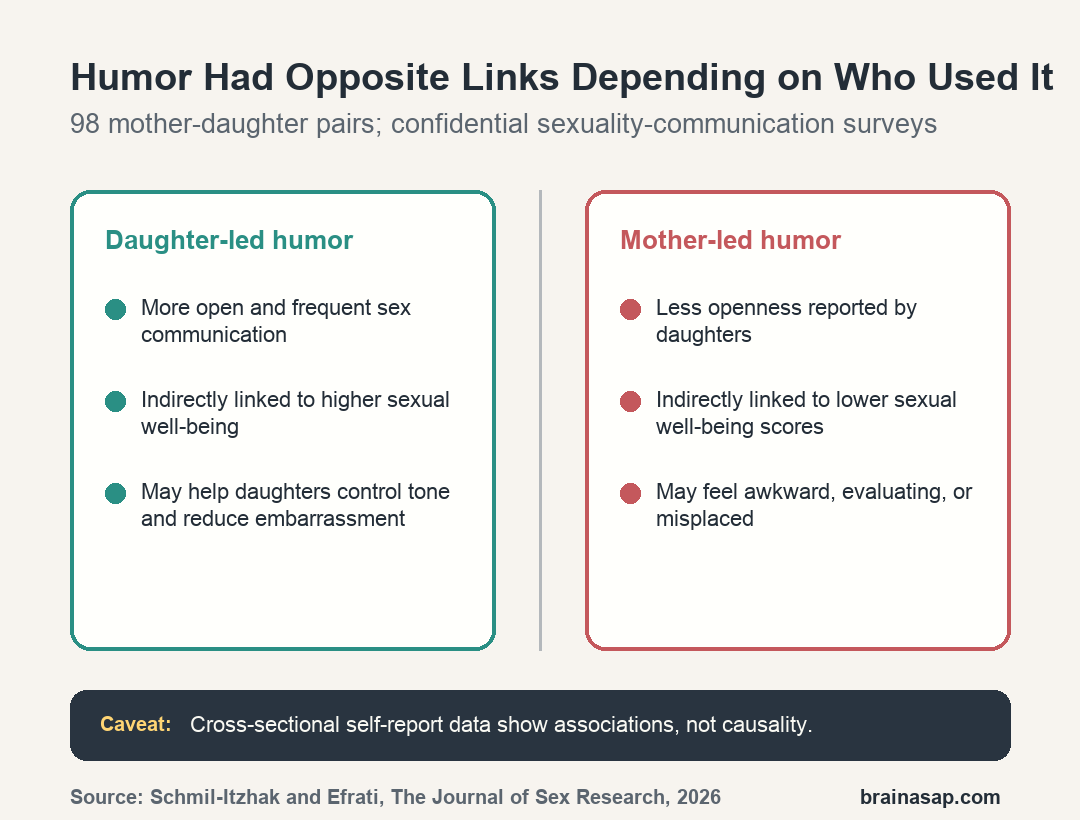
- Daughter humor predicted openness: When daughters reported using more humor, they also reported more frequent and open sexuality communication with their mothers.
- Maternal humor showed the opposite pattern: Mothers’ humor was associated with lower openness from daughters, which was indirectly linked to lower sexual well-being scores.
- Similarity did not explain the result: Matching levels of humor between mothers and daughters did not predict better outcomes.
- Design limits causality: The cross-sectional, self-report study can show associations, not whether humor caused better or worse communication.
Source: The Journal of Sex Research (2026) | Schmil-Itzhak and Efrati
Daughter-Led Humor Was Linked to More Open Sex Communication
Parent-adolescent conversations about sexuality often carry embarrassment, avoidance, and uncertainty. This study asked a narrow but practical question: does humor make those conversations easier, and does it matter who uses it?
The mother and daughter associations moved in different directions. In 98 mother-daughter pairs, daughters’ own use of humor was linked to more open and frequent sexuality communication.
That openness, in turn, was linked to higher scores on measures of sexual well-being, meaning confidence, acceptance of developing sexuality, and perceived ability to navigate sexual situations.
Researchers framed humor as a possible way to lower tension during sensitive conversations. For teenage daughters, that seemed plausible.
Humor appeared to work as a self-directed coping tool, giving adolescents a way to bring up uncomfortable topics without making the interaction too formal or exposed.
Mothers’ Humor Was Associated With Less Openness From Daughters
The maternal pattern moved in the opposite direction. When mothers reported using more humor in sexuality conversations, daughters tended to report less open communication.
Mothers can still be warm, relaxed, or playful. The study points to a more specific interpretation: humor from a parent can land differently than humor from a teenager.
That difference is especially relevant when the parent has more authority and the adolescent already feels evaluated.
The researchers offered a power-dynamics explanation. A daughter using humor can control the pace and emotional distance of the conversation.
A mother using humor can seem supportive from the adult side, but from the daughter’s side it can read as misplaced, embarrassing, dismissive, or too close to teasing.
- Adolescent-initiated humor: can help the daughter reduce embarrassment while keeping control over what she shares.
- Parent-initiated humor: can increase discomfort if the daughter hears it as judgment, minimization, or pressure.
- Matched humor levels: did not explain the outcomes, so simply being “equally humorous” was not the important factor.
The Dyadic Model Separated Each Person’s Role
The study used a dyadic analysis, which means the researchers did not treat mothers and daughters as unrelated survey respondents. They analyzed how each person’s behavior related to their own outcomes and the other person’s outcomes.
Family conversations are relational. A daughter’s comfort is not only about her personality, and a mother’s communication style is not only about the mother’s intentions.
The same exchange can have different meanings for each person in the pair.
The surveys measured several connected pieces:
- Humor use: how often each person used humor when discussing sexuality with the other person.
- Sexual communication: how frequent and open those conversations felt.
- Parental control and secrecy: whether the communication climate felt controlling or hidden.
- Daughter sexual well-being: confidence, acceptance, resilience, and perceived control in sexual development.
The clearest pathway was daughter-led. Daughters’ humor was associated with more open communication, and that openness statistically carried the link to higher sexual well-being.
The Finding Is About Tone, Not Jokes
The study measured how much humor people used, not the exact kind of humor. That leaves a large open question.
Affectionate lightness, awkward joking, sarcasm, teasing, and embarrassment-covering laughter are not the same thing. A questionnaire score cannot tell whether a joke helped a daughter feel safer or made her want to shut down.
Parents should read the result cautiously. The data supports the idea that daughters benefit when they can set some of the emotional tone.
It does not support a rule that adults should force humor into sensitive conversations.
- Let the teenager lead the tone: if humor comes from the adolescent, it can signal comfort and control.
- Avoid using humor to dodge discomfort: a parent joke can read as avoidance when the teenager wants a direct answer.
- Keep the topic respectful: sensitive questions are easier to ask when the adolescent does not feel evaluated.
The Study Cannot Prove Humor Caused Better Well-Being
The strongest caveat is the design. This was a cross-sectional self-report study, so the researchers measured all variables at one point in time and relied on what mothers and daughters reported about themselves.
That means the direction of effect remains uncertain. Daughters who already feel more sexually confident can use more humor because they are comfortable.
That is different from proving that humor made them more comfortable. Families with generally open communication can also create room for daughter-led humor.
The sample also came from the Jewish Israeli community, where the researchers noted that sexuality may be especially sensitive because of conservative social norms.
The result should not be assumed to apply identically across cultures, family structures, fathers and sons, or different parent-adolescent pairs.
Future Work Needs Observed Conversations
The next useful version of this research would observe real conversations over time. That would help separate supportive humor from teasing, avoidance, sarcasm, or embarrassment-driven laughter.
Longitudinal research can also test whether open communication predicts later sexual well-being, or whether early adolescent confidence makes open communication easier from the start.
For now, the study gives a narrower message: who controls the tone can matter as much as whether humor is present.
For families, the practical takeaway is direct. Humor helps most when it gives adolescents more agency in a hard conversation.
It can hurt when adolescents feel watched, judged, or pushed into an adult’s idea of comfort.
Citation: DOI: 10.1080/00224499.2026.2653032. Schmil-Itzhak and Efrati. Humor in Sexual Communication and Sexual Well-Being Outcomes Among Mother-Daughter Dyads. The Journal of Sex Research. 2026.
Study Design: Cross-sectional dyadic survey analysis of mother-daughter pairs.
Sample Size: 98 mother-daughter pairs from Israel, including 98 teenage daughters ages 14 to 18 and 98 mothers ages 40 to 63.
Key Statistic: Daughter-reported humor was positively associated with open sexual communication and indirectly with higher daughter sexual well-being; maternal humor showed an indirect negative association through lower daughter openness.
Caveat: The study used self-report data from one cultural context and cannot show whether humor caused the communication or well-being differences.