TL;DR: A 2025 study in Thinking & Reasoning found that twelfth graders outperformed seventh graders on fast probability reasoning, but adult-like logical intuition was still not fully developed by the end of high school.
Key Findings
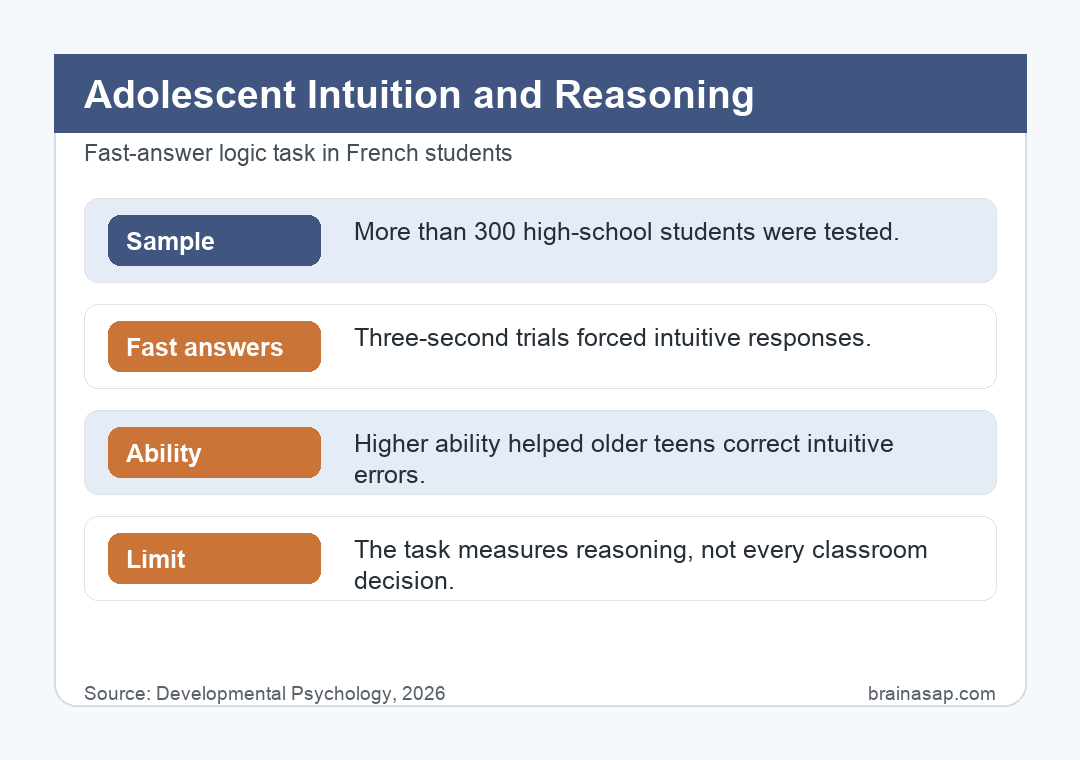
- More than 300 French students were tested: The study compared seventh graders around age 12 with twelfth graders around age 17.
- Three-second answers captured the first instinct: Students solved probability-conflict problems under a strict time limit while holding a symbol grid in memory.
- 995 accountants beat 5 clowns mathematically: The correct answer required using the base rate, even when the description made “clown” seem tempting.
- Twelfth graders improved with time: Older students used the unlimited-time second pass to correct more errors, while seventh graders showed little slow-phase gain.
- Cognitive ability predicted repair: Among twelfth graders, higher ability predicted fixing wrong first answers more than having adult-like correct intuition from the start.
Source: Thinking & Reasoning (2025) | Charbit et al.
Good reasoning is often described as the victory of slow thought over a reckless gut feeling. But adults can sometimes do something stranger: they can give a logical answer almost immediately.
This study asked when that smart intuition begins to appear. The study used a classic kind of reasoning task where a vivid description fights the numbers.
Imagine a group with 995 accountants and 5 clowns . A randomly selected person is described as funny.
The stereotype points to clown. The base rate points almost overwhelmingly to accountant, because accountants outnumber clowns 199 to 1.
The correct answer requires treating the statistical structure as stronger evidence than the personality cue. The answer sounds obvious once the numbers are laid out.
During the task, though, students had to resist the story-like cue and use the less flashy numerical fact.
The conflict is not between knowing math and not knowing math; it is between two answers that arrive with different psychological force.
3 Seconds Made Reasoning Show Its First Move
To separate intuition from deliberation, the researchers made students answer each conflict problem twice.
The first answer had to arrive within 3 seconds, and students also had to memorize a grid of symbols before seeing the problem.
The memory load occupied the students’ active attention, making it harder to quietly calculate or rehearse the base-rate logic.
The first response was meant to reveal what the mind could do quickly, under pressure.
Then the same problem appeared again with unlimited time. Students could rethink the problem and change their answer. This second phase let the researchers distinguish two forms of success:
- Fast logical intuition: The student gives the mathematically correct answer immediately, before careful reflection has much room to work.
- Slow correction: The student first falls for the tempting answer, then uses extra time to repair the mistake.
- No available repair: The student does not improve with extra time, suggesting the needed rule is not yet easy to retrieve.
The researchers also included control items where the description and the numbers pointed to the same answer.
Both age groups did very well on those, which helps rule out the dull explanation that younger students were simply confused, inattentive, or guessing.
Seventh Graders Needed More Than Extra Time
The seventh graders, averaging around 12 years old, did not benefit much from the unlimited-time phase on the conflict problems. Their performance stayed relatively flat after the second look.
Extra time only helps if the student has a helpful strategy available.
If a seventh grader has not internalized the relevant probability rule, a slower second pass may only produce more reflection on the same misleading description.
The younger adolescents were not just blurting out impulsive answers.
The study suggests that the underlying reasoning tools were still under construction.
The rule had not yet become easy enough to retrieve and apply when the stereotype was pulling the other way.
Twelfth Graders Could Catch Themselves
The twelfth graders, averaging around 17 years old, showed a different pattern.
They gave more correct answers in the 3-second phase than the seventh graders did, suggesting that base-rate logic had started to become more available.
They also improved when given unlimited time.
That second-phase gain is the clearest sign of active repair: some older teens recognized that the first answer was suspect and switched from the stereotype to the mathematical answer.
This is a developmental middle ground.
Twelfth graders were not adult smart intuitors with fully trained gut logic.
They were better at both fast responding and correction, but their cognitive ability showed up most clearly in the repair process.
Cognitive Ability Predicted Repair in Older Teens
After the reasoning task, students completed a standardized cognitive-ability test using complex visual patterns.
In adult research, higher cognitive ability is often linked to better initial reasoning: smart adults are more likely to give the correct answer right away.
The adolescents did not show the full adult profile.
Among twelfth graders, higher cognitive ability predicted who used the second chance to fix a wrong first response.
It did not strongly predict already having the correct answer as an instant intuition.
Among seventh graders, cognitive ability did not meaningfully predict performance in either the fast or slow phase. Even the higher-ability younger students did not reliably outperform peers on the conflict problems.
The strongest developmental claim is simple: intelligence did not instantly become intuition. In older adolescents, it first appeared as a better capacity to notice and correct an error after the initial answer.
Education May Turn Rules Into Reflexes
Researchers interpret the pattern as gradual optimization. When students first learn fractions, probabilities, and formal reasoning rules, applying them is effortful.
With practice, those rules can become easier to launch, then eventually fast enough to become automatic. The educational implication is straightforward.
If students do not yet have reliable logical intuition, telling them to “think harder” is not enough.
They need repeated practice connecting a problem’s surface description to its underlying structure.
The findings point toward several classroom-relevant ideas:
- Teach the conflict explicitly: Students may benefit from seeing how stereotypes, vivid descriptions, and base rates compete inside the same problem.
- Practice correction, not only first answers: The twelfth-grade pattern suggests that learning to repair a bad first response may be a bridge toward mature intuition.
- Use varied problems: Repeated exposure across examples can help the rule become portable instead of tied to one familiar problem format.
- Do not confuse speed with mastery: A quick correct answer can be impressive, but the developmental test is whether the rule is stable across pressure, distraction, and new contexts.
Why the Adult Pattern Still Needs More Evidence
The study has limits.
The accessible abstract describes the sample as more than 300 French secondary-school students but does not provide the exact split between seventh and twelfth graders.
The journal page or full paper should be checked before publication for exact sample details and model statistics.
The researchers also tried to include the famous bat-and-ball problem, but it was too difficult for both age groups and produced too few correct answers to analyze properly.
A broader set of reasoning tasks would make the developmental pathway stronger. Mature reasoning is not just the ability to suppress intuition.
It is the slow conversion of learned rules into faster, better first responses. By twelfth grade, that conversion has begun, but the smart intuitor is still developing .
Citation: DOI: 10.1080/13546783.2025.2527672. Charbit et al. Emergence of the smart intuitor: how cognitive ability shapes adolescent reasoning. Thinking & Reasoning. 2025
Study Design: Developmental reasoning experiment comparing fast three-second responses with unlimited-time second responses on probability-conflict and control problems, plus standardized cognitive-ability testing.
Sample/Model: More than 300 French secondary-school students, roughly seventh graders around age 12 and twelfth graders around age 17.
Key Statistic: Twelfth graders improved with unlimited time and cognitive ability predicted correction of wrong initial answers; seventh graders showed little slow-phase gain.
Caveat: The accessible source does not provide the exact grade split or full model statistics, so those details should be checked against the full paper before publication.